Vitreous Enamel Tableware: What It Is and Why It Confuses Everyone
My grandmother had a set of white enamel plates with a cobalt blue rim. Twelve of them, plus a serving bowl that went in the oven every Sunday. She cooked on them for forty years, and they outlived two dishwashers and one move across the country.
Then I bought a "enamelware" pan from a department store, left it on the burner too long, and chipped a 3 mm crescent of white coating off the inside. Same word on the box. Same word on hers. Completely different failure mode, because hers was steel and mine was cast iron, and because I was an idiot with a hot pan.
That gap is the whole reason this article exists. The enamel vs ceramic question comes up in nearly every comment section on enamelware, so here's the honest answer up front: vitreous enamel tableware is not a ceramic. It is glass powder melted onto a metal body, and once you understand that the difference is a difference of substrate, most of the confusion dissolves.
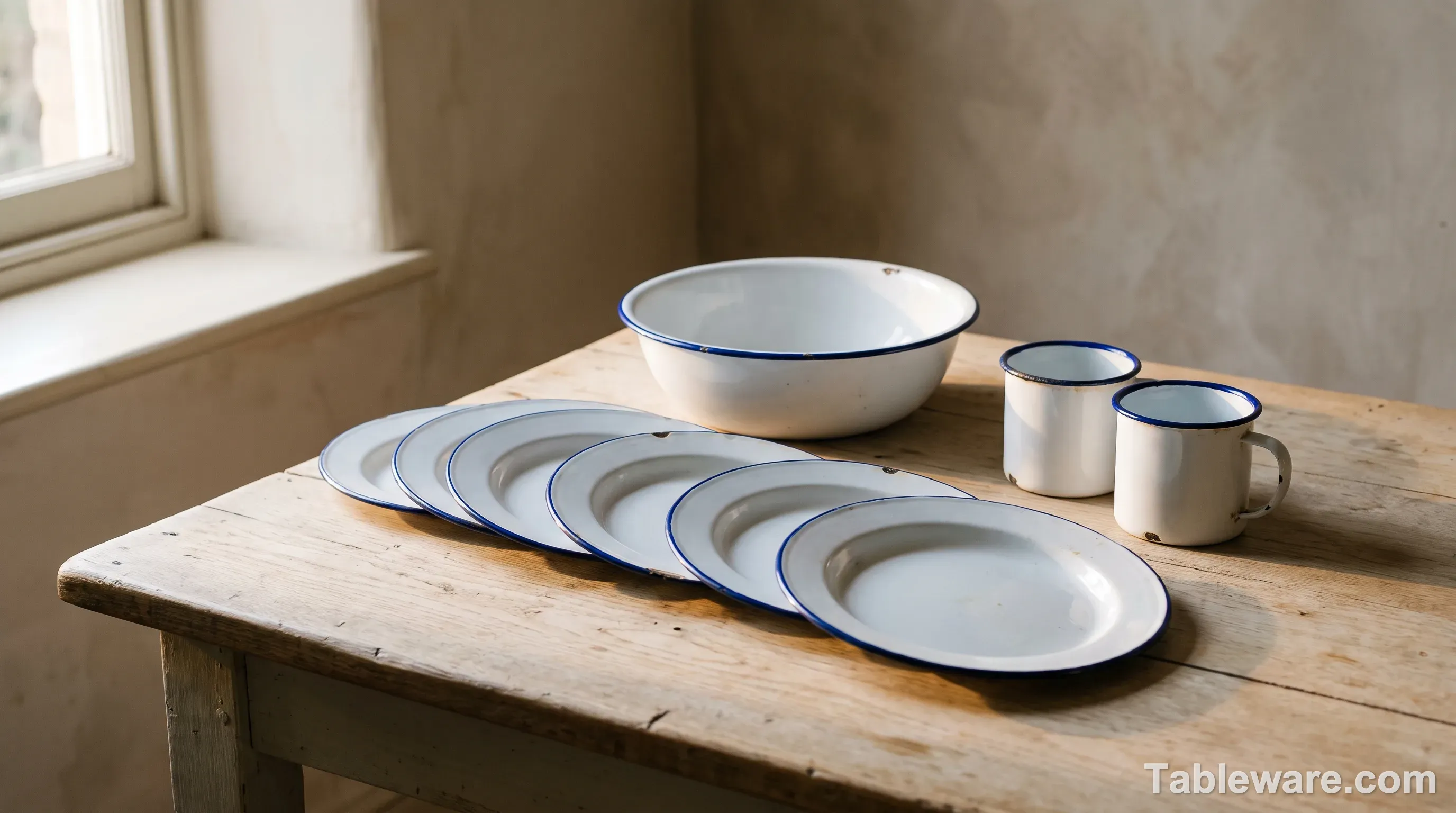
Fig 1. A vintage white-and-blue enameled steel set. The cobalt rim is not painted — it was applied as a separate enamel and fired. That layering is why rims chip differently than the white body.
What vitreous enamel tableware actually is
Take crushed glass. Not soda-lime glass like a drinking tumbler — specifically borosilicate or frit, the same family of glass used in oven-safe bakeware. Add oxides for color: cobalt for blue, manganese for brown, chromium for green, uranium (historically) or tin (now) for white and opacifiers. Mix it into a slip with clay and water. Spray or sift it onto a steel or cast iron body. Then fire it.
The firing range is roughly 750–890°C (1,380–1,640°F), depending on the enamel system and the metal. That's well below the 1,300°C+ you'd need to vitrify porcelain. The result: a glassy, non-porous, chemically inert surface fused to a metal that has no idea it was ever going to be dinnerware.
Two consequences follow from that one fact, and they explain nearly everything else:
It cannot chip like a glaze. A ceramic glaze is a thin glassy skin over a porous clay body — chip it and you expose absorbent clay that waters and stains. An enamel sits on steel. Chip it and you expose steel. No absorption layer. Nothing wicked.
It is not fired in a potter's kiln. It is fired in a tunnel kiln or enameling oven, sometimes for hours, in a factory. So the craft vocabulary you've built for ceramic — reduction atmosphere, wedging, glaze chemistry, cone 6 — mostly doesn't apply. Enamelware is industrial product design with a 19th-century decoration tradition grafted on.
Enamel on steel vs enamel on cast iron
This is the distinction that bit me.
Enamel on steel — thin pressed or drawn steel, roughly 0.6–1.5 mm, enamelled on both sides. Light, cheap, and it conducts heat fast, which means it scorches food badly if you put it over a flame. This is the Falcon and Riess tradition. It belongs in the oven. It does not belong on the stovetop. Plates, bowls, mugs, casserole dishes, bread trays, roasting pans.
Enamel on cast iron — a sand-cast iron body 4–6 mm thick, machined smooth, then enamelled. Heavy, expensive, and it holds heat like a brick. This is the Le Creuset, Staub, and Lodge-enamel category. It's cookware first and tableware second.
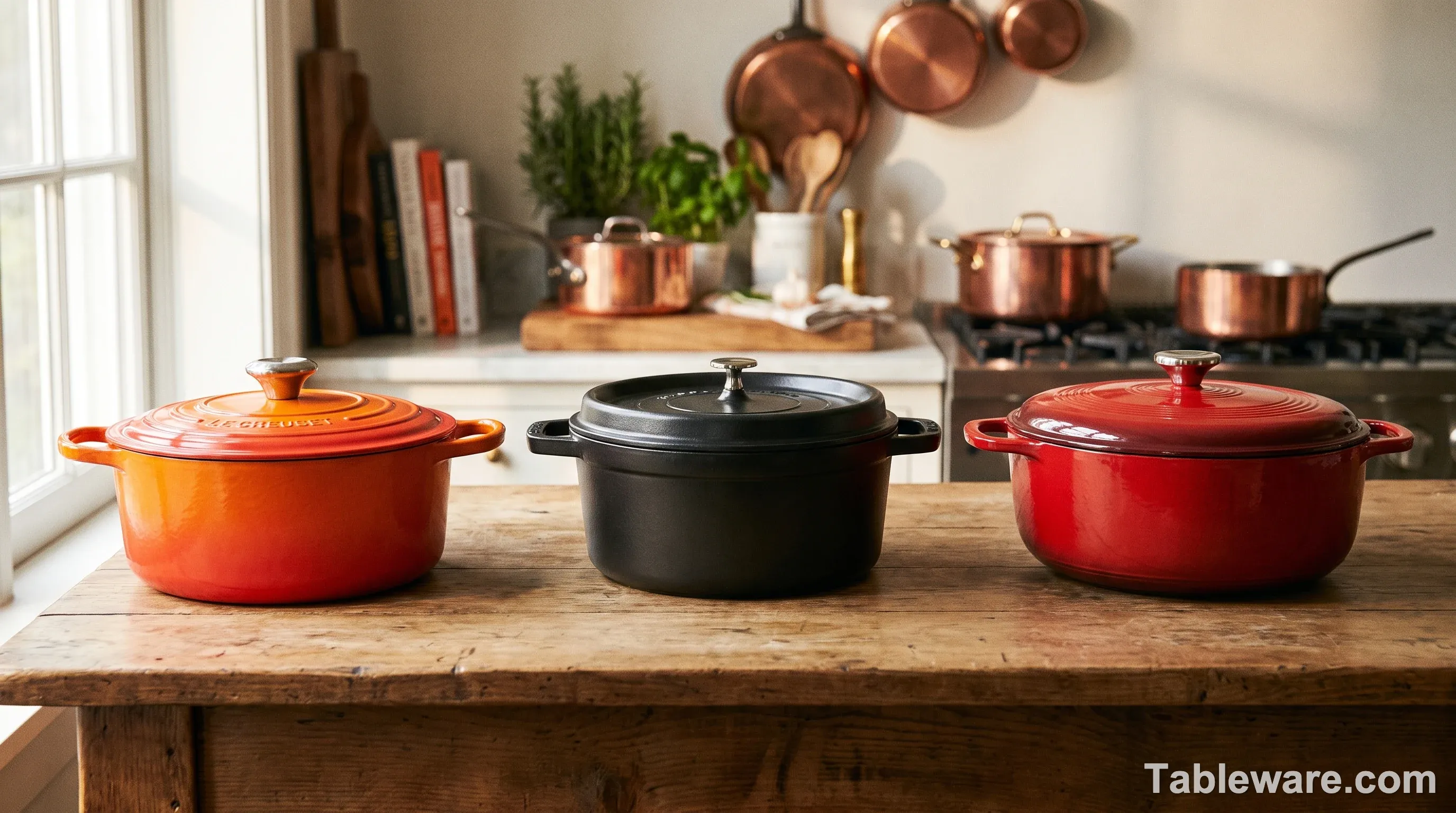
So when a store lists "enamelware" next to a "Dutch oven," they're describing two products that happen to share a coating chemistry and almost nothing else. A steel-enamel plate and a cast-iron-enamel pot have different failure modes, different heat limits, and different price logic. Our hands-on Dutch oven comparison goes deep on the cast-iron side if that's what you're shopping for.
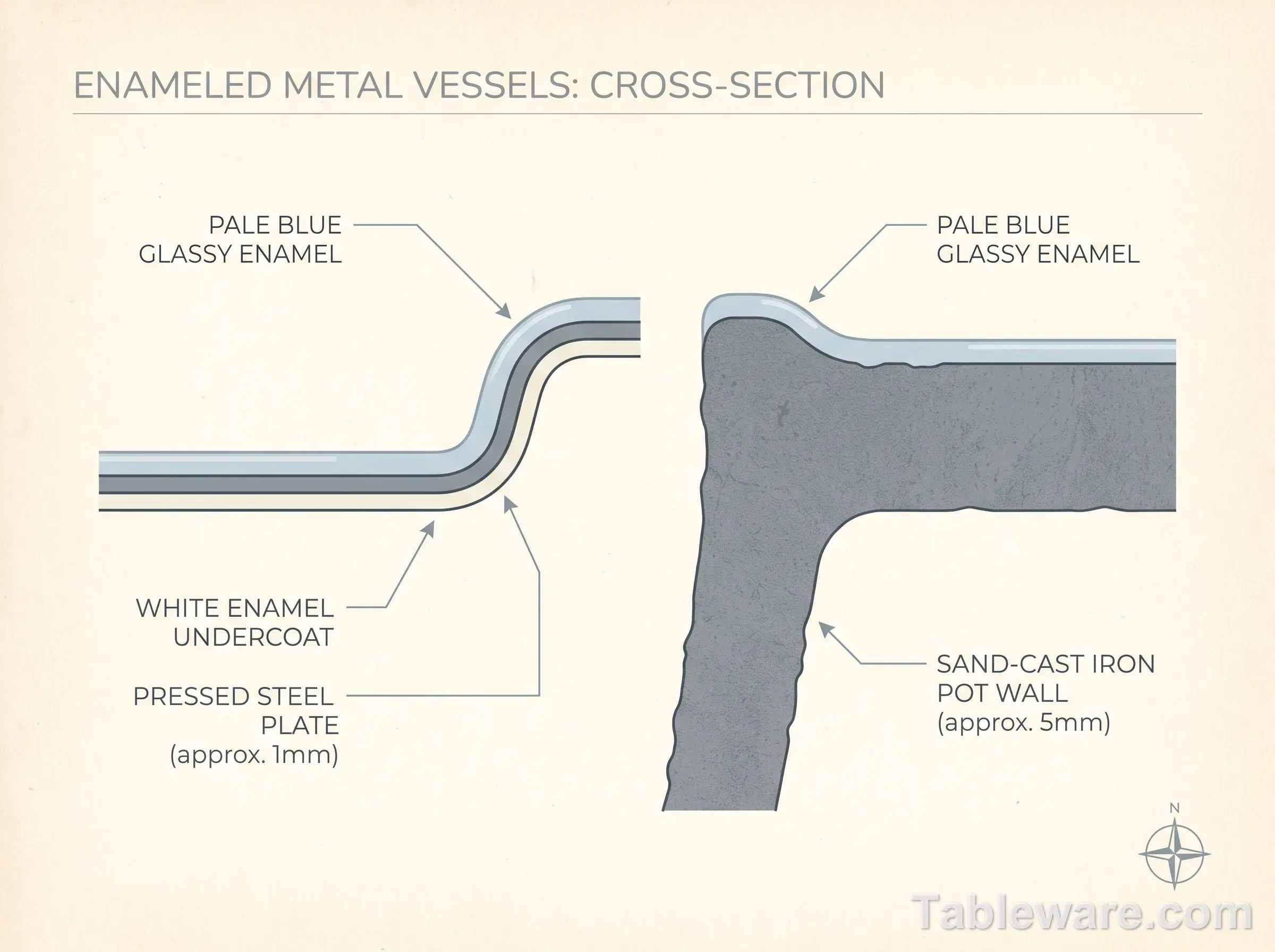
Fig 2. Same glassy coating, two substrates. Thin pressed steel takes a decorative, oven-ready form factor. Thick cast iron takes a heavy, heat-retaining cookware form factor. The enamel itself is chemically similar; the engineering underneath is not.
Enamel vs ceramic: the difference that actually matters
Everyone wants a table comparing these, so here it is — but let's be precise about what differs, because the popular version of this comparison is mostly wrong.
| Vitreous enamel | Ceramic (stoneware/porcelain) | |
|---|---|---|
| Body | Steel or cast iron | Clay, feldspar, silica |
| Firing temp | 750–890°C | 1,000–1,400°C |
| Water absorption | Zero | Stoneware 1–5%, porcelain ~0% |
| Chip damage reveals | Bare metal, non-porous | Porous clay body (stoneware), or clean body (porcelain) |
| Thermal mass | High (cast iron) / low (steel) | Moderate |
| Metal utensils | Fine | Avoid — scratches glaze |
| Typical use | Oven, broiler, serving, mugs | Oven, microwave, table |
The row that actually decides things is what a chip exposes. Chip a porcelain plate and you expose a dense, vitrified, non-absorbing body. Chip a stoneware plate and you expose clay that will take on water and oil. Chip an enameled steel plate and you expose rust-prone steel.
So for vitreous enamel tableware, if your fear is "will a chip make it unsafe," the honest answer is generally better than for stoneware and roughly comparable to porcelain. The catch is rust, not leaching. More on that in a minute.
The other thing people get wrong: enamelware is not a type of ceramic, and an "enamel" (the verb/noun for fused glass) is not the same as an "enamel" (the colored coating on jewelry). The confusing cousin here is cast iron itself — people cookware-splain the whole category, which is why every search for "enamel vs ceramic" returns pots.
For the ceramic side of this comparison, we have stoneware and pro porcelain broken out separately, including why stoneware is the one that actually stains and why porcelain isn't as chip-proof as people assume.
Is chipped enamelware safe to use?
Short answer: usually yes, and the "no" you're reading online is usually about cast iron cookware, not tableware.
Here's the actual decision rule I use.
Chip on the food-contact surface, small (under ~2 mm / 1/16") — still fine for eating. You've lost a bit of glass. No metal is exposed because enamel sits on top of the substrate with thickness. Keep using it.
Chip on the food-contact surface, large (over ~2 mm, or the substrate is visible) — stop using it for acidic or hot food. Now steel can contact tomato sauce, wine, vinegar, and salt. The steel isn't dangerous, but it will rust and stain, and a rusty patch traps moisture. Replace it.
Chip on the rim, base, or handle — cosmetic only, keep it.
Chip exposing black cast iron on the inside of a pot — this is the genuinely dangerous case, and it's why people conflate the categories. Bare cast iron leaches iron into food (harmless, sometimes beneficial) but more importantly the missing enamel exposes an iron surface that oxidizes, pits, and eventually fails. Manufacturers say replace it. Agreed for a pot you use weekly.
There's a test that tells you fast. Steel on steel rings. Steel on glass doesn't. If you tap a chip and get a dull thud instead of a metallic ring, you're touching bare metal. If it still rings, the enamel is intact and the chip is shallow.
The lead-and-cadmium question, by contrast, is almost entirely a glaze problem, not an enamel problem. Modern enamel colors use cobalt, chromium, manganese, tin, and zirconium oxides, none of which are the ceramic heavy-metal issue covered in our lead and cadmium in ceramic glaze guide. If you're worried about a specific antique piece, that's a fair question — but the test protocol there is built for glazed pottery and enamelware simply won't respond to it the same way.
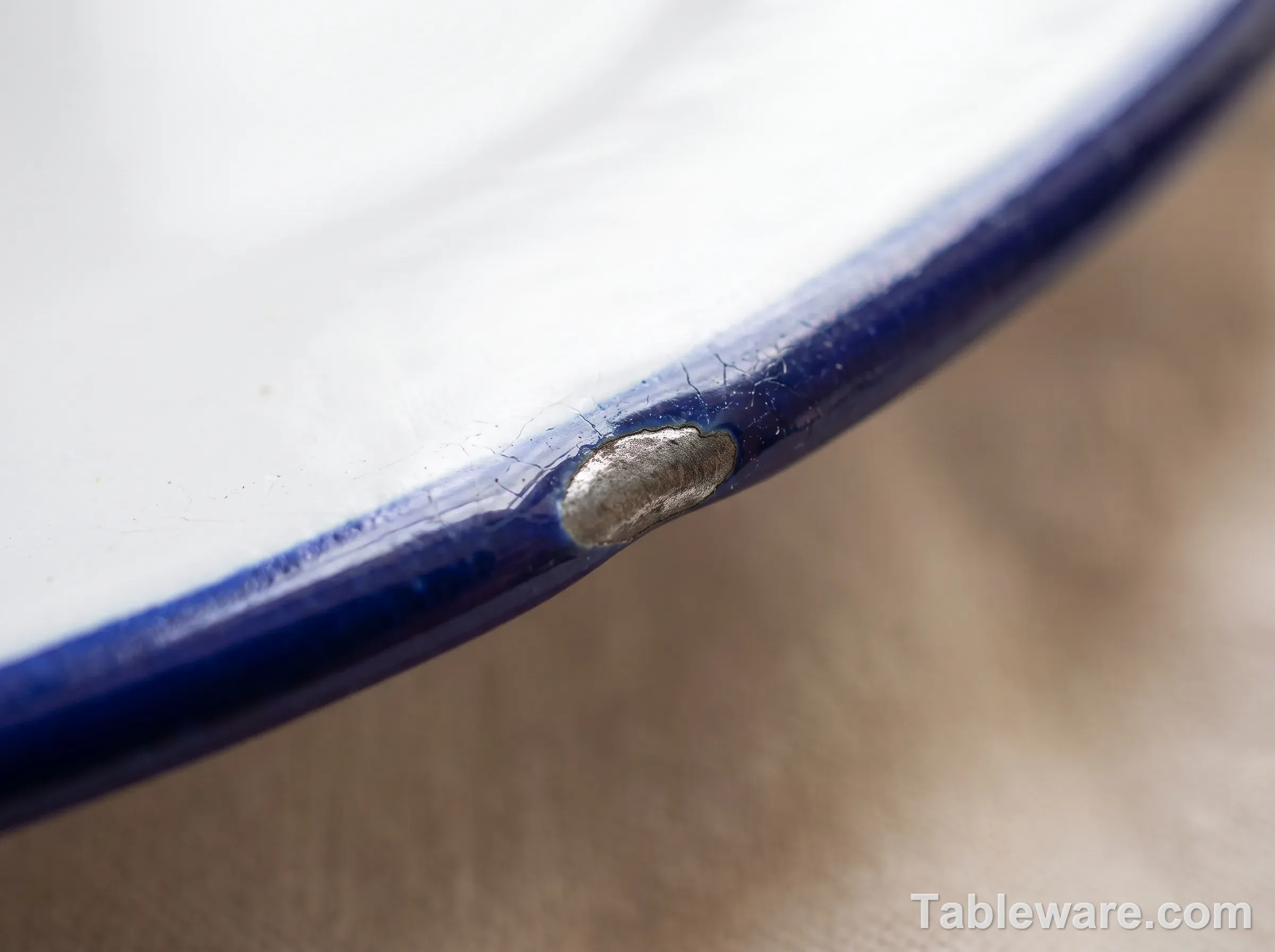
Fig 3. A typical chip at a rim. This one is cosmetic and safe — the enamel is still continuous across the food-contact surface. Notice the grey steel beneath the blue layer. That exposure is why rust, not leaching, is the real failure mode.
Care: dishwasher, microwave, and open flame
Is enamelware dishwasher safe?
Usually, yes for modern steel enamelware — and the manufacturer will usually tell you plainly. Falcon, for instance, has historically said hand-wash preferred but top-rack dishwasher acceptable. Riess is a story of its own: many pre-war pieces are marked hand-wash only, because the older tin-and-zinc substrate can corrode under modern alkaline detergent.
The reason to hand-wash is not the enamel. The enamel is glass and shrugs off detergent. The reason is the exposed edge steel at the rim and any chip, plus decades-old substrate under a forty-year-old surface. Modern high-temp detergent cycles with rinse-aid residue will find every exposed steel edge.
Our dinnerware care mistakes list covers the broader principles, but the enamel-specific rule is: top rack, no heated dry, and if you see rust forming, stop and treat it immediately with a fiberglass or metal polishing pad.
Microwave
No. A metal body in a microwave is a bad idea, full stop. This is not an enamel question.
Open flame
Also no, for steel enamelware. Thin steel conducts heat brutally and the enamel will crack off over a flame, or you'll scorch whatever you're cooking.
Cast iron enamelware is the exception. Le Creuset and Staub are explicitly designed for all heat sources including direct flame. Cast iron's low conductivity means gradual heating, no thermal shock to the enamel. This is the single biggest practical reason cast iron is a different product.
Oven and broiler, though? Steel enamelware is superb at it. That's what it was made for. My grandmother's plates went through Sunday roasts for decades with zero drama.
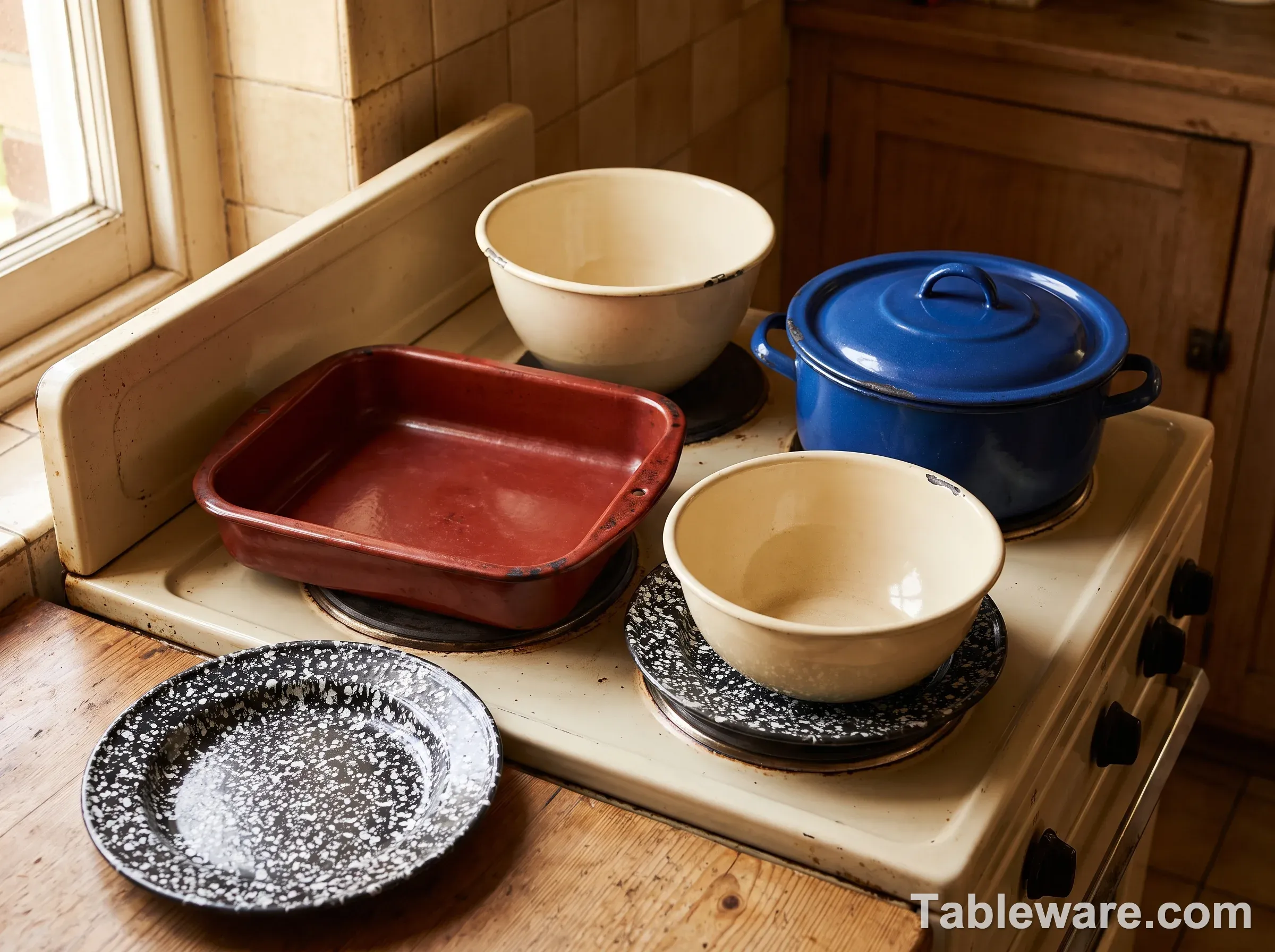
Fig 4. A working vintage collection: steel enameled baking dishes and bowls in the common factory colors of red, cobalt blue, cream, and speckled black-and-white. These are oven and serving vessels, and the chipping on the rim of the red dish is cosmetic, not a safety problem.
Why vintage enamelware value ranges from $10 to four figures
Vintage enamelware value runs on four things: the maker, the decoration technique, the color, and whether it's a complete set.
Riess (Waldviertel, Austria, active 1880s–1980s) is the big Austrian name, and its hand-painted pieces are genuinely collectible — the thick black-outline enamel painting style on cream bodies is unmistakable. Smalt-decorated pieces and the leopard/folk-pattern series command real money.
Falcon (France, 1940–present) is the most-produced enamelware in the world. The white-with-cobalt-rim pattern from the 1950s–60s is now the default vintage enamel look, and it's not rare. But the fluted shapes and the deeper serving bowls do carry a premium. Falcon also numbered pieces in patterns and colors, which is a helpful dating tool.
Finel Arabia (Finland, 1950s–70s) and Arabia (Finland, since 1878) are a genuine international craze — the blue-and-white "Arabia" motifs became collectible well beyond Scandinavia. If you've ever been in a Helsinki design shop and seen people paying for a vintage Arabia teapot, that's the same market.
Graniteware — the speckled gray-and-white look, made in massive quantity in the US and UK from the 1930s through the 1950s — is the most available vintage enamelware. It's cheap. That's why it's a good first collecting category, and why you can assemble a service for a two-bedroom apartment without much pain. Identifying it visually is the same skill set as spotting spatterware, spongeware, and stickware, since graniteware and sponged ware came out of the same 1930s American factories.
Two honest caveats. First, most vintage enamelware is not rare. A 1950s Falcon plate is a $10 object. Second, the condition that actually kills value is not chips — it's rim rust and edge loss, because that's what makes a piece unusable and unsellable. Our guide to reading maker's marks covers the general principles of backstamp dating that apply here too.
The rule I'd follow: pay for the set, the shape, and the decoration. Don't pay for a maker's name alone on common shapes.
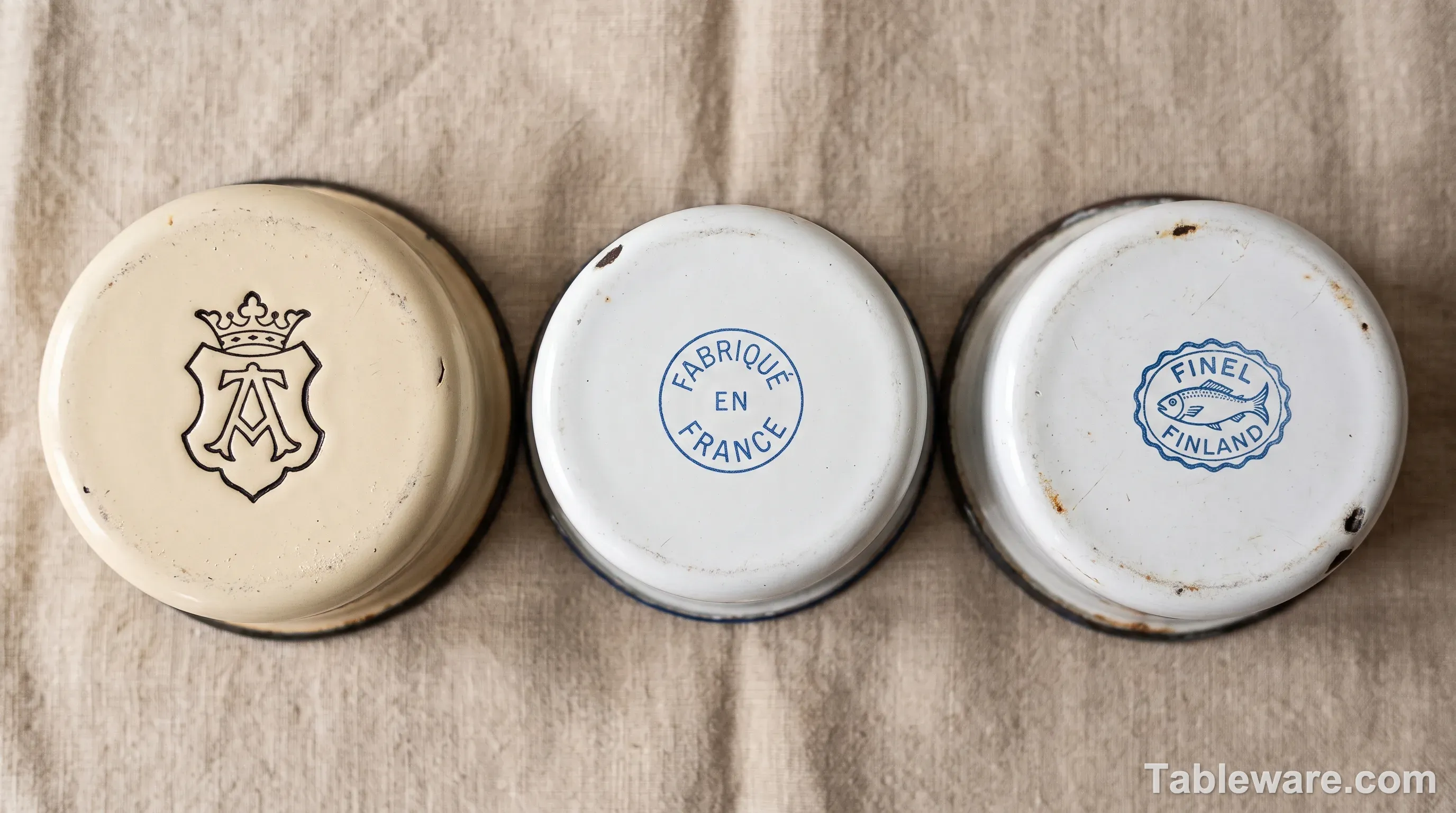
Fig 5. Backstamps, left to right: Riess (Austria), Falcon (France), Arabia (Finland). Read the stamp first, then look at the decoration style — Riess hand-painted pieces have that thick black outline, Falcon's rim shapes are usually stamped into the rim itself, and Arabia's motifs are usually painted in a very specific underglaze blue.
Where vitreous enamel tableware actually wins (and where it doesn't)
Being fair to a category that gets dismissed as "cheap stuff" or "retro kitsch":
It wins on durability against chips and staining, oven and broiler performance, zero lead-cadmium glaze concerns in modern production, being almost unbreakable (steel doesn't shatter the way porcelain does — it just dents), a 100-year-plus service life if you're careful, and price. A complete vintage enamel service is often cheaper than one bone china place setting.
It loses on heat conduction (steel enamelware scorches), microwave usability, rim rust on neglected pieces, the weight and bulk of cast iron versions, thin-walled steel warping if you shock it from fridge to hot oven (the same thermal-shock mechanics as any thin-walled vessel, covered in our oven-to-table bakeware engineering guide), and a genuinely limited modern retail channel — it's much easier to buy a Le Creuset than a piece of steel enamelware today.
It doesn't fit if you need microwave-safe dinnerware, or if you're matching a formal bone china service, or if your household treats dinnerware roughly enough that chipped rims will bother you constantly. It's a working-kitchen material.
The 7 facts, if you just want the short version
- It's glass on metal, fired at 750–890°C. Not a ceramic, not a glaze.
- Steel body = tableware and ovens. Cast iron body = cookware and stovetop.
- A chip exposes steel, not absorbent clay. Safer than stoneware, comparable to porcelain.
- Under ~2 mm chip on a food-contact surface: keep eating off it.
- Dishwasher is usually fine on steel enamelware; hand-wash vintage and anything rimmed or rusted.
- No microwave, ever. Open flame only on cast iron.
- Vintage value lives in Riess hand-painted, Arabia/Finel, and complete fluted Falcon sets. Common Falcon graniteware is cheap on purpose.
FAQ
Is enamelware the same as cast iron cookware? No. They share a glass-fused-to-metal coating, but steel enamelware is a thin oven-and-serving material, and cast iron enamelware is a thick stovetop material. Different use cases, different failure modes.
Can you cook on enameled steel plates? Technically you can put them in a hot oven. You should not put them on a burner — thin steel conducts heat too aggressively and the enamel will crack or the food will scorch.
Is enamelware microwave safe? No. Metal in a microwave is the issue, not the coating.
Does enamel contain lead? Modern enamelware does not, in any meaningful sense. The colorants are metal oxides like cobalt and chromium. Vintage uranium-colored yellow enamelware exists, but it was used sparingly on decorative pieces. If you're worried about an antique, ask.
Why does my enamelware have rust spots? Exposed steel at the rim, or steel exposed through a chip, oxidizing. Scrub it off with a fiberglass pad and keep the piece dry. Rust means an exposed edge, which means the piece was handled hard — worth knowing before you invest in more of the set.
The short version: if you want unbreakable oven-to-table ware with a hundred-year service life and you don't need a microwave, vitreous enamel tableware is the most underrated material on the dinnerware market. If you need one dish that does everything, it isn't.