7 Clues That Prove Mid-Century Modern Dinnerware Is Real
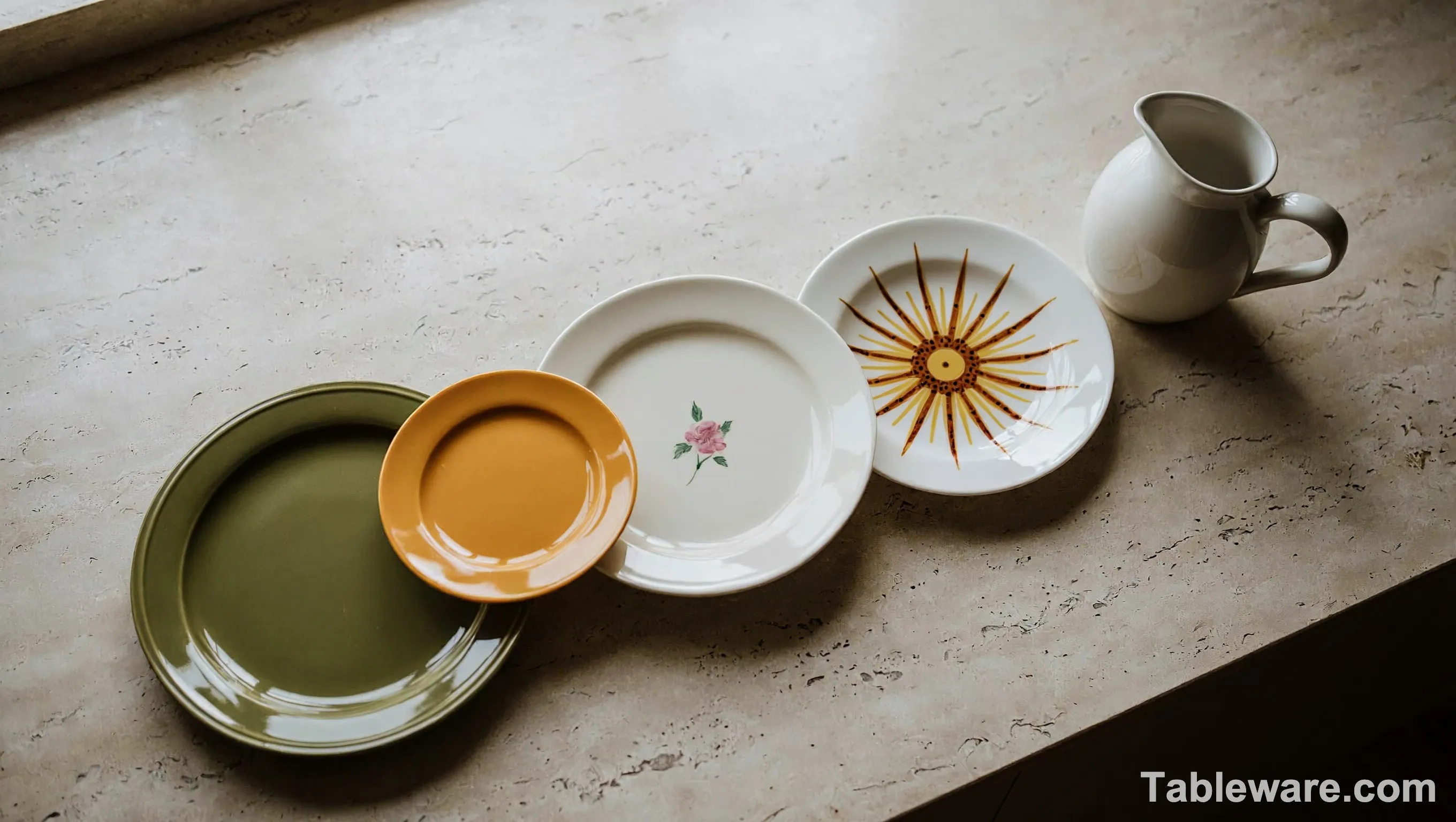
Fig 1. Five plates, five decades, one market. Every one of them was sold to somebody as "mid-century modern," and the asking prices were all over the place.
There's a shelf in a house in Kowloon Tong that looks like a kitchen from 1958. A mustard plate. An avocado bowl. A cream pitcher with a fat belly and a tiny handle. The owner bought the whole run at an estate sale for about $40, and the seller told her it was worth a few hundred dollars because it was vintage.
The seller wasn't lying, exactly. Vintage mid-century modern dinnerware does carry real money — a complete 1950s service in clean condition sells for hundreds. But that shelf isn't $300. It's closer to $60, and the gap between those two numbers comes down to things almost nobody mentions before you hand over the cash.
I've been buying, sorting and writing about this stuff for years. Here's the thing that matters: the difference between a $400 plate and a $12 plate is rarely the shape, the color, or the story the seller tells you. It's the backstamp, the body, and the damage.
Mid century modern dinnerware has a reputation problem too. The phrase gets stretched over anything with a swoopy handle, and sellers use it as a price tag instead of a description. A plate is not mid-century because it looks it. It is mid-century because somebody in Ohio pressed it in 1954 and a buyer used it every night until 1981.
Seven clues. That's the whole checklist.
And if you're trying to work out how to tell if dinnerware is vintage, the answer is never the shape. It isn't the color either. It's the bottom of the piece, the body underneath, and the damage.
Clue one: how to tell if dinnerware is vintage — read the backstamp first
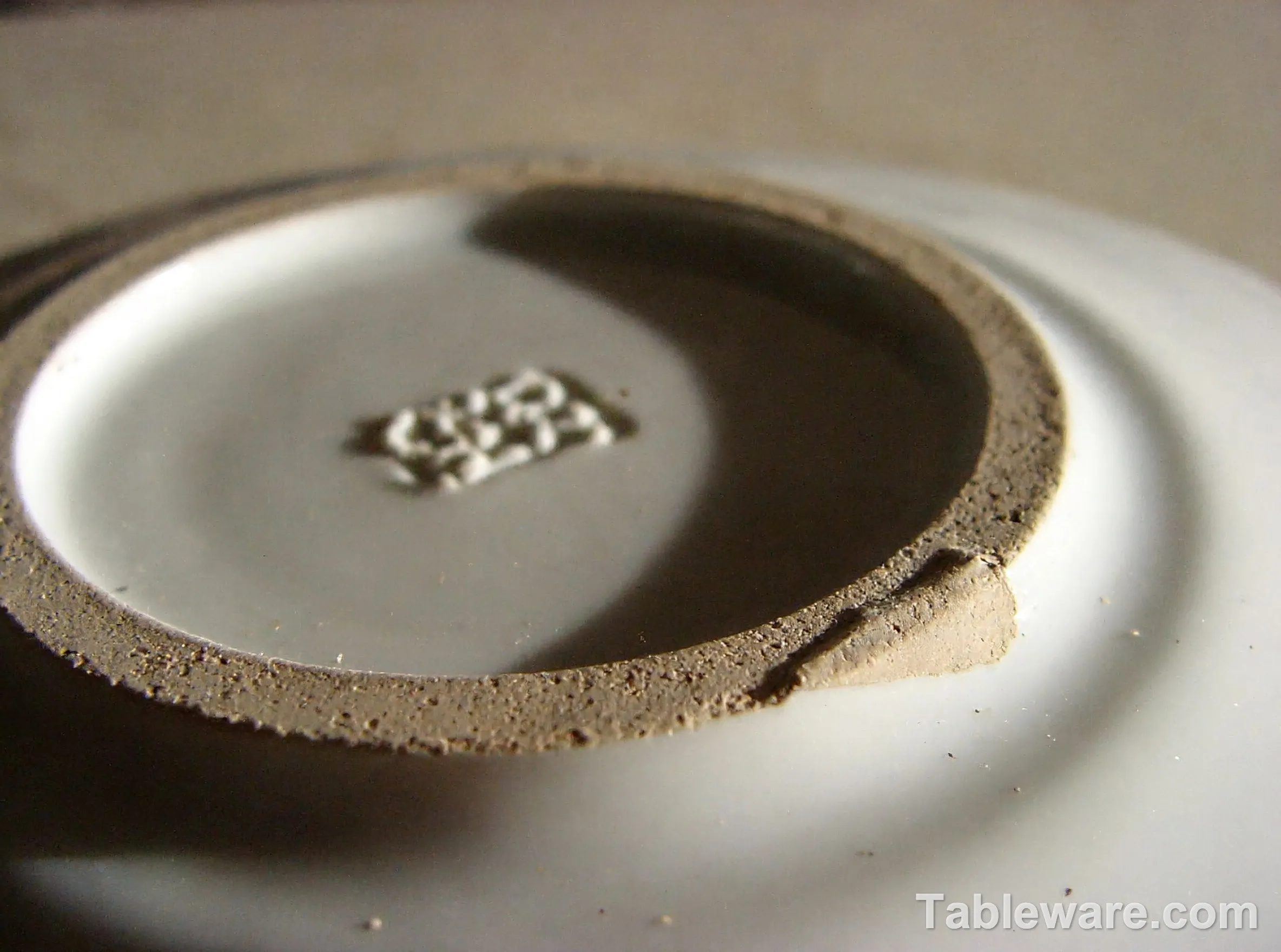
Fig 2. A maker's stamp pressed into the biscuit clay of the foot ring. It's the only part of the piece the owner never washed, so it usually survives.
Start here. Every time. Turn the piece over and look at the unglazed ring on the bottom.
The backstamp is the single most useful thing you own, because it's the part nobody washed. Glazes get worn, patterns get faded, rims get chipped. The foot ring usually just sits there, dusty and honest.
The rule that saves people money: a backstamp is a starting point, not a verdict. Plenty of marks have been copied, and the modern reproduction trade is good at it. What tells you the truth is the mark plus the body, the glaze, and the wear pattern all agreeing with each other. When they disagree, you have a reproduction, a mis-marked piece, or a piece that has been rebacked.
Five marks worth memorizing, because they're the ones you'll see most:
- HALLCRAFT / intertwined HC monogram / SHAPE BY EVA ZEISEL / MADE IN U.S.A. BY HALL CHINA CO. That facsimile signature is the giveaway. If a "Zeisel" piece doesn't carry the facsimile, it's a copy.
- FRANCISCAN with a country line. This is where the factory trail shows up, and it's the single most useful dating tool on mid-century tableware. More on that in clue five. The same footring usually carries the safety stamps too — dinnerware symbols explained decodes the cross-tower, the microwave triangle and the fork-and-cup.
- Russel Wright's script signature. Look for the shape number too. And be warned: the name on the bottom does not mean the piece is old.
- IROQUOIS CHINA. The Casual line ran 1947 to 1967 and it's true vitrified china, which makes it the one modernist line you can genuinely use every day.
- Made in Japan, with a Japanese maker. Gladding, McBean put two dinnerware lines into Japanese production in 1959: Whitestone Ware, made by Toyo Toki Kaisha, and Cosmopolitan China, made by Nippon Toki Kaisha. If a "Franciscan" says Japan, you're looking at 1959 or later.
Here is my buying rule, and it has saved me more money than any other single habit: never buy a piece with a worn-off or unreadable backstamp. At $12, it's a gamble. At $150, it's a donation. When you hit a mark you don't recognize, how to read pottery marks is the reference I use. If the mark is gone, the piece is a decorative object, and price it like one.
Clue two: the body tells you what this mid-century modern dinnerware can handle
Turn the piece over and look at the clay itself where the glaze stops.
Two broad families show up in this era, and they behave completely differently in a kitchen:
Earthenware is soft, porous, opaque, and usually a warm buff or dark red-brown. Franciscan's Apple, Desert Rose, Ivy and most of the hand-painted lines are earthenware. It handles a dishwasher about as well as a crackerboard.
True china and porcelain are vitrified — fired until the body fuses into a glass-like mass. Iroquois Casual is one. So are Eva Zeisel's Museum pieces for Castleton China. They ring when you tap them, they feel denser in the hand, and they handle a sudden temperature change far better than soft earthenware.
You can hear the difference. Tap the rim of a vitrified piece with a fingernail and you get a clean, high ring. Tap soft earthenware and you get a dull thud. Not fancy, but it works.
Zeisel is the case that trips people up. Her Museum line for Castleton China is porcelain. Her Tomorrow's Classic for Hall China is glazed earthenware. Same designer, same decade, completely different body — and the backstamp is the only way to tell which one you're holding.
Why you care: if you want to use mid-century modern dinnerware rather than display it, body matters more than price. A $20 Iroquois Casual plate that survives the dishwasher is worth more to you than a $200 earthenware plate you'd never put food on. And on older soft-glazed pieces, watch the glaze on the food-contact surface. Some mid-century glazes carried lead or cadmium, which is a whole subject of its own — we covered it here — and crazing makes leaching more likely, not less. If the piece is crazed and you want to eat off it, test it first.
Clue three: the glaze tells you the decade
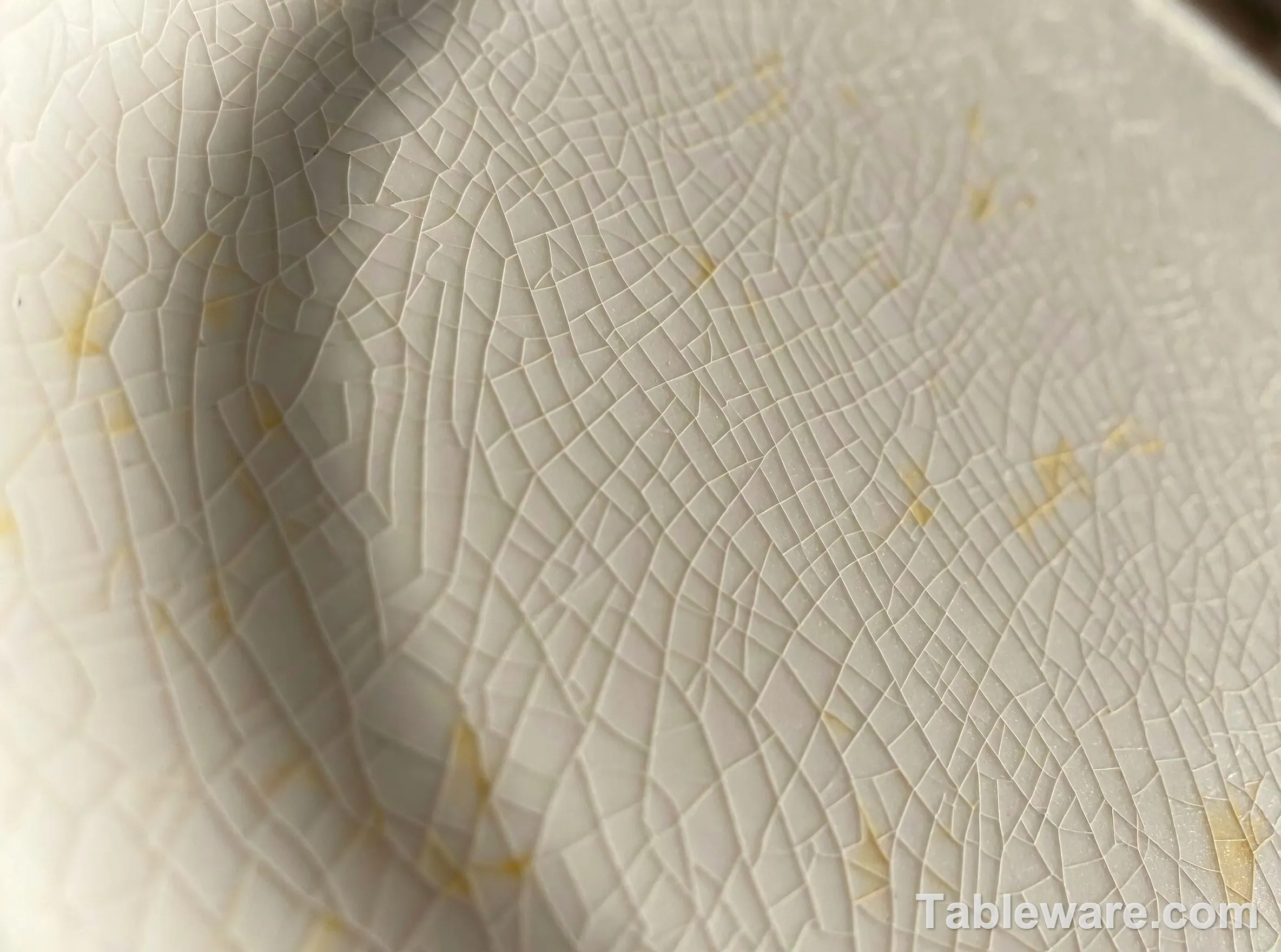
Fig 3. Crazing — a fine web of hairline cracks in the glaze surface. Unstained crazing on an older piece is normal wear. Brown-stained crazing is a different conversation.
Glaze is where style lives, and style is chronological.
A genuine 1950s solid glaze has a very particular look: rich, even color, a soft gloss rather than a plastic shine, and tiny variations in tone that come from a sprayed or hand-applied glaze rather than a printed decal. Modern reproductions of mid-century colors are printed decals on modern glaze, and the difference is visible once you know it. Printed color sits on top. Real glaze has depth.
The most reliable dating trick in this whole hobby is color, and Homer Laughlin handed us a free system for it with Fiesta. The original colors — red (which reads as orange), yellow, cobalt blue, light green, ivory, and turquoise — were all in place by 1937. The "1950s colors" — chartreuse, forest green, gray, and rose — first showed up in 1951. Medium green arrived in 1959. Collectors call the full eleven the "standard 11," and color alone will date most pieces to about five years — with one big exception. Red is the exception: it has three separate glaze eras (1936–1943, the depleted-uranium red of 1959–1972, and a post-1986 red), so a red plate tells you almost nothing on its own. The full Fiesta color history is here.
Two other glaze clues worth using:
The eight o'clock test. Hold a glossy plate at an angle to a window. If you see a faint network of hairlines catching the light, that's crazing. Do it in indirect light. Crazing doesn't mean fake — it usually means the piece is genuinely old. But it does affect value, and when crazing is actually dangerous is a separate question worth reading.
Matte versus gloss. A matte glaze in a saturated mid-century color is a 1950s signature. A glossy one in the same color is usually later.
Clue four: condition decides more than anything else
This is where the $400 becomes the $12.
Buy the piece. Turn it over. Run a fingernail along the rim, slowly, all the way around. That single pass will find more chips than any photograph will show you, and chips on the rim are the defect that kills value fastest.
The damage checklist, in order of how much it should cost you:
- Rim chips. The worst. A $25 plate with a chip on the rim might fetch $8.
- Hairline cracks through the body. Serious. That piece is structurally finished.
- Glaze skips — a bare patch where the glaze pulled away from the clay during firing. Usually on the underside or foot. Cosmetic, and common on older hand-glazed pieces.
- Crazing. Fine and uniform crazing on older earthenware is accepted and barely dents value. Crazing that's stained brown or black with years of use is a real deduction, because it means the piece lived hard and probably got damp.
- Knife marks and grey utensil scarring across the plate centers. Expected on anything that was actually used. Don't pay a premium for a pristine center, because it wasn't used, which usually means it was a wedding gift that never left the box.
One more: restoration. For mid-range pieces, professional restoration routinely costs more than the uplift it creates. Collectors pay more for honest unrestored condition — even at a discount — than for a glued-up piece at full price. If something has been repainted, re-glazed or re-stamped, the discount should be meaningful, and honestly more than you first think.
Clue five: the factory trail behind mid-century modern dinnerware
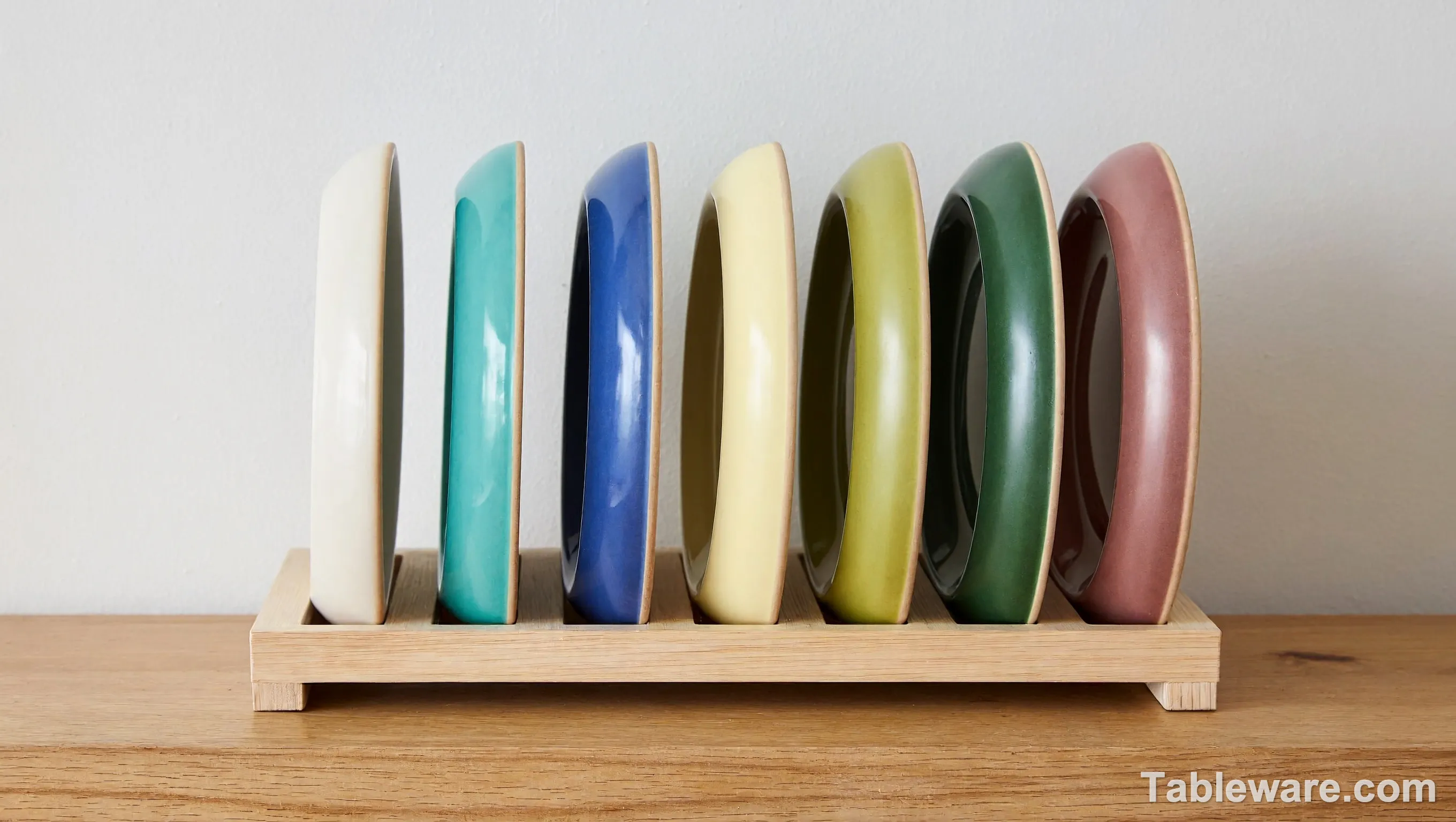
Fig 4. Solid-glaze color families like these are the easiest dating tool you own. Seven plates, and each one narrows the window on when it was made.
Brands get bought, renamed and moved. The factory trail is more reliable, and in this category it's fascinating.
Take Franciscan. Gladding, McBean & Co. was founded in 1875 in Lincoln, California, by Charles Gladding, Peter McGill McBean and George Chambers. Their first product was clay sewer pipe. They grew into architectural terra cotta and dominated the trade across California and the Far West before they ever made a plate. They started experimental dinnerware work in 1932 and launched the Franciscan line in 1934, named after the Franciscan friars who founded the California missions. The famous "Apple" and "Desert Rose" patterns arrived in the 1940s and have been in production ever since — Desert Rose in 1941.
Then the ownership changes, and the changes show up on the bottom of the plate:
- 1934 to 1962 — Gladding, McBean & Co., Los Angeles
- 1962 to 1979 — International Pipe and Ceramics, better known as Interpace
- 1979 to 1983 — Wedgwood
- 1983 — Wedgwood closes the Los Angeles plant and moves Franciscan dinnerware production to England
- 1986 — Waterford Glass buys Wedgwood, creating Waterford Wedgwood
- 2009 — KPS Capital Partners takes over
- Today — WWRD, short for Wedgwood Waterford Royal Doulton, and it still makes Desert Rose and Apple
So a Desert Rose piece marked "Made in California" is older than a sister piece marked "Made in England." Collectors pay a real premium for California-made examples, and they pay it because there are fewer of them.
Now the trap that catches everybody.
Bauer Pottery makes Russel Wright's American Modern today. The original American Modern was designed by Russel Wright and manufactured by Steubenville Pottery in Ohio from 1939 to 1959. The Metropolitan Museum of Art calls it one of the most popular ceramic services ever created — it came in six colors that you could mix and match, and the tall pitcher had no real competition when it appeared. It is also, today, a modern production piece.
Which means: a piece marked "American Modern" proves nothing about age. Bauer reproductions carry the name and the shape. They do not carry the value. If you find an "American Modern" pitcher with a clean modern glaze and a crisp unmarked foot ring, that is what you are looking at. The originals have a softer, slightly uneven glaze, wear that looks used rather than manufactured, and foot rings that show the character of a decades-old firing.
Wright also designed a line called Casual for Iroquois China, in production 1947 to 1967, in a muted palette and a tougher body than American Modern. Casual pieces are widely confused with Wright's Steubenville work. If the mark says Iroquois, you have something different — and usually something more usable.
Clue six: the piece tells you what it is
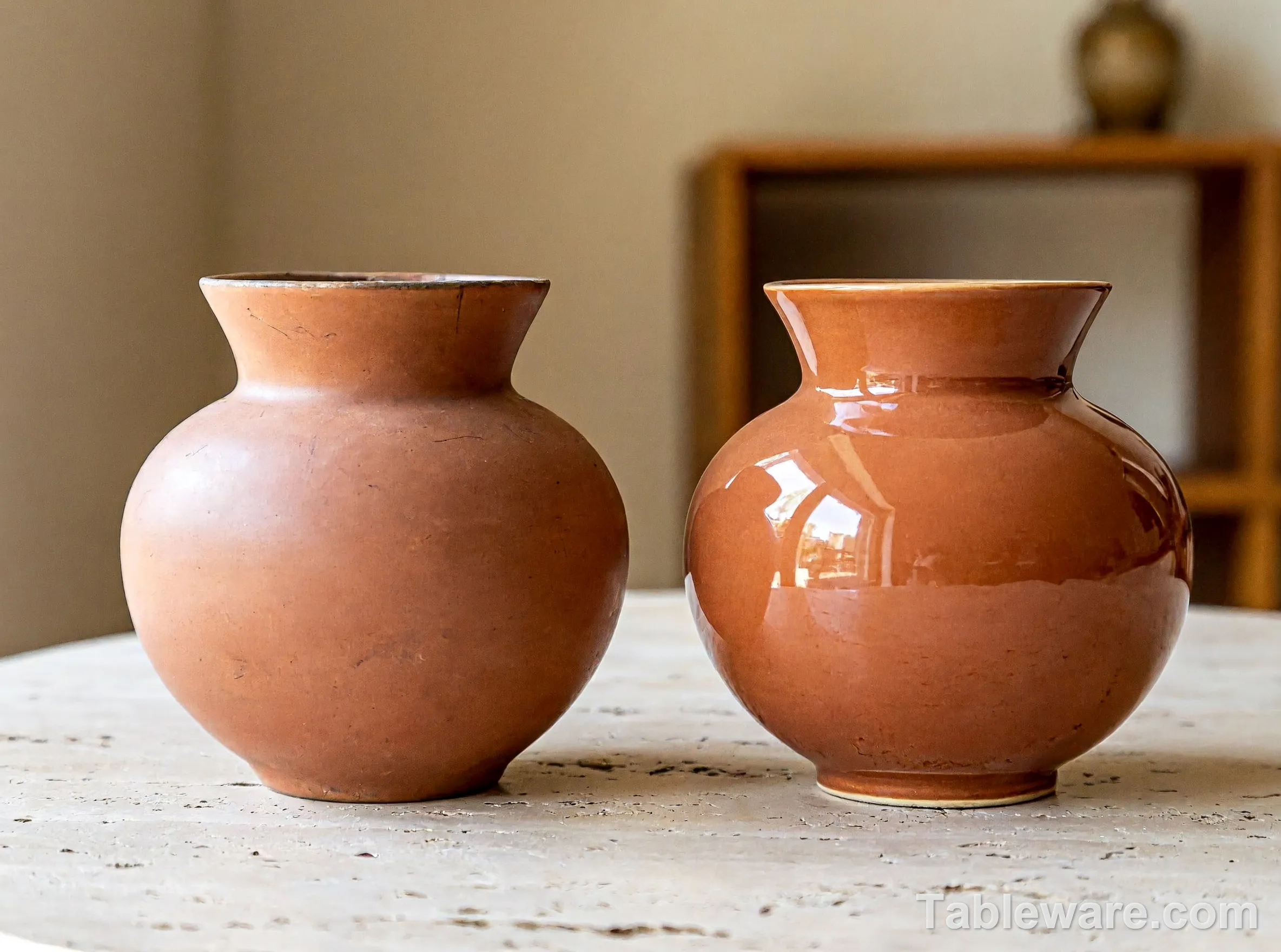
Fig 5. Two pitchers, same silhouette. The one on the right is brighter, glossier and cleaner at the foot — which is exactly what a modern reproduction looks like next to a genuine 1950s firing.
At some point you have to stop looking for a mark and look at the object itself.
Shape is a fingerprint. Designers did not repeat themselves much. Russel Wright's American Modern dinner plate has a specific lifted rim and a slightly squared-off roundness that no reproduction copies exactly, because the original was drawn by hand in the 1930s and the copies are drawings of the drawings. Zeisel's handles are one-offs — the way a handle meets the body on a Tomorrow's Classic cup carries a slight irregularity that a modern copy smooths away.
Other details that give it away:
- Weight. Genuine mid-century pieces feel heavier than reproductions of the same shape. Softer clay, thicker walls.
- Glaze pooling. Where glaze runs into a corner or a recessed handle, an old piece shows a visible thicker bead of color. Modern reproductions tend to be flatter and more even.
- Hand painting versus decal. This is worth learning because mid-century decorators did both. A hand-painted rose has brush overlap and a slightly uneven line. A decal is a photograph of a rose, identical on every piece in the set, with a telltale edge where the transfer film ended. The full hand-painted vs. decal breakdown is here.
- Shape numbers. Gladding, McBean's own shapes carried numbers — the 1800 Eclipse shape and the 1900 Flair shape from their 1954 Modern Americana promotion. Seven patterns ran across three shapes that year. Those numbers on the backstamp identify a form exactly.
Clue seven: the mid-century modern china patterns worth learning by heart
If you're going to buy mid-century modern dinnerware, learn a short list. These are the names that hold value and, more importantly, the names whose marks you should recognize on sight. Here are the mid-century modern china patterns worth learning by heart, and why each one earns its place.
The factory names
Franciscan (Gladding, McBean). Desert Rose, from 1941, the pink-and-green hand-painted pattern that ended up in one of the most widely owned American dinnerware designs of the postwar decades. Apple, the embossed companion. Ivy, from 1948, hand-painted and embossed by Mary Jane Winans. Encanto, from 1948, in a clear glaze with optional platinum or gold banding, and good enough that MoMA picked it for the 1951 Good Design exhibition. Starburst, the atomic motif that ran on the Eclipse shape in the company's 1954 Modern Americana promotion — and the one to be most careful with, because it's the most copied pattern in the hobby. Watch the name too: Franciscan has used Starburst more than once, so a pattern name on a listing tells you far less than a backstamp does.
Hall China. East Liverpool, Ohio — the company the trade called the Teapot King for its teapots. The Museum of Ceramics in East Liverpool notes that Tomorrow's Classic was, for a stretch in the 1950s, the fastest growing dinnerware in America.
Melmac. A melamine resin dinnerware brand made by American Cyanamid, most popular from the 1940s through the 1960s. Russel Wright designed Melmac lines. Melmac is lightweight, unbreakable and mostly worthless to a collector. Which is fine. Not everything from the period deserves a glass case.
Syracuse China. Mostly known for heavy restaurant ware, but the home lines from the period — Trendline in 1955, Carefree in 1957, with the modernist Jubilee pattern on Trend — have a small, devoted following.
The designer names
Russel Wright. American Modern, Steubenville Pottery, 1939 to 1959. Casual for Iroquois China, 1947 to 1967. His flatware for John Hull Cutlery Corp. around 1951.
Eva Zeisel. This is the big one, and her story is better than her price. Born Éva Amália Striker in Budapest in 1906, she was the first woman to qualify as a journeyman in the Hungarian Guild of Chimney Sweeps, Oven Makers, Roof Tilers, Well Diggers and Potters. She was arrested in the Soviet Union in 1936 and spent 16 months detained, 12 of them in solitary confinement. She fled to England, then to New York, and arrived with $64. In 1942 the Museum of Modern Art and Castleton China commissioned her to design modern undecorated porcelain. The show that resulted, "New Shapes in Modern China Designed by Eva Zeisel," ran from April 17 to June 9, 1946, and it was the first one-woman exhibition in MoMA's history. Wartime constraints meant the dinnerware didn't go into production until 1949. She called those pieces Museum and Castleton White. Then Town and Country for Red Wing in 1947, including the biomorphic mother-and-child salt and pepper. Then Hallcraft's Tomorrow's Classic, commissioned around 1949 and in production from 1952, and the Hallcraft Century line from 1956. She was still designing in the 2000s, and she died in 2011 at the age of 105.
What vintage mid-century modern dinnerware value looks like right now
Here are real numbers, not vibes. Vintage mid-century modern dinnerware value is easier to talk about than to pin down, but these anchors will keep you honest.
Because so much Desert Rose survives, ordinary dinner plates usually sell for roughly $10 to $25 each (as of late 2026; that range has held for years). The money is elsewhere: large platters, covered serving dishes, pitchers, and pieces marked made in California before production moved to England. For comparison, a typical Lenox Ivory China place setting with gold bands — from 1918, when Lenox produced the first American-made state china for the White House — usually goes for around $30 to $60 per five-piece setting (as of late 2026), because estates keep releasing complete services.
Rules that follow from those numbers:
- A complete matched service almost always beats the sum of its parts. Buyers pay for the convenience and the certainty. The arithmetic behind that is in open stock vs full set.
- Serving pieces outperform dinner plates. A lone plate is easy to replace. A gravy boat or a covered casserole is not.
- Don't pay collector prices for collector-level pieces with collector-level damage. Condition is not a rounding error.
- Rare forms can beat a complete common set. A single unusual shape in excellent condition will outperform twelve chipped standard plates.
And be honest about what vintage dinnerware is not. It's a collecting hobby with real, physical objects attached. Buy the pieces you want to eat off. Buy the pieces you'll keep for forty years. Skip the ones you're buying purely because a listing used the words "atomic" and "rare."
Caring for mid-century dinnerware without wrecking it
The good news: this stuff is mostly robust. The bad news: it dies fast in a modern dishwasher.
Hand wash, always. Warm water, mild dish soap, a soft sponge or cloth. No abrasives, no bleach, no steel wool.
Skip the dishwasher. The heat cycle, the harsh detergent and the water jets accelerate crazing, fade decals and can drive thermal shock into a piece that spent sixty years fine on a shelf. Our dinnerware care guide has the storage rules in detail.
Skip the microwave. Older ceramics aren't vitrified to modern standards, so they can absorb water and superheat. If it doesn't give a clean ring when you tap the rim, treat it as microwave-unsafe.
Store with separators. A paper towel or a felt plate divider between stacked plates stops scratches. Don't stack a heavy serving platter on top of a set of salad plates.
Keep it dry. Damp storage is what turns uniform crazing into ugly stained crazing, and that's the difference between a $25 plate and a $10 plate.
Don't scrub off the evidence. If a piece is dirty, wash it gently. Never polish a backstamp or a foot ring to "clean it up." You're sanding off the thing you paid for.
Where to buy, and where to be careful
Best value, in order:
- Estate sales and thrift stores. The best prices in the hobby, and you can turn every piece over before you buy. This is where a $400 service sometimes turns up.
- Replacement services. Companies that specialize in replacing single lost pieces from a pattern. Ideal for completing a service you already own — and a good way to see what a complete set looks like before you commit.
- Local antique malls and specialist dealers. Slower, pricier, and they'll usually pull a piece out of the back for you.
- Online marketplaces. Workable, but only with rules.
The rules for online buying:
- Ask for a photo of the full backstamp, in focus, with the piece held in the hand for scale. If the seller won't shoot the bottom, walk away.
- Ask for a photo of the rim in raking light. That's how you find chips.
- Beware the composite listing. Sellers routinely photograph the good plate and ship you the one with the chip.
- Beware the "set of 4." Four plates that don't match each other in glaze or shape, listed as a set.
- Beware the restored piece. If the rim looks suspiciously smooth, or the color is slightly off from the rest, someone filled it.
A few questions people keep asking
How old is mid-century modern dinnerware, really? The period is usually given as roughly 1945 to 1970, with the dinnerware itself most popular from the late 1940s through the early 1960s. Some lines ran longer — Franciscan Desert Rose and Apple have been in production continuously into the present day.
Is a Russel Wright American Modern plate worth anything? The originals are, and the modern Bauer Pottery ones are not. That distinction is the entire value of the line, and it is invisible unless you know what to look for: glaze depth, weight, foot-ring character and wear that looks lived-in rather than factory-fresh.
Should I buy a complete set or a mismatched one? Buy the best single pieces you can find and mix them. Most people end up with a partial service from three different sales, and a matched set assembled later is worth more than three mediocre singles. Buying one complete set in one condition is rare and expensive.
Is mid century modern dinnerware worth collecting if I only want to eat off it? For some lines, absolutely. Iroquois Casual is vitrified china made for daily use and it survives a dishwasher. Just don't buy a soft-glazed earthenware service on aesthetics alone — that's the version of this hobby that ends with a drawer of china you can't put food on.
Can I eat off vintage mid-century dinnerware? Yes, with caveats. Vitrified lines like Iroquois Casual are made for it. Soft-glazed earthenware from the 1940s and 1950s is a different question — check for crazing, and if the piece is crazed or the glaze is worn to the clay, test it for lead first.
I'm starting out. Where should a beginner buy mid-century modern dinnerware? Estate sales first, always. You can pick up a whole service for less than a single plate costs online, and you get to turn every piece over before you commit. Learn four marks — Hallcraft, Franciscan, Russel Wright and Iroquois — and you'll be able to read most of what you turn up.
Why does everyone say to check the backstamp? Because it is the one part of the piece that never gets worn, washed or scrubbed. It's also the part reproduction makers work hardest to copy, which makes it the best test — when it disagrees with the body and the glaze, you know something is wrong.
The whole thing comes down to this. Pick the piece up. Turn it over. Read the mark. Feel the weight. Run a fingernail along the rim. Check the glaze in angled light.
Six things, about thirty seconds. That thirty seconds is the difference between buying a $40 curiosity and buying a piece worth keeping for the next forty years.