Last spring I watched a woman at a Vermont estate sale pay $215 for a "Royal Doulton" tea set. She was so sure of herself. The box had the right colors, the gold trim looked real, the cups even had the faint Doulton-style rim. The seller had listed it as "vintage English bone china, Royal Doulton pattern, valued at $1,400." She paid cash. I flipped the sugar bowl over before she walked out. The back stamp was a clean, laser-perfect printed script that said "ROYAL ALBERT — ENGLAND." Different maker, different era, and (in the configuration she bought) worth maybe $80.
That moment is exactly why this guide exists. I have been collecting, buying, and occasionally getting burned on estate-sale china for about eight years now. I have a Wedgwood jasperware plate with a Bristol back stamp I paid $30 for at a Brimfield flea market. I have a Spode Copeland turkey platter from the 1950s I bought for $18 at an Albany church sale. I have a Noritake 7-piece place setting in the Mariposa pattern that I overpaid for by about $90 because I did not know the dating letter code in 2019. The difference between the wins and the losses almost always came down to one thing: I read the back stamp or I did not.
This is the article I wish someone had handed me eight years ago. It is a buyer's guide, not a museum catalog. The goal is for you to walk into your next estate sale, eBay listing, or grandma's attic with the confidence to read a maker's mark, place it in time, and know whether the price tag makes sense.
Here is how to read pottery marks on a piece you have in your hand right now, in seven clues. We will cover what a back stamp actually is, the seven clues inside every maker's mark, deep dives on the three makers you are most likely to find (Wedgwood, Noritake, and Spode), how to date a mark even if you have never seen it before, the five red flags that catch most fakes, and the workflow to photograph and research a mark you cannot identify on your own.
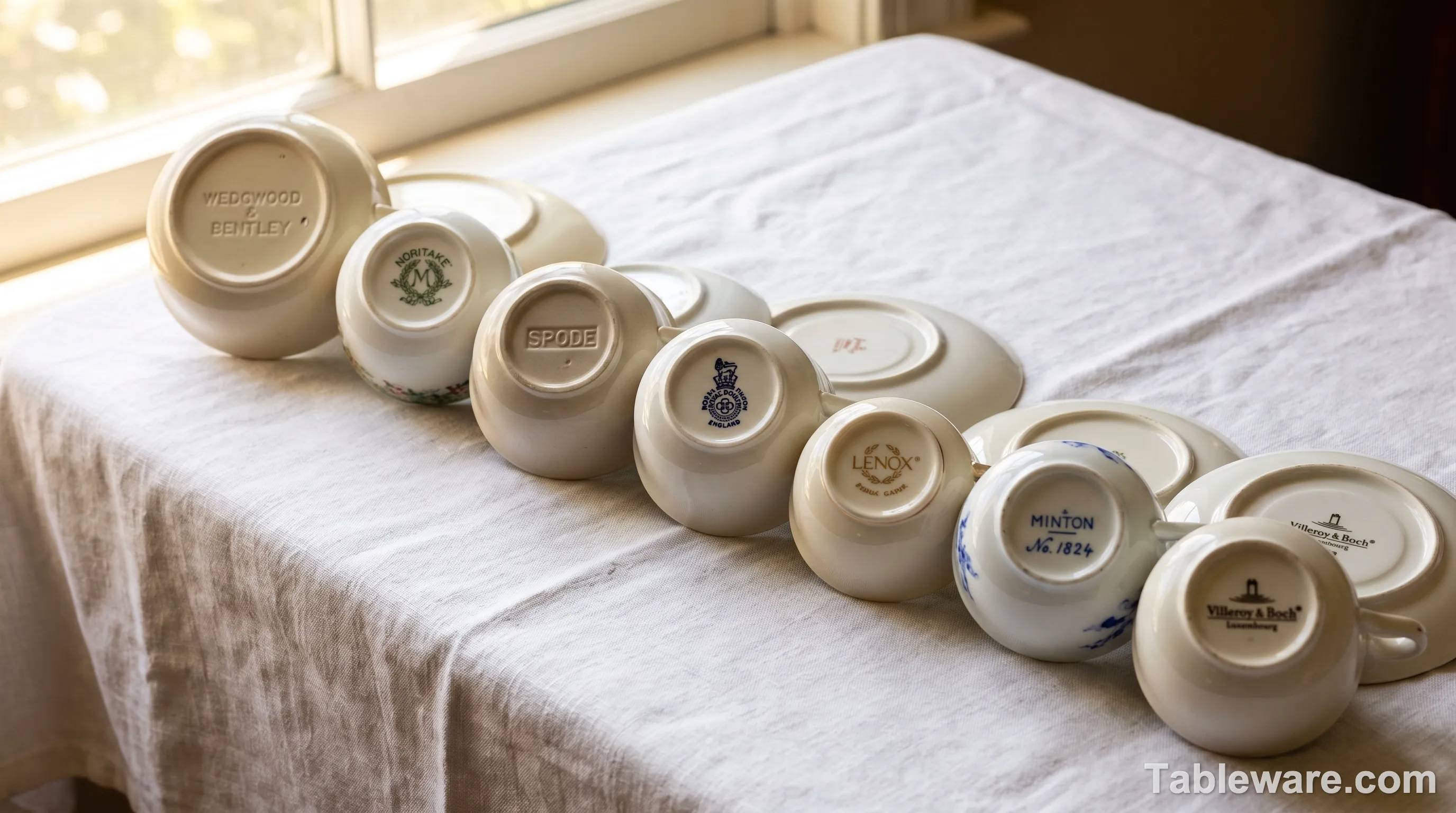
Fig 1. Seven back stamps from seven different makers, lined up on linen. They are upside down, and that is the point — you learn the most about a piece by flipping it over.
What a Back Stamp Actually Is (and Why It Matters)
A back stamp is the maker's mark, factory mark, or country-of-origin mark printed, impressed, or hand-painted onto the underside of a piece of pottery, porcelain, or stoneware. The phrase "back stamp" comes from the act of stamping a mark on the back of the piece before the glaze is fired. Most English and American manufacturers have used back stamps for at least 175 years. Most Japanese, German, French, and Scandinavian makers use them too. If your piece has a mark on the bottom, that mark is the single most reliable piece of evidence for who made it, where, and roughly when.
There is a small distinction worth keeping in mind. The phrase back stamp refers specifically to the mark on the bottom of the piece. The phrase maker's mark is the broader category that includes back stamps, side stamps, and the impressed marks you sometimes see on the foot rim of a cup. In everyday buying-guide speak they mean the same thing. When I say "read the mark" in the rest of this article, I mean any printed, impressed, or hand-painted identifier on the underside of the piece.
The second distinction is more practical. A maker's mark identifies the company. A decorator's mark (sometimes called a painter's mark or gilder's mark) identifies the artisan who painted or gilded the piece. On finer hand-decorated work, you will see both. The maker's mark tells you who owned the factory. The decorator's mark tells you who actually held the brush.
Back stamp vs. maker's mark: the small distinction most buyers miss
When you flip a piece over and you see one mark, it is almost always the maker's mark. When you see two, three, or four marks stacked on top of each other, the top one is usually the maker and the smaller ones below it are decorator's marks, pattern numbers, year codes, or country-of-origin stamps. The Wedgwood Portland Vase in my own kitchen, for example, has three marks stacked on the underside: the impressed "WEDGWOOD" word mark, a small "Made in England" line, and a tiny impressed "B" for the year 1971 in Wedgwood's internal dating system. That three-mark stack is normal. It is not a red flag.
Why back stamps are the single most reliable dating tool
A back stamp is the only piece of information about a piece that the maker deliberately put there at the moment of production. The shape, the glaze, the decoration — all of those can be faked or copied. The stamp, when it is correctly applied, is a piece of historical evidence. Even forgers know this, which is why they work so hard on the stamp. The flip side is that the stamp is also where they slip up. We will come back to that in the fakes section.
Quick safety check: when no mark at all is a red flag
If a piece of supposedly antique or vintage china has no mark on the underside at all, treat that as a soft red flag. It does not mean the piece is worthless. It means you have less information than you would like. Mass-produced utility ware from the 19th and early 20th centuries (think plain white restaurant platters or railroad china) was often sold unmarked. Modern studio pottery is also often unmarked by design. But for branded English bone china, French porcelain, or Japanese fine china, an unmarked piece should make you ask more questions, not fewer. This is one of the most common traps when you are trying to identify antique china maker's mark conventions on inherited pieces.
Anatomy of a Maker's Mark: 7 Clues to Read in Any Stamp
A maker's mark, when it is well-designed, contains seven different categories of information. Not every piece shows all seven. Most show three or four. The job is to learn which clues are present on the piece in your hand and what each one tells you. These are the seven clues that make up the core of how to read pottery marks on any piece of ceramic you pick up.
The seven clues are: the maker's name or initials, the country of origin, the pattern name or number, the shape number, registration or design numbers, the date letter or year code, and the decorator's mark. Let me walk through each.
1. The maker's name or initials
This is the obvious one. Look for the company name in full ("WEDGWOOD," "ROYAL DOULTON," "SPODE"), the initials ("MINTON," "L & B" for Limoges and Bavarian), or a logo ("N" inside a wreath for Noritake, the crossed swords for Meissen, the interlocked "WD" for Wedgwood). If the name is too long, it is often abbreviated. The maker's name is your single biggest clue.
2. Country of origin and "Made in" wording
"ENGLAND," "MADE IN ENGLAND," "BONE CHINA — ENGLAND," "GERMANY," "JAPAN," "MADE IN OCCUPIED JAPAN" (a big one for 1945-1952 pieces), "FRANCE," "LIMOGES FRANCE," "PORTUGAL," "TAIWAN," or "CHINA." Country of origin rules do not just date the piece, they sometimes prove it. If a piece claims to be a 1920s English bone china and the back stamp says "Made in China," somebody is making up a story. Also, "OCCUPIED JAPAN" pieces (1945-1952) are collectible in their own right — the wording is an automatic date range.
3. Pattern name and pattern number
Most manufacturers print a pattern name ("MARIPOSA," "PEMBERLEY," "BLUE WILLOW") or a pattern number ("R4773," "D5641," "466/21"). Pattern numbers are more useful than pattern names for cross-referencing. Replacements, Ltd. has a database at replacements.com that lets you look up most pattern numbers. If you have a piece with a pattern number and no maker, that is often enough to start narrowing down who made it.
4. Shape number
Less common on most modern ware, but very common on older English and French pieces. The shape number is a small alphanumeric code ("R4895," "B-3," "6124") that tells you which physical mold the piece was made in. Two pieces with the same pattern number but different shape numbers are the same pattern in two different physical forms. The shape number is also useful for dating — many manufacturers changed their shape-numbering schemes at known historical points.
5. Registration or design number
A "Rd No" (registered design number) or "Reg No" is a British legal artifact: a design registered with the UK Patent Office. The number is preceded by the year the design was registered. "Rd No 784921" was registered in 1903. "Reg No 900123" was registered in 1964. A design number narrows the earliest possible year the piece could have been made. There is a free database at the UK government's historical design register if you want to be precise.
6. Date letter or year code
Many manufacturers (especially British ones) used a single-letter year code that changed every year. Wedgwood used impressed letters from 1860 to 1929. Royal Doulton used a year code system from 1884 on. Spode used a series of different systems across the centuries. Learning the year code for the maker you collect is a one-time investment that pays off forever.
7. Painter's, decorator's, and gilder's marks
On finer hand-decorated work, you will see small initials or symbols painted in colored enamel that identify the artisan. Minton, Sevres, Meissen, Royal Crown Derby, and Herend all used these. The marks are often illegible without a magnifier, but they are usually on the underside near the maker's mark. They are not just collectible trivia — on a high-end Royal Crown Derby or Herend piece, the painter's mark can multiply the value of a piece by 3x to 10x.
Decoding the Big Three: Wedgwood, Noritake, and Spode
Wedgwood, Noritake, and Spode are the three brands you are most likely to find at a US estate sale, eBay listing, or family inheritance. They have been in continuous production for over 100 years each, they made millions of pieces, and they used back stamps consistently enough that you can date the piece. Here is how to read each one.
Wedgwood back stamp identification (1759-present)
Wedgwood back stamp identification starts with recognizing that this is the most over-collected and most over-faked English maker. Genuine Wedgwood has been in continuous production since 1759, and the back stamps have evolved through at least six distinct phases. The three main periods to know for any practical Wedgwood back stamp identification work:
1759-1860 (early period, impressed marks). Pre-dating the back stamp as we know it. Marks are impressed into the clay body itself. The "WEDGWOOD" word mark in capital serif letters is the most common. Pieces in this period are rare and extremely valuable when you find them, but they were often unmarked.
1860-1929 (three-letter impressed marks). Wedgwood's impressed "Portland Vase" mark and three-letter date codes (a single letter for the year, with a system that changed periodically). The "Made in England" line was not yet standard. This is the period where you see lots of "WEDGWOOD" word marks impressed into the foot rim.
1929-present (printed marks). Modern Wedgwood uses a printed "WEDGWOOD" mark, usually with "Made in England" or "Made in Indonesia" underneath, plus a small "B" impressed letter (or series of letters) indicating the year. The modern "W in a circle" logo is what you see on new production. The full dating-letter system is in the Wedgwood Museum's online reference. Most of what you will encounter at US estate sales falls in this third period, so the practical core of Wedgwood back stamp identification work is learning to recognize the printed marks and decode the impressed year letter.
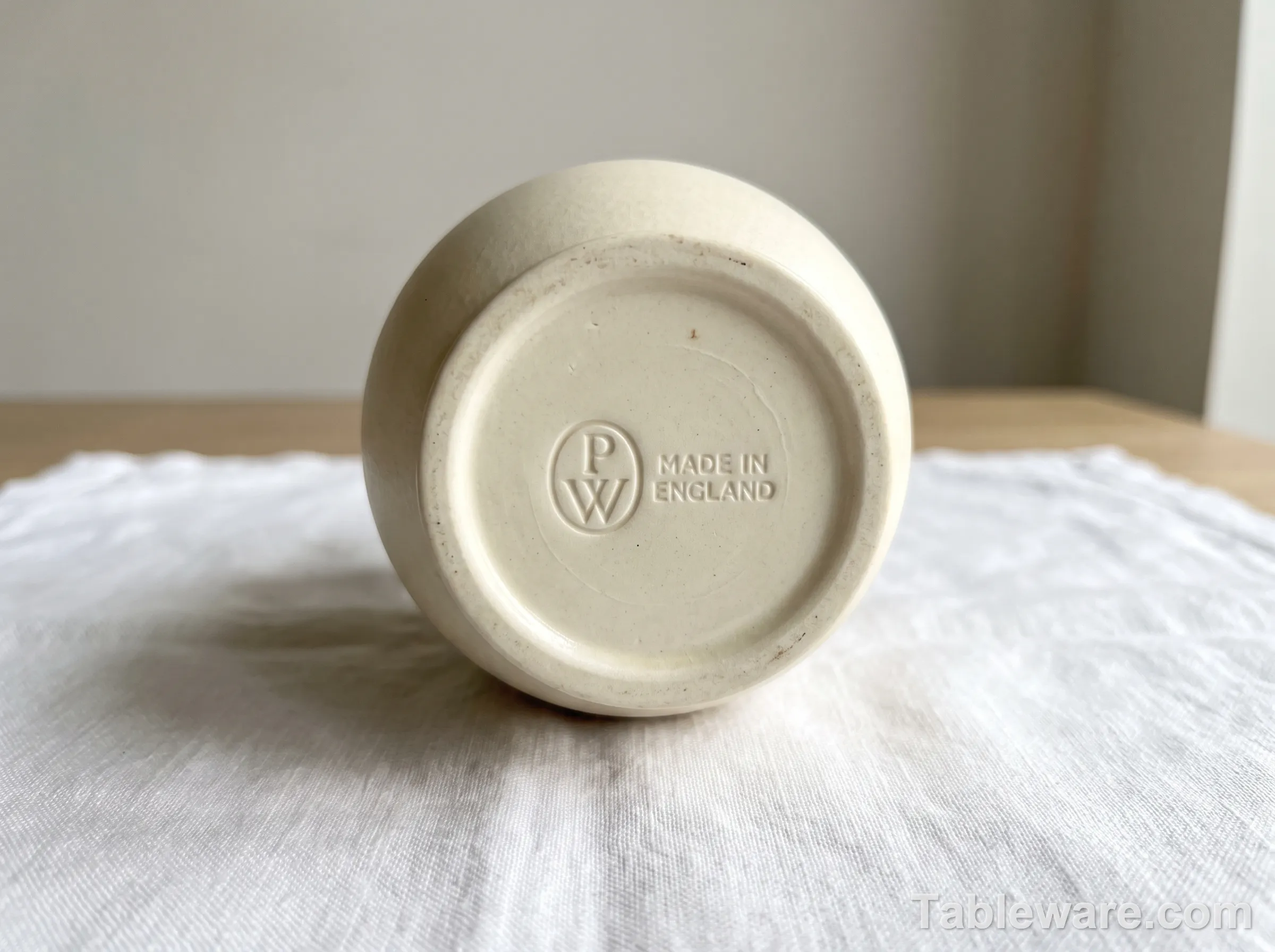
Fig 2. A genuine Wedgwood impressed mark, mid-20th century. The crisp impressed letters (not printed) and the consistent stroke weight are both tells.
Noritake back stamp identification chart (1904-present)
A Noritake back stamp identification chart is the single most useful tool for dating a piece of Noritake china, and the back stamps are confusing if you try to decode them by eye. Noritake is the most over-collected Japanese maker in the US, and the two main systems:
The M-in-wreath (1904-present). The classic Noritake back stamp. A green, gold, or sometimes black "M" inside a laurel wreath. The color of the "M" is itself a dating clue — green was most common in the mid-century, black and gold are later. A red "M" is a commemorative piece, often higher value. The "Made in Japan" or "Made in Occupied Japan" line confirms the country and the era.
The dating letter code. This is the trick that gets most people. Noritake used a single-letter year code, but the code varied depending on the line of ware. The "M" mark is your factory, the letter next to it is your year. For the most common "M-in-wreath" line, the year codes run from 1914 onward, with gaps during WWII when production shifted to military ware. A Noritake collector's reference book is the easiest way to decode these — and yes, you will need one if you collect Noritake in any volume. There is also a community-maintained Noritake back stamp chart on the Noritake Collectors Guild site.
A Noritake back stamp identification chart is genuinely useful because the variation between 1940s, 1950s, 1970s, and 2000s Noritake marks is wide enough that a single image comparison helps more than any amount of text. Keep one open in your phone when you shop. There is no shame in pulling out a Noritake back stamp identification chart at an estate sale. The sellers are doing the same thing.
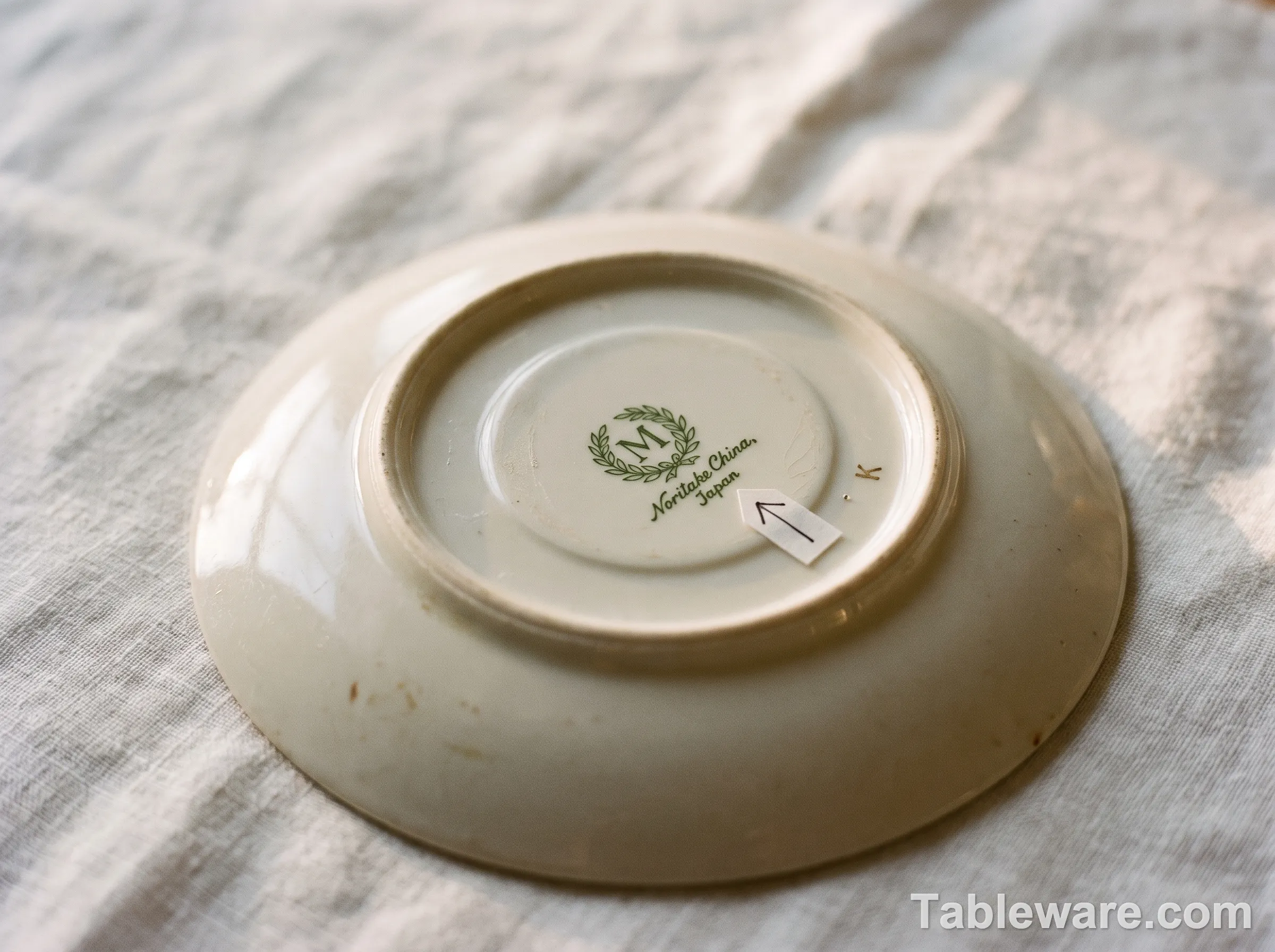
Fig 3. A typical mid-century Noritake M-in-wreath mark, with the dating letter code visible to the right of the wreath. The green color and the pattern number on the rim are both useful clues.
Spode back stamp history (1770-present)
Spode back stamp history is the trickiest of the three to learn because the company name on the back has changed through five distinct periods, and the modern mark looks almost nothing like the 1830s mark. The history goes like this:
1770-1833 (Josiah Spode era, impressed marks). Original Spode marks are impressed in cursive script — the famous "Spode" capital-S cursive mark. These are highly collectible, and the 1815-1830 impressed marks in cursive script are the ones that fool the most buyers at auction.
1833-1847 (Spode and Copeland). After Josiah Spode II took over, the mark was "SPODE" in capital letters, often with a "Copeland" attribution.
1847-1970 (Copeland and Garrett, then Copeland alone). The Spode factory became W.T. Copeland & Sons in 1847. Most of what collectors call "Spode" in the 20th century is technically Copeland-marked ware. The "Spode" word mark was retained as a brand name, but the back stamp often read "COPELAND" or "SPODE COPELAND."
1970-present (modern Spode, the "spode" word mark and a printed design). The modern mark is "spode" in lowercase serif font with a printed pattern indication underneath. The older "Copeland" attribution is gone.
The point of all this is that Spode back stamp history is not one history, it is a layered set of marks that all belong to the same company under different owners and different naming conventions. A piece that says "Copeland" on the back is Spode. A piece that says "Spode" in cursive is older than a piece that says "spode" in lowercase. Knowing the period tells you the era. (For the deeper material story behind English bone china, see our guide to bone china composition.) When you read a Spode back stamp, the wording alone tells you roughly which century you are in. That is the practical value of knowing Spode back stamp history.
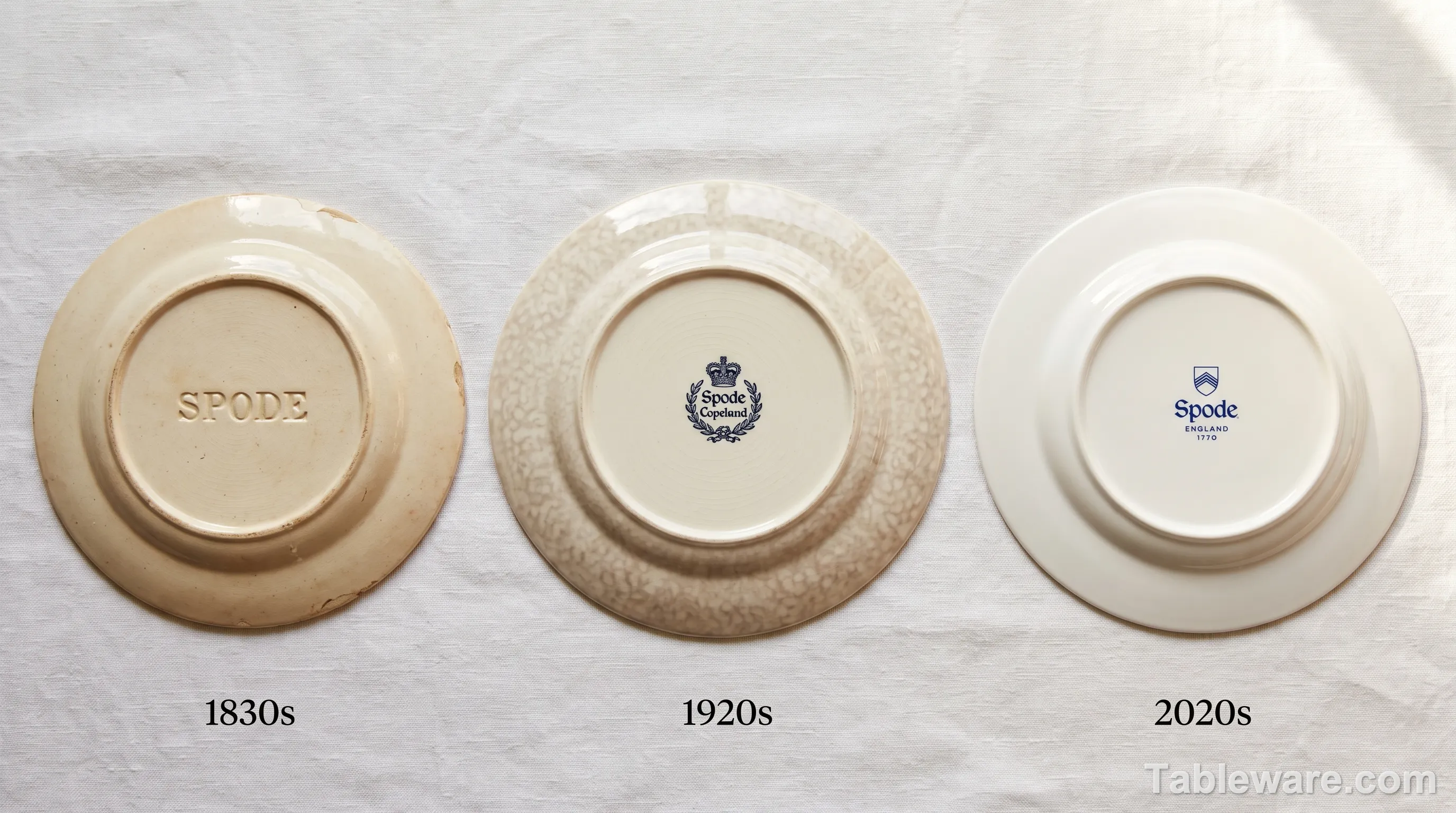
Fig 4. Three Spode pieces, three different centuries, same factory. From left: an 1830s impressed cursive Spode mark, a 1920s Spode Copeland printed mark, and a 2020s modern spode printed mark. If you can recognize these three, you can recognize almost any Spode.
Dating a Mark: Crowns, Letters, and Other Period Clues
Beyond the maker's name, there are five period clues that help you date a piece even if you have never seen that exact mark before. The point of this section is to give you a dating workflow that works on a piece you have never seen before, in five minutes, with just the mark. If your goal is to identify antique china maker's mark conventions, this is the section to read twice.
Royal cyphers and coronet marks (UK pieces)
A "cypher" is the monogram of a British monarch. "GR" (Georgius Rex) is George. "VR" (Victoria Regina) is Victoria. "ER" (Elizabeth Regina) is Elizabeth. "GvR" (with the v instead of u) is a Victorian cipher in the older style. A coronet above the cypher indicates a royal warrant. "ROYAL WARRANT" or "BY APPOINTMENT TO..." on a back stamp means a UK maker held a royal warrant during a particular reign.
You will see these on Royal Doulton, Royal Albert, Royal Worcester, Royal Crown Derby, and a handful of others. The cypher narrows the date range. A Royal Doulton piece with "GvR" was made during or before Victoria's reign (1837-1901). A Royal Doulton piece with "ER" was made during Elizabeth II's reign (1952-2022). It is not exact, but it is a strong starting point. If you are trying to identify antique china maker's mark conventions on an inherited UK piece, the cypher is the first thing to look for.
Letter codes, date letters, and registration numbers
A single-letter date code was used by many English manufacturers. Wedgwood used impressed letters from 1860 to 1929. Royal Doulton used a year code from 1884. Minton, Royal Worcester, and Royal Crown Derby all had their own internal letter systems. The catch is that each maker's system is different. There is no universal "G = 1935" rule. The good news is that every major English manufacturer has a published reference for their own date letter system, and the references are all free online.
Registration numbers ("Rd No" or "Reg No") are the most reliable single dating tool. A "Reg No 784921" was registered in 1903. A "Reg No 991207" was registered in 1974. The numbers run sequentially, so you do not need to memorize them. You look them up at the UK government's historical design register. It is a 30-second lookup.
Impressed vs. printed vs. lithographed: what the medium tells you
This is a dating trick that most guides skip. The physical medium of the back stamp is a clue in itself.
Impressed marks (the letters are pushed into the clay body) are older. Most impressed marks predate 1920. By the 1930s, most major manufacturers had moved to printed marks. A hand-applied impressed mark is consistent with a piece made before about 1920. A machine-applied impressed mark is consistent with a piece made 1920-1960. A printed mark is consistent with a piece made 1940-present.
Lithographed marks (the mark is printed with a transfer and then fired) are mid-century. The colors of the transfer (green, red, blue, black, gold) often narrow the period. A Noritake mark in green is more often pre-1970. A Noritake mark in black or gold is more often post-1970.
Laser-printed or digitally applied marks are modern. Most "Made in China" contemporary production uses digital printing for the back stamp. The mark is dead-crisp and has no imperfection. The mark on a 1950s Noritake, by contrast, will have tiny variations in registration or color from piece to piece of the same pattern.
Spotting Fakes and Reproductions: 5 Red Flags to Look For
The hardest part of reading a back stamp is being honest about the fact that forgeries exist. The good news: forgers make predictable mistakes. The bad news: those mistakes are subtle. Here are the five red flags that, taken together, will catch most of the fakes you will encounter. If you are trying to learn how to read pottery marks for the express purpose of avoiding fakes, this is the section that will save you the most money.
Why back stamps are where forgers slip up most
A forger has to copy a mark they did not design, on a piece they did not make, in clay they did not fire. Even good forgers get the stamp slightly wrong. Sometimes the spacing is off. Sometimes a serif is too thick. Sometimes the color of the printed mark is wrong. Sometimes the mark is crisp in a way that no 19th-century mark ever was. The mark is where the work shows.
The 5 red flags in any back stamp
Red flag 1: The mark is too perfect. Genuine back stamps from the 18th and 19th centuries have tiny imperfections — slight variation in stroke weight, micro-fuzziness in the edges, occasional small underglaze pinholes. A 19th-century hand-painted mark does not look like a 2020s digital print. If the mark on a claimed antique is laser-perfect, ask more questions.
Red flag 2: The country of origin is wrong for the date. A piece claiming to be 1920s English bone china that says "Made in China" is, at minimum, misrepresented. The country of origin on a back stamp cannot be more modern than the rest of the piece. (There is a small exception: genuine 19th-century pieces were sometimes re-marked with "Made in England" during 20th-century UK re-imports. But this is rare and well-documented.)
Red flag 3: The pattern name does not match the maker. A piece stamped "ROYAL DOULTON" with the pattern name "MARIPOSA" is a fake. Royal Doulton did not make the Mariposa pattern — that is Noritake. Always cross-reference the pattern name against the maker. Replacements.com and the maker's own archives are your best friends here.
Red flag 4: The mark is misaligned or off-center. A hand-applied impressed mark or a 19th-century transfer-printed mark will not be perfectly aligned with the foot of the piece. The maker rotated the piece on a wheel and the mark was applied by hand. A perfectly centered, perfectly aligned mark is suspicious. Slight rotation or slight offset is normal.
Red flag 5: The piece's age story does not match the back stamp's age story. If the seller says "this is a family heirloom, my grandmother bought it in 1947" and the back stamp is a 2020s digital print with a QR code, the story is wrong. The back stamp does not lie about the date. The seller might be wrong, but the stamp is right.
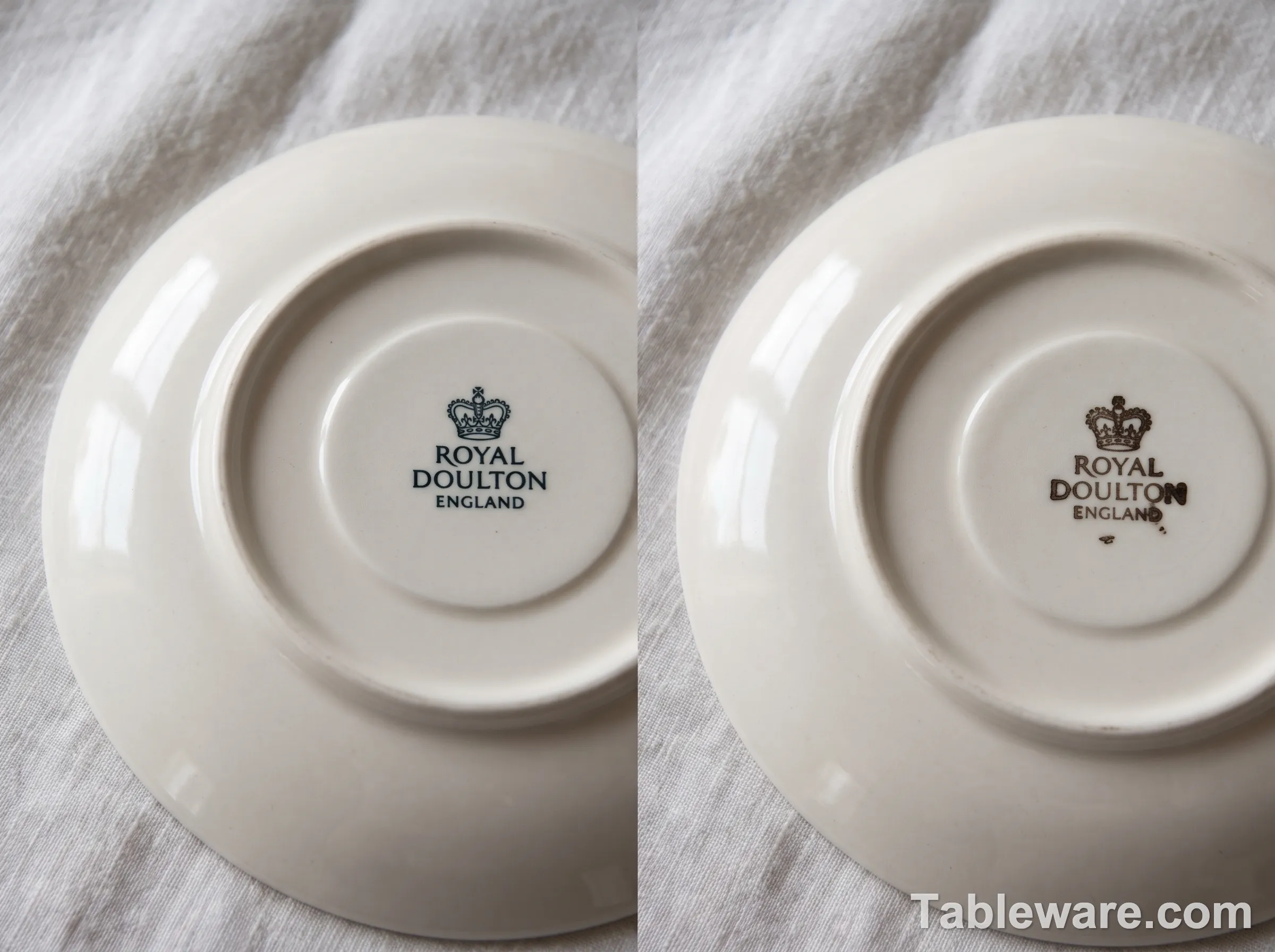
Fig 5. Genuine vintage Royal Doulton mark (left) vs. a knockoff reproduction (right). The genuine mark is crisp but with the tiny imperfections of a hand-applied transfer. The fake mark is mechanically perfect in a way that real 1930s ware never was.
When the price alone is a red flag
A genuine Royal Doulton character jug in the "Aramis" design (1980s) sells for about $30-50 on the secondary market. If a seller is listing one for $400 with a "rare back stamp" story, the price is the red flag. The most reliable authentication in the antiques world is a price that is too good (or too bad) to be true. Cross-reference sold listings on eBay's "sold items" filter before you pay anything over $50 for a marked piece. The sold listings are the real market, not the asking prices.
How to Photograph and Research a Mark You're Stuck On
Sometimes you get a piece home, you flip it over, and the mark does not match anything in the maker's own reference. It happens. Maybe the mark is partially worn off. Maybe it is a maker you have never heard of. Maybe the seller told you one story and the stamp tells you a different one. This is where the most advanced piece of how to read pottery marks happens: the cross-reference workflow. Here is what to do next.
Lighting, angle, and macro shots that show the mark clearly
The first job is to get a usable photograph of the mark. Most amateur photos of back stamps are useless because the light is wrong or the angle is wrong. Three rules:
- Use raking light. Hold a lamp or window so the light comes in from the side at a low angle, not directly above. Raking light makes impressed marks readable. Direct light washes them out.
- Shoot from above at a slight angle. Not straight down, not from the side. A 15-30 degree angle from directly above is the sweet spot for showing both impressed and printed marks.
- Use a macro lens or a phone with a macro mode. The decorator's mark is often smaller than 1/8 inch. A standard phone shot will not show it.
4 free online resources to cross-reference a mark
Once you have a usable photo, these four resources will resolve the majority of marks you will encounter in the wild:
- Replacements.com — Pattern and maker database, with photos. Free to search, paid for full data. Best for English, American, and Japanese marks.
- gotheborg.com — The most complete Chinese and Japanese mark reference on the public web. Best for Asian marks.
- The British Museum collection database — The British Museum has a public collection database with photos of maker's marks on actual pieces. Useful for dating by mark format.
- The Potteries Museum & Art Gallery (Stoke-on-Trent) — The Potteries Museum covers the Stoke-on-Trent potteries (Wedgwood, Minton, Doulton, Spode, etc.). The online collection has thousands of maker's marks, with the date range of the mark and the maker.
When to bring in a professional appraiser
If the piece is worth more than $500 by your best estimate, the mark is unusual, and the value is not clear from cross-referencing, bring in a professional appraiser. The American Society of Appraisers has a directory at asa-appraisers.org. Auction houses like Skinner Auctioneers and Heritage Auctions have free "Ask an Expert" services where you can email a photo and get a rough opinion.
The rule of thumb: if you would not want to lose $500 on a guess, do not guess.
Frequently Asked Questions About Pottery Marks
Are unmarked pieces worth anything?
Yes, sometimes. Mass-produced utility ware from the 19th and early 20th centuries (plain white restaurant platters, railroad china, hotel ware) was often sold unmarked, and the pieces can be valuable in their own right for collectors of that specific genre. Modern studio pottery is also often unmarked. The answer is "it depends on the piece," and the only way to know is to look at the shape, glaze, weight, and construction quality. A heavy, well-glazed, perfectly balanced piece with no mark is more likely to be valuable than a light, rough, thin piece with no mark.
Can two pieces with the same mark still be different values?
Yes, all the time. The mark tells you who made the piece, not what the piece is. A Royal Doulton "Olde Aylesbury" pattern dinner plate and a Royal Doulton "Bunnykins" pattern baby plate both have Royal Doulton marks, and they are worth radically different amounts. The mark is the brand, not the value. The pattern, the shape, the age, the condition, the regional scarcity — these all affect value more than the mark itself.
What's the difference between a maker's mark and a decorator's mark?
The maker's mark identifies the factory that produced the piece. The decorator's mark identifies the artisan who painted or gilded it. The maker's mark is usually printed, impressed, or stamped and is the larger, more visible mark. The decorator's mark is usually hand-painted in colored enamel, often much smaller, and is frequently illegible without a magnifier. On finer hand-decorated work, the two marks together identify both the company and the artisan.
Where can I find the value of a marked piece?
Three free resources, in order of usefulness:
- eBay "sold items" filter. Search for the maker + pattern + shape, then filter to "sold items." The sold prices are the real market.
- Replacements.com. Their "sell" page lists suggested resale values for most major English, American, and Japanese patterns. The values are conservative; they assume the piece is not in mint condition.
- LiveAuctioneers.com and Invaluable.com archives. These are auction databases. They show the actual hammer prices for pieces sold at auction. The auction prices are the most accurate market read, especially for higher-end pieces. (For a side-by-side look at the broader dinnerware market at different price points, our ceramic comparison piece is a useful cross-reference.)
For pieces worth more than $500, a professional appraisal is worth the $50-150 cost. The professional appraisal also serves as documentation for insurance.
That Vermont estate sale is still on my mind. The woman who paid $215 for the Royal Albert set got a real set — it was just not the set the seller described. If she had read the back stamp, she would have either paid the right price or passed on it. The back stamp would not have saved her from being out $215, but it would have saved her from thinking she had gotten a deal on a $1,400 set. That is the real value of knowing how to read pottery marks. It does not make you a buyer who never loses. It makes you a buyer who always knows what they are buying.
The next time you walk into an estate sale, an antique mall, or your grandmother's attic, flip the piece over first. Read the mark. Cross-reference the pattern. Check the date code. Then decide what it is worth to you. That habit alone will save you hundreds of dollars over the rest of your collecting life. If you are starting fresh and want a broader frame for what to buy in 2026, our ultimate dinnerware buying guide is the next piece to read.