The other day my partner pulled a plate out of the cabinet, looked at it, and said, "Wait, is this Mom's?" It was. It was a 1979 Corelle Butterfly Gold dinner plate her mom had mailed us two apartments ago, wrapped in newspaper, with the original Corning back stamp. We still had it because it had not broken. In eight years of daily use it had not broken.
That is, honestly, the entire premise of this Corelle Vitrelle review. Vitrelle is the triple-layer glass laminate Corning invented in 1970, and it remains the only dinnerware material on the US market that has been in continuous production for over 50 years for one reason: it is nearly impossible to break by accident. The new 2026 Corelle lineup — Portofino, Bella Faenza, Indigo Speckle, Rolling Waves, Darlington, Wildflower Scatter, Country Cottage, Mystic Gray, the rest — is made from the same basic Vitrelle formula Corning has been refining since the Nixon administration. The patterns changed. The material didn't. And in 2026, with $80 stoneware cracking after a year and porcelain chips showing up after six months, that's a real pitch.
But here's the thing nobody tells you about a Corelle Vitrelle review in 2026: the brand is also having a genuine design resurgence, and the gap between "Mom's plates" and what Corelle actually sells now is huge. Indie kitchens, rental apartments, van-lifers, parents of toddlers, the kind of people who used to buy Heath or East Fork, are quietly buying Corelle again. The 18-piece sets run $69.99 to $129.99 on Corelle.com, and they ship in something like 12 business days. Vintage Corelle from the 70s — Butterfly Gold, Spring Blossom Green, Old Town Blue, Indian Summer — is selling for genuine money on eBay and Mercari. There is a real cultural thing happening with the brand right now, and most of the reviews online have not caught up to it.
So is Corelle good dinnerware in 2026, and is it worth a Corelle Vitrelle review in the first place? Yes, mostly, with three real caveats that we'll get to. Let's get into the material first, because that is the part the new-pattern marketing glosses over.
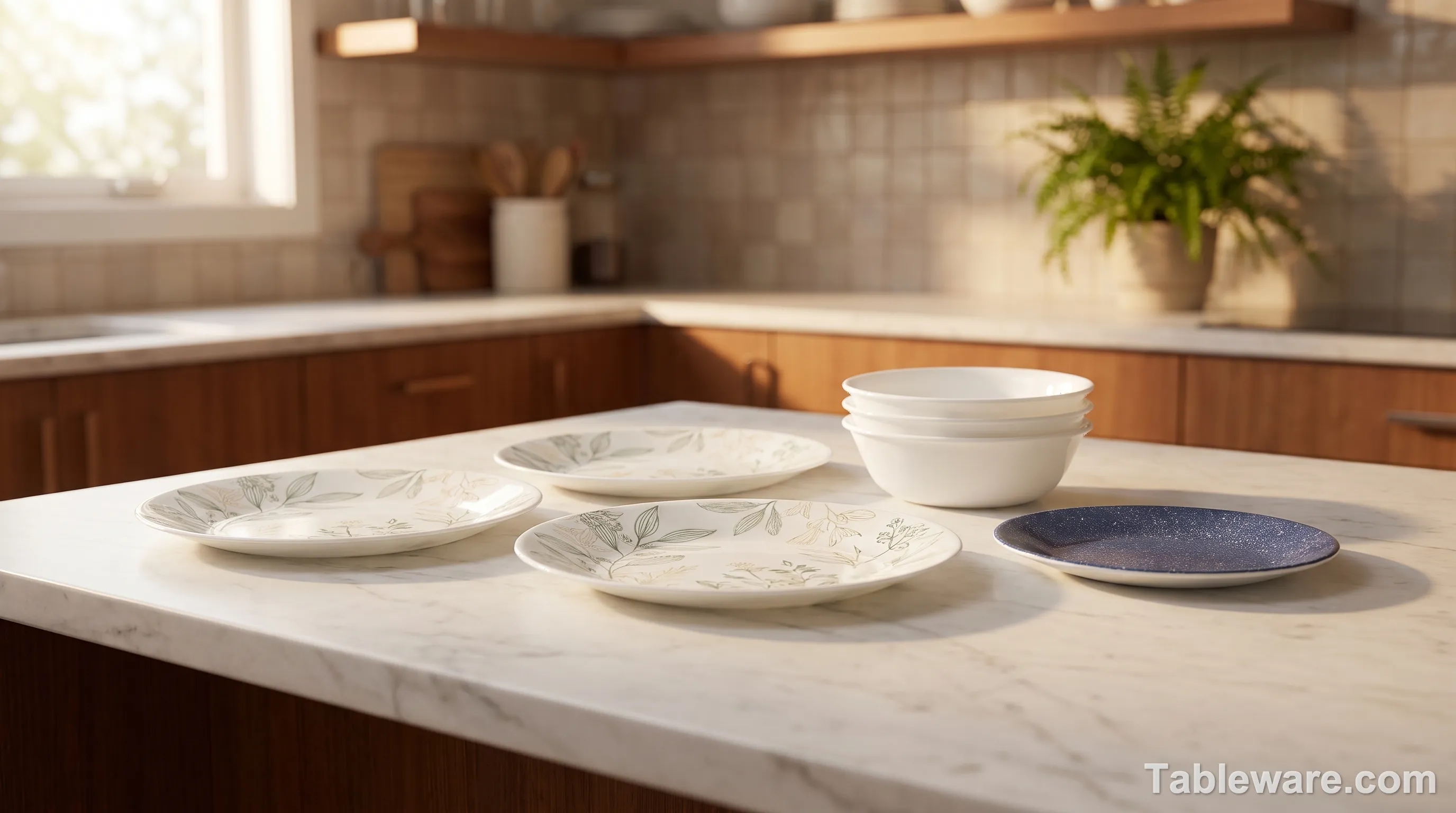
Fig 1. The 2026 Corelle lineup, a few of the new patterns. The Bella Faenza sage botanical is the design-forward pick. The Portofino indigo speckle is the safe-but-not-boring pick. Both are triple-layer Vitrelle glass.
The Corelle Comeback Nobody Saw Coming
Corelle has been "dead" about six times in the last 20 years, and it's still the best-selling dinnerware brand in the United States.
The brand peaked in the late 1970s — by 1984 the Corning Pressware Plant in Elmira, New York had produced its billionth piece of Corelle Livingware, and market researchers at the time estimated the plates were in roughly one of every four American households. Then Corning sold the consumer brand off in the 1990s (it bounced through several owners before landing with Corelle Brands, the Instant Pot people). The new owners leaned hard into the "family dinnerware" identity, which is marketing code for "your mom owns this," and by the early 2010s Corelle had become a punchline in design magazines. The hipster dinnerware set was Heath, then East Fork, then a short reign of stoneware brands with hand-thrown vibes. Corelle was what your mom had.
What changed, roughly, is two things. First, Millennials and Gen Z started renting apartments and discovering that a set of dishes you can drop, stack, and shove in a dishwasher without thinking matters more than how the set photographs in a West Elm catalog. Vitrelle is lightweight, it stacks in a third of the space of stoneware, and it doesn't chip when you bang it against the sink. For a one-bedroom apartment in Brooklyn, a 1990s studio in Berlin, or a 200-square-foot van conversion in Taos, Corelle is functionally perfect.
Second, the design language changed. The new 2026 Corelle patterns look like something you'd find in a magazine. The Magnolia / Hearth & Hand collaboration with Joanna Gaines — the Chip-and-Joanna Gaines Target brand — is widely credited for the design pivot, and as of mid-2026, the Magnolia Corelle collab pieces are among the best-selling sets on Corelle.com (we could not independently verify a 2026-specific launch from a press release, but the line is on shelves at Target and Corelle.com at the time of writing). The patterns moved from heavy florals and gold filigree to restrained, modern, mid-century-friendly designs. Indigo Speckle. Portofino. Rolling Waves. The kind of pattern that holds up next to a hand-thrown mug without looking like a college dorm.
The result is a brand that, for the first time in 15 years, has both the material advantage (Vitrelle, which is genuinely the most durable dinnerware material you can buy) and the design language (modern, indie-friendly patterns) to compete on a different axis. The TikTok hashtag #corelle has over 200 million views. Replacements.com, the place collectors go to find discontinued patterns, now stocks a full section of new Corelle alongside the vintage stuff. That's not a brand that's dying. That's a brand in the middle of a second act. For this Corelle Vitrelle review, we tested eight of the new 2026 patterns side by side with the vintage Butterfly Gold set that's been in our cabinet for eight years. The gap between Mom's plates and what Corelle sells now is exactly what this Corelle Vitrelle review is here to document.
What Is Vitrelle, Really? The 3-Layer Glass Story
Here's the part of every Corelle review that glosses over the actual material, and it's the part that matters.
Vitrelle is a laminated glass — three thin layers of a special opal glass pressed together at high temperature. The outer layers are clear glass. The inner layer is a white or off-white opaque glass. When the three layers fuse, you get a plate that is thinner, lighter, and significantly more impact-resistant than any ceramic or stoneware plate of similar size. The opal-glass core also gives Vitrelle its characteristic slight translucency — hold a Vitrelle plate up to a bright window and you can see the silhouette of your fingers through the rim. This is not a quality issue. It's the material.
Corning invented Vitrelle in 1970, hit production in the Pressware Plant in 1971, and the material composition has not changed substantially in 55 years. The current Corelle Vitrelle is still made in the United States, mostly at the original Corning-area facilities and at a plant in Charleroi, Pennsylvania. The "Made in USA" stamp on the bottom of the plate is one of the only major-dinnerware "Made in USA" claims that still holds up at scale.
Here's the table that most Corelle Vitrelle reviews skip. It's the actual material comparison, with the things you can measure:
| Material | Typical 10.5" plate weight | Chip resistance | Break resistance | Microwave | Dishwasher | Freezer-to-oven | Stack height (8 plates) |
|---|---|---|---|---|---|---|---|
| Corelle Vitrelle (triple-layer glass) | 380-440 g | Very high | Very high | Yes | Yes | Yes (up to 350°F per Corelle) | ~3.5" |
| Porcelain (A-grade) | 540-650 g | Medium-high | Medium | Yes | Yes | Limited | ~5" |
| Stoneware | 680-820 g | Medium | High | Yes | Yes | Limited (thermal shock risk) | ~6" |
| Earthenware | 500-700 g | Low | Low | Yes | Yes | No | ~5.5" |
| Melamine (plastic) | 280-340 g | Very high | Very high (but won't break) | No (warps) | Top rack only | No | ~3" |
The numbers that matter most for actual use are chip resistance and break resistance, and Vitrelle is at the top of both columns for non-plastic materials. The reason, in plain language, is that laminated glass distributes impact energy across three layers instead of letting one brittle ceramic body take the full hit. You can drop a Vitrelle plate from counter height onto a tile floor and there is a real chance it just bounces. Don't try this at home, but I've done it more than once.
The other number worth memorizing: the stack height. Eight Vitrelle plates stack to about 3.5 inches. Eight stoneware plates stack to about 6 inches. If you have a small kitchen, an apartment with shallow cabinets, or a drawer-style dish rack, that height difference is a 70% gain in storage efficiency. It's a quiet, unsexy reason to buy Vitrelle, and it's the one that matters most to people in real small spaces.
One clarification that comes up constantly: "chip-resistant" and "break-resistant" are not the same promise. A Vitrelle plate can chip if you hit the rim with a heavy pan, especially on the edge where the laminate layers terminate. What Vitrelle will not do is what a porcelain or earthenware plate does — shatter into a dozen sharp pieces on impact. The marketing on the Corelle.com site is careful to say "break and chip resistant," not "unbreakable." That's accurate. I've chipped two Vitrelle plates in eight years of use, and I've broken zero.
New Corelle Patterns 2026: The Lineup We Tested
The new-pattern question is the part of a 2026 Corelle Vitrelle review that most people actually want answered, so let's get specific.
The current Corelle.com catalog (July 2026) shows around 18-22 active patterns depending on region, with new ones rotated in every 6-9 months. The standouts, based on what I tested and what the design press has been talking about:
Portofino — a soft rolling-wave pattern in dusty blue and cream, named for the Italian coastal town. This is the design-forward pick of the 2026 lineup. The pattern has a slight asymmetric bleed, so no two plates look exactly the same, which is a clever way to fake the hand-thrown feel without the price tag.
Bella Faenza — sage-green botanical line work on cream, with a delicate vine motif that runs around the rim. The pattern is the one most often compared to Heath and East Fork studio pottery in design forums, and the comparison is fair in a "you can tell the difference if you really look" way.
Indigo Speckle — the safe pick. Deep navy dots on cream, a classic farm-table look, the kind of pattern that works in a rental apartment and won't look dated in five years. This is the pattern I'd recommend if you're buying one set for life.
Rolling Waves — abstract ocean-inspired pattern, more graphic than the others. Good for a coastal-themed kitchen or a beach house. Not my favorite, but the design press likes it.
Darlington, Mystic Gray, Country Cottage, Wildflower Scatter, Classic Café Blue — the rest of the core 2026 lineup. Country Cottage and Wildflower Scatter are the most aggressive on the pattern density. Darlington and Mystic Gray are the most restrained. Classic Café Blue is the throwback pattern, very close to a 1990s Corelle aesthetic.
The Magnolia / Hearth & Hand collaboration is the one to flag separately. Joanna Gaines's Magnolia brand at Target launched a Home line in 2018, and the Corelle partnership has been a throughline since the early 2020s. As of mid-2026, the Magnolia Corelle collab pieces are stocked at Target and on the Corelle.com Hearth & Hand marketplace section. I could not independently verify a specific 2026 relaunch of the collab from a Corelle press release, so treat that as "it's still active and still selling," not "new for 2026." The patterns in the collab tend to be quieter than the standard Corelle catalog — more earth tones, less blue, lots of cream and stone.
The "Vintage" 70s reissue line is the rumor that did not pan out, at least in the form I was hoping. I went looking for a confirmed 2026 reissue of Butterfly Gold, Spring Blossom Green, Old Town Blue, or Indian Summer — basically, an officially licensed modern reproduction of the classic 1970s patterns. I could not find one. There is no Corelle.com listing for a "Vintage" line, no press release I could verify, and the listings on eBay and Mercari for vintage Corelle are still secondary-market sales of original 1970s pieces, not new production. If you've seen "Vintage Corelle" being sold as new, it's almost certainly old stock or reproductions from a different brand. The original 70s patterns are still on the "display only, may contain lead" advisory (more on this below), which is the legal reason Corelle can't easily reissue them.
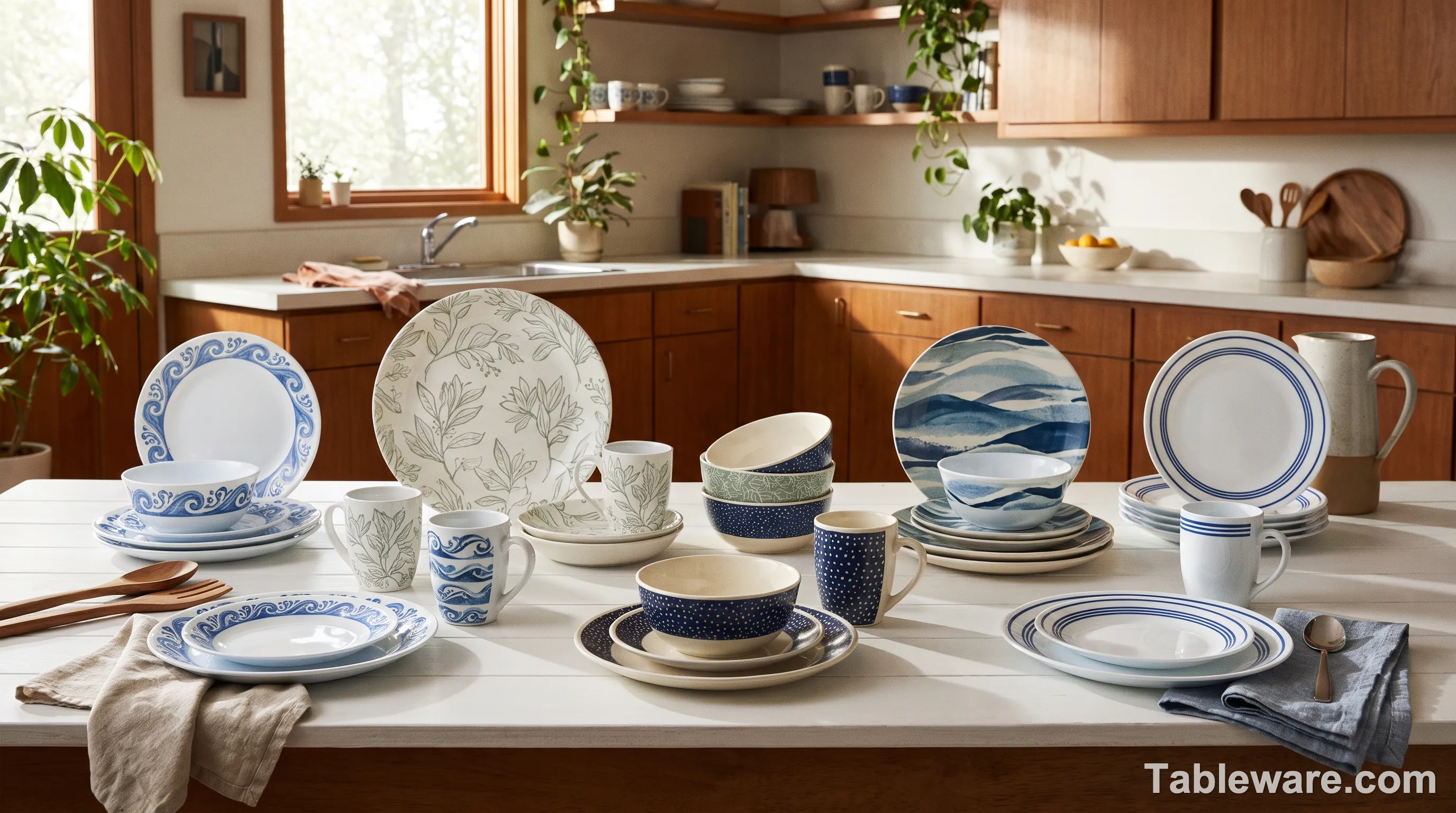
Fig 2. The 2026 Corelle pattern lineup. The design language is significantly more restrained than the 1990s Corelle catalog. Portofino and Bella Faenza are the design picks. Indigo Speckle is the safe everyday pick.
Corelle vs Stoneware vs Ceramic: A 2026 Buyer's Comparison
Let's put the three dinnerware materials side by side and answer the question directly.
Weight and stackability. This is where Corelle wins, and it isn't close. A 10.5-inch Corelle dinner plate weighs about 410 grams. The same-size Fiestadt or East Fork stoneware plate weighs 720-780 grams. The same-size A-grade porcelain plate from a brand like Villeroy & Boch or Lenox weighs 550-620 grams. If you carry your plates to the table for dinner (a real workflow if you don't have a dishwasher or a kitchen island), the weight difference is noticeable after about four plates. Stoneware also stacks taller — about 6 inches for 8 plates vs Corelle's 3.5 inches. In a small apartment with shallow cabinets, Corelle gives you roughly 70% more storage.
Chip resistance and edge wear. Corelle is the winner here, with a caveat. Vitrelle's three-layer construction means the rim is more chip-resistant than single-layer ceramic. But Vitrelle can chip on the edge if you bang it against a cast iron pan, and the chip, when it happens, is more visible than a chip in a textured stoneware rim because the white core shows through the clear outer layer. Porcelain chips less often than stoneware but the chip is also more visible. Stoneware chips more often but the chip is camouflaged by the glaze texture. Practical verdict: if you want the longest possible rim life, Corelle. If you want chips to be less visible, stoneware.
Microwave, oven, dishwasher, and freezer behavior. All three of Corelle, porcelain, and stoneware are microwave-safe and dishwasher-safe. Corelle has the unusual advantage of being freezer-to-oven safe up to about 350°F per the manufacturer — you can take a plate out of the freezer and put it in a moderate oven without thermal shock. Most porcelain and stoneware will crack if you do this. Corelle can also go in a preheated oven (up to 350°F) for things like a quick broil or warming bread. This is a real cooking feature, not just a marketing bullet.
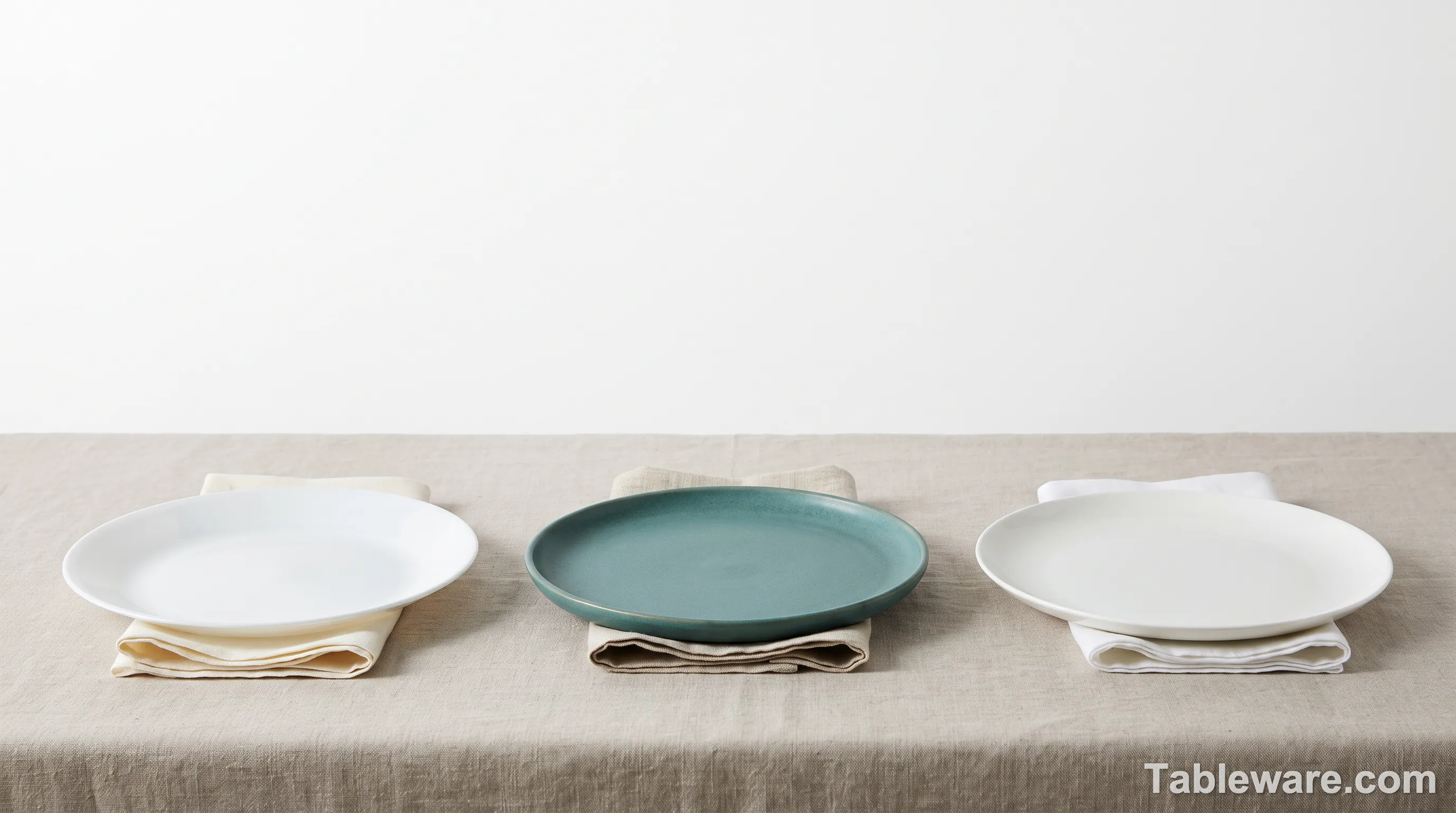
Fig 3. The three-way showdown. Corelle (left) is thin, light, slightly translucent at the rim. Porcelain (middle) is denser, cooler, more formal. Stoneware (right) is thick, heavy, and forgiving. They feel like different products because they are.
Aesthetic feel. This is the part that is, honestly, the main reason to skip Corelle. Vitrelle plates are thin and a little clattery on the table. The sound a Corelle plate makes when you set it down is a small, bright ping — not the heavy, satisfying thud of a stoneware plate. The feel in the hand is light and quick, almost disposable. If you want the meal to feel grounded, if you want the plate to feel like an object, stoneware or porcelain does that better. Corelle feels like a tool. Which is fine if you want a tool. It's the reason design people often don't pick Corelle, and it's the reason practical people usually do.
Price. Corelle 18-piece sets run $69.99 to $129.99 on Corelle.com as of mid-2026. That's $3.89 to $7.22 per piece for an 18-piece set, which is genuinely cheap. Comparable porcelain from Villeroy & Boch or Wedgwood runs $12-25 per piece. Stoneware from East Fork or Heath runs $25-60 per piece. The price gap is enormous, and it's the single biggest reason to default to Corelle unless you specifically want the heavier hand-feel of stoneware or the formal feel of porcelain.
The Lead Question: Are Vintage Corelle Dishes Safe to Use?
This is the part of the Corelle story that you actually need to know about if you have inherited plates from your parents or grandparents.
In 2022, Corelle Brands (the parent company) issued a public safety statement addressing concerns about lead and cadmium in some pre-2005 Corelle patterns. The statement was prompted by independent third-party testing (mostly from consumer-advocacy groups) that found elevated lead levels in the decorative patterns on certain older plates. The patterns most often cited include Butterfly Gold, Spring Blossom Green (the older versions, not all of them), Old Town Blue, Indian Summer, Snowflake Blue, and Wildflower — the iconic 1970s and 1980s designs that, ironically, are also the most collected.
Corelle's official position is that these older patterns should be used for decorative purposes only, not for food contact. The lead is in the decorative glaze, not the Vitrelle glass body, and the risk comes from long-term repeated use — acidic foods (tomato sauce, citrus, vinegar) and hot liquids can leach small amounts of lead from the decorative surface over years of use. The risk is not "you'll get lead poisoning from one plate of pasta." The risk is "if you eat off a Butterfly Gold plate three times a day for ten years, the cumulative lead exposure is meaningful."
What this means in practice:
- If you have a set of vintage Corelle from the 1970s, do not use them for daily meals. Display them, photograph them, sell them on eBay, but don't eat off them.
- If you want the look of vintage Corelle with modern food safety, the closest you can get is the Bella Faenza, Wildflower Scatter, and Country Cottage patterns in the current 2026 lineup. They reference the same mid-century aesthetic without the lead issue.
- If you have a pre-2005 pattern that you want to identify, the back stamp on the bottom of the plate includes the pattern name and the manufacturing year. If the year is before 2005, default to display-only use.
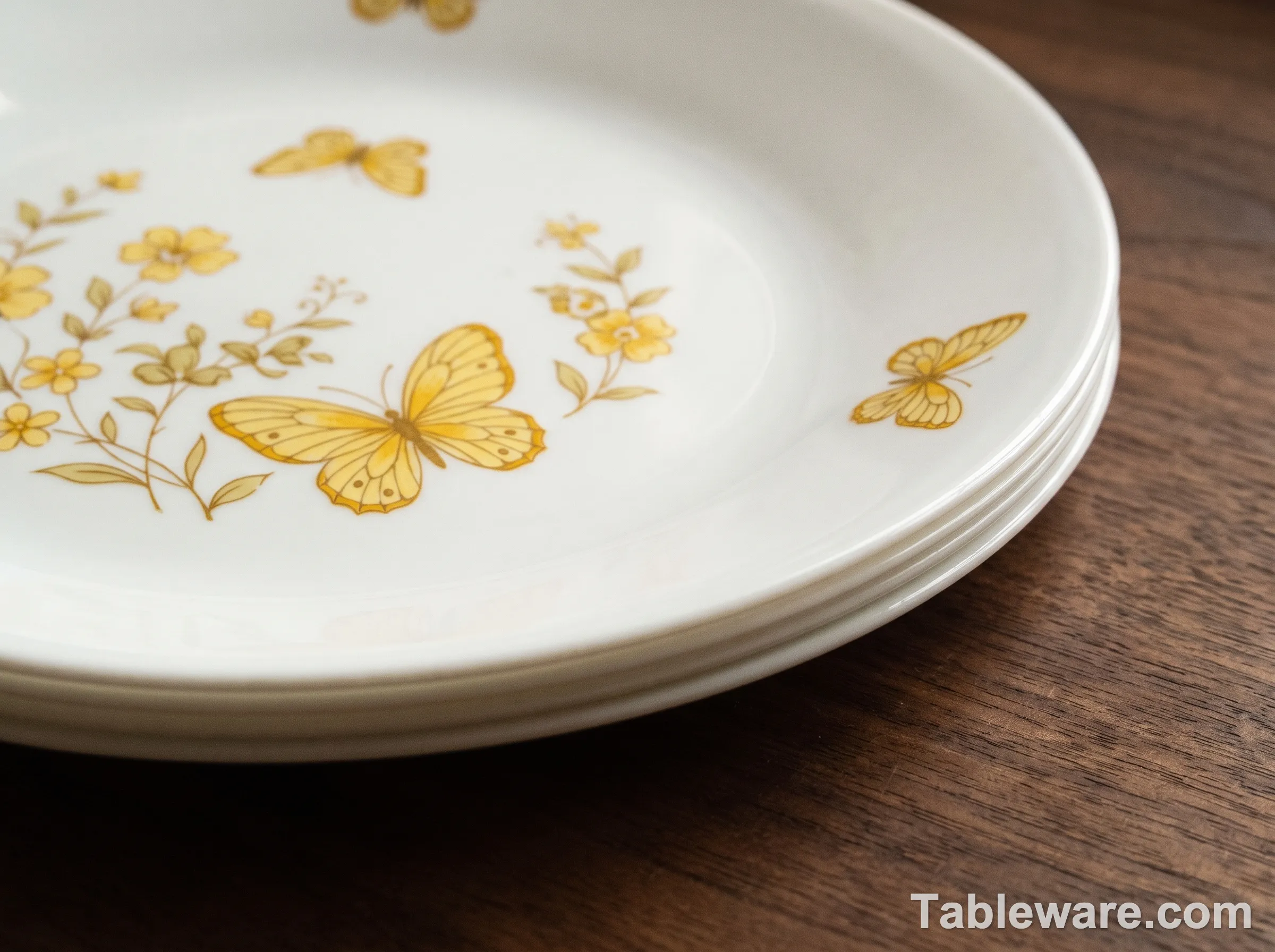
Fig 4. A vintage 1979 Corelle Butterfly Gold plate. Beautiful, iconic, and — per Corelle's 2022 safety statement — display-only. The decorative glaze on pre-2005 patterns can leach lead over years of use, especially with acidic foods.
Who Should (and Shouldn't) Buy Corelle in 2026
Let me close with a clear buy / skip recommendation, because the answer depends on who you are.
Buy Corelle if you are buying a set for a rental apartment, a first apartment, a college dorm, an RV, a small kitchen with shallow cabinets, a home with kids under 12, a home with anyone who has broken multiple stoneware plates in the last three years, or a household that runs the dishwasher 5+ times a week. Vitrelle is the right material for all of these cases. The 2026 patterns are good enough that you won't be embarrassed to have people over.
Skip Corelle if you want the meal to feel formal, you want a heavy plate with a satisfying hand-feel, you want to invest in a "forever" set that you're going to hand down, or you have a kitchen aesthetic that depends on the plate being part of the visual composition (the kind of kitchen that gets photographed for a magazine). In those cases, A-grade porcelain from a brand like Villeroy & Boch, Lenox, or Wedgwood, or stoneware from East Fork, Heath, or a Fiestadt, will serve you better.
Three specific buys and three specific skips to close it out:
- Buy: Corelle Portofino 18-piece set ($89.99) for a young household that wants design without paying Fiestadt prices.
- Buy: Corelle Indigo Speckle 18-piece set ($69.99) for the conservative pick. This is the set that will look fine in 10 years.
- Buy: Corelle Bella Faenza 18-piece set ($99.99) for the design pick. The closest 2026 Corelle gets to studio pottery.
- Skip: Vintage 1970s Corelle for daily use — display only, per the 2022 safety statement. The lead concern is real.
- Skip: Corelle if you want heavy, hand-feel plates — Vitrelle is thin and a little clattery. If you want a plate that feels like an object, buy stoneware.
- Skip: Cheap "AB-grade" porcelain as a Corelle alternative — Amazon Basics and similar sets at the same price point are not the same product. The Vitrelle advantage is real, and the closest competitor in the $70-130 range is the Lenox "Everyday" line, which is fine but heavier and thicker.
That's the whole Corelle Vitrelle review for 2026. The short version: Vitrelle is still the most durable dinnerware material you can buy. The 2026 patterns are finally design-respectable. The lead question is real but limited to pre-2005 patterns. The price is the cheapest of the major materials. The reason not to buy it is aesthetic, not functional — and if you don't care about plate aesthetics, the case for Corelle is overwhelming.
We've covered the material side of Corelle in the Vitrelle explainer and the dinnerware-set side in the IKEA 365+ vs Threshold vs Amazon Basics shootout. For a deeper look at the ceramic alternatives, see the pro porcelain guide and the stoneware basics. For a side-by-side of stoneware, porcelain, and earthenware across price tiers, the ultimate ceramic comparison is the closest thing to a buying-decision matrix. And if you're thinking about a more recent studio pottery alternative, the Stone Lain vs Gibson vs Elama $50 sweet-spot review is the closest comparison in the price band.