Here's the thing nobody tells you when you start shopping for handmade American dinnerware: you're not really buying plates. You're buying an argument. About what "craft" means. About whether a dishwasher is a tool or a betrayal. About how much irregularity you can tolerate before "charm" becomes "crooked."
I've spent the last six months cycling through stacks of plates from three of the loudest names in American studio pottery — Jono Pandolfi, Heath Ceramics, and East Fork — and here's my honest take. Not the Instagram version. The "I just chipped a $42 plate on my faucet and now I'm rethinking my life choices" version.
Why American Studio Pottery Is Having a Moment
Go to any decent restaurant opened in the last five years. Not the white-tablecloth type — the good ones. The ones with concrete floors and a natural wine list and a chef who name-checks their farmer. Look down at the plates.
Chances are you're looking at Jono Pandolfi.
The broader thing happening here is real: people are sick of mass-produced dinnerware. The same four patterns from the same two factories in China, sold under different brand names at Crate & Barrel and Williams-Sonoma and West Elm with different markups. You buy a set, three plates chip in the first year, and by year four you're eating off a mismatched collection of survivors.
Handmade American pottery promises something different. A plate with personality. A bowl someone actually touched. A relationship with a brand rather than a bar code.
But that promise comes with a steep price tag and a bunch of trade-offs nobody talks about in the marketing copy. So let's talk about them.
Jono Pandolfi: The Restaurant Workhorse Comes Home
If you've eaten at Eleven Madison Park or The Nomad or any of about 800 other restaurants in the last decade, you've eaten off Jono Pandolfi. The Union City, New Jersey studio has been quietly supplying the American fine-dining world since 2004, and their Instagram bio says it perfectly: "We make dinnerware for professional chefs & serious home cooks."
Not "design enthusiasts." Not "collectors." Chefs and cooks. People who will put these plates through a commercial dishwasher 400 times a year and expect them to still look presentable.
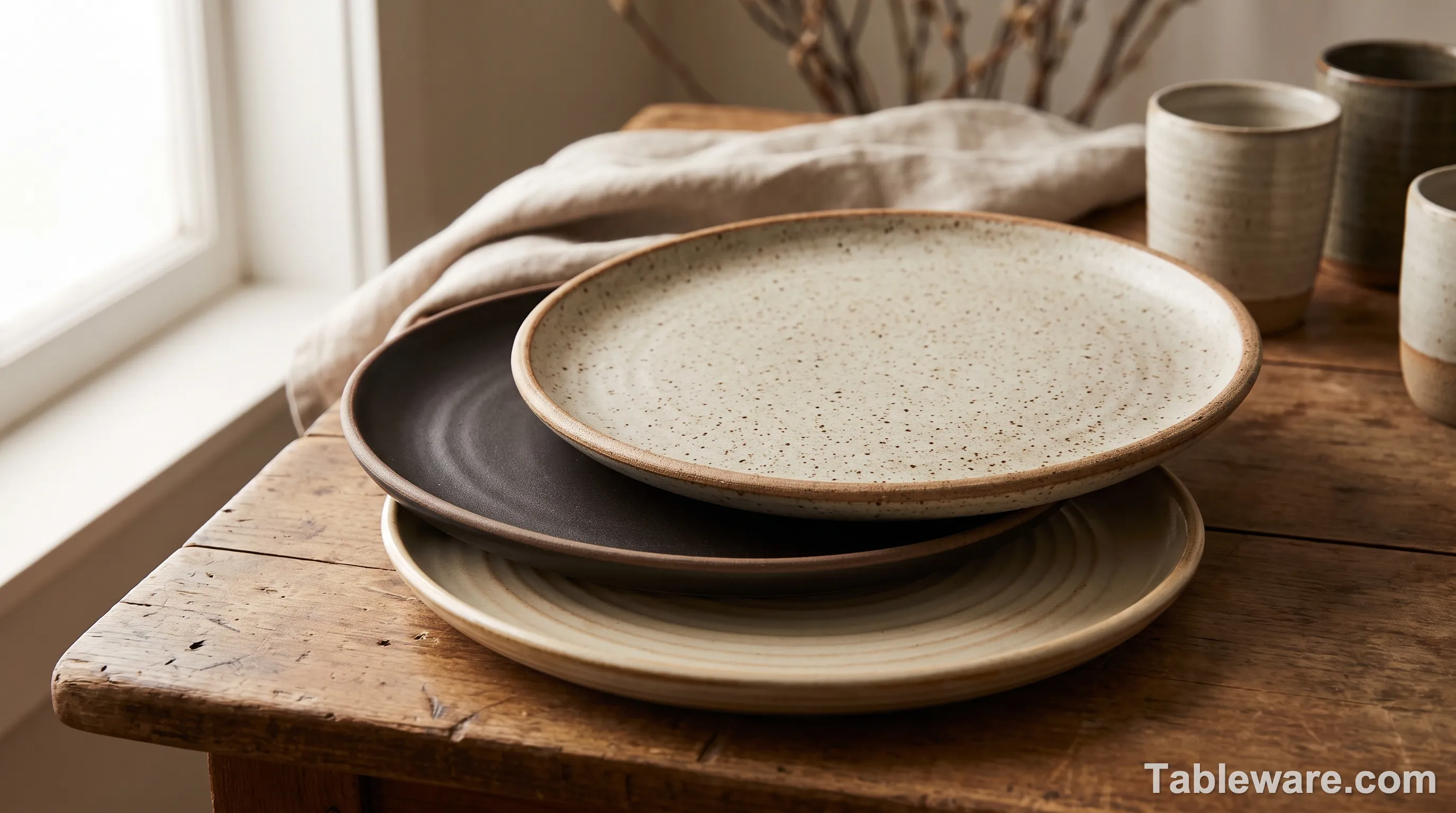
What you're actually buying: The core Coupe Collection is what made them famous. Dinner plates ($38–42), salad plates ($28–32), and bowls ($34–40) — all sold à la carte, no sets, no bundles, no "buy 4 get 1 free" nonsense. Each piece is thrown and trimmed by hand, then glazed in one of maybe a dozen colors that have names like "Cream" and "Moss" and "Charcoal." Nothing precious. The glaze coverage is intentionally imperfect — you'll see a finger mark or a thin spot on the rim, and that's the point.
The Alaska Bowl ($40) has become something of a cult object. Justine Doiron (Justine Snacks) did an April 2026 collaboration that sold out fast — two exclusive green-banded styles with a custom backstamp. It's the "everything bowl" shape: deep enough for pasta, wide enough for cereal, elegant enough to serve soup when your mother-in-law visits.
The durability question: Here's where Jono Pandolfi separates from the pack. These are legitimately tough plates. The clay body is a custom stoneware formula fired to cone 10 (~2,350°F), which produces a dense, vitrified body with near-zero absorption. Translation: they don't soak up water, they don't crack in the microwave, and they handle thermal shock from fridge-to-oven better than most.
More importantly, the glazes are formulated to survive a commercial dishwasher's 180°F rinse cycle without crazing. I've run mine through a Bosch dishwasher maybe 200 times now. No glaze cracks, no fading, no metallic marks from flatware. One edge chip from a particularly aggressive unloading incident — that one's on me.
The trade-off? Weight. These are substantial plates. A Jono Pandolfi dinner plate runs about 2.2 pounds. Stack six of them and you're feeling it in your wrists. If you have upper cabinets, measure — they won't fit in every standard dish rack.
Heath Ceramics: The California Icon
Heath has been around since 1948. Edith Heath started the company in Sausalito as a one-woman operation, and today it's practically a California institution — the dinnerware equivalent of an Eames chair or a Case Study House.
What you're buying: The aesthetic is mid-century modern distilled into ceramic form. Clean lines, gentle curves, and that signature exposed clay rim — the "wipe" — where the glaze stops just short of the edge, revealing the sandy, textured clay body beneath. It's a tactile detail that's become Heath's visual trademark.
The Rim Line and Coupe Line are the two main shapes. Rim is more traditional; Coupe is rimless and slightly more contemporary. Prices are roughly in line with Jono Pandolfi: dinner plates around $40–46, bowls $34–38.
The reality of living with Heath: Heath plates are beautiful objects. They're also thinner and lighter than Jono Pandolfi — about 1.6 pounds per dinner plate — which means they stack better and take up less room. But they're more fragile. I've had two Heath plates develop small edge chips from normal use over about three years. Not catastrophic, but noticeable.
The glaze quality is generally excellent, though I've seen batch-to-batch color variation that's significant enough to matter if you're buying across years. A "Moonstone" dinner plate from 2023 may not perfectly match one from 2025. Some people find this charming. If you're the type who gets annoyed when things don't match, buy everything at once.
Heath loyalists are loyal for a reason. The brand carries genuine design credibility. Put a Heath plate on your table and architecture nerds will nod approvingly. But there's also a quiet tolerance that Heath owners develop — for the price increases (they've gone up about 30% in five years), for the occasional irregularity, for the fact that the "handmade variation" some plates display is, let's be honest, sometimes just a glaze defect.
East Fork: The Asheville Cult Favorite
East Fork started in 2009 on an old tobacco farm outside Asheville, North Carolina. Alex and Connie Matisse (yes, that Matisse — Henri was her great-grandfather) built a brand that feels less like a ceramics company and more like a lifestyle. The Instagram following is rabid (over 250K). The seasonal color drops — "Panna Cotta," "Morel," "Soapstone" — create genuine hysteria. People set alarms.
What you're buying: East Fork's aesthetic is earthy, robust, and unapologetically chunky. These are thick-walled pieces — dinner plates around 2.4 pounds, with visibly irregular rims and a weight that feels substantial in hand. The glaze palette is what drives the collecting impulse: deeply saturated matte colors that photograph like a dream, released in limited seasonal batches.
Pricing is the most accessible of the three: dinner plates around $34–36, bowls $28–32. The Seconds Sale is legendary — deeply discounted pieces with minor glaze imperfections, first-come-first-served, often with lines around the block.
The reality: East Fork makes genuinely lovely pottery. The colors are undeniably gorgeous — "Panna Cotta" is the perfect warm off-white, "Morel" is a mushroom brown that makes every meal look like it belongs in a Kinfolk spread. But here's what the marketing doesn't emphasize: these plates are heavy and thick in a way that can feel inelegant. Stacking them is an arm workout. And the matte glazes, while beautiful, can develop a patina over time — slight staining from oils and acidic foods that doesn't wash off. It's not a defect, exactly. It's a characteristic. Whether you find it charming or annoying is a personality test.
The seasonal drop model also means that if you break a plate two years later in "Panna Cotta," you might never find a replacement. East Fork collectors have learned to buy spares. You've been warned.
Head-to-Head Comparison: The Five Dimensions That Matter
Let's get specific. Here's how these three brands stack up on the things you actually care about after the unboxing video excitement fades.
Durability & Daily Abuse Tolerance
Jono Pandolfi wins here, and it's not particularly close. These plates were designed for restaurants — for line cooks who don't have time to be precious, for dishwashers running at commercial speed and temperature. The cone-10 stoneware body and the glaze formulations are engineered for survival. East Fork is second — those thick walls are genuinely tough, though the matte glaze surface can show wear. Heath brings up the rear; beautiful but fragile, and edge chips are a known issue.
Design Versatility
Heath is the design gold standard. A Heath Coupe plate works in a SoHo loft, a Marin County Eichler, or a Brooklyn brownstone — it's the universal donor of dinnerware aesthetics. East Fork reads as more distinctly rustic-modern; it belongs in a farmhouse or a thoughtfully renovated craftsman. Jono Pandolfi splits the difference — it's honest and unfussy, with a neutrality that lets it disappear into the background of any table setting while the food takes center stage. That's exactly the point.
Price Per Place Setting
A dinner plate + salad plate + bowl combo runs roughly:
- Jono Pandolfi: $110–120
- Heath: $116–130
- East Fork: $90–100
East Fork is the value play, especially if you hit a Seconds Sale. But the real cost question isn't per-piece — it's how many you need and whether you'll be able to replace broken pieces five years from now. On that metric, Jono Pandolfi's stability (they've maintained the same core line for years) and Heath's permanence (75+ years in business) both beat East Fork's seasonal model. Break an East Fork bowl in "Soapstone" from summer 2024 and you're out of luck.
Stackability, Storage & Kitchen Footprint
Heath plates are the thinnest and lightest, so they stack the tightest. East Fork is the bulkiest — those thick rims eat cabinet space. Jono Pandolfi falls in the middle: substantial but stackable if you have standard-depth cabinets. If storage is tight and you're buying for 8–12 settings, Heath is the practical choice.
Brand Ethos & Intangibles
All three manufacture in the US. All three pay fair wages and talk about sustainability. But they feel different. Heath is an institution — there's a museum-like quality to the brand, a sense of legacy. East Fork is a community — the seasonal drops, the transparency about pricing and process, the active Instagram presence make you feel like you're part of something. Jono Pandolfi is quietly confident — no hype, no seasonal games, no "join the cult" messaging. Just plates that work, sold to people who cook.
I'll take quiet confidence over marketing every time, but your mileage may vary.
Verdict: Which Brand Belongs on Your Table?
If you want restaurant-grade durability and the most honest, unfussy aesthetic of the three, buy Jono Pandolfi. These are plates for people who cook seriously, host often, and want their dinnerware to outlive their kitchen renovation. The à la carte model means you can build your set piece by piece. No regrets.
If mid-century design credibility and the California aesthetic matter more than everyday durability, buy Heath Ceramics. There's a reason architects and designers love this brand. Just budget for occasional replacements and buy a complete set up front to avoid batch-matching headaches.
If color joy, approachable pricing, and collecting things makes you happy, buy East Fork. The seasonal drops are genuinely fun. The colors are sensational. Just understand you're signing up for a relationship with a brand that rewards early adopters and punishes latecomers.
The honest answer? Most people mix and match. I've got Jono Pandolfi dinner plates, East Fork bowls in "Panna Cotta," and a few Heath Coupe salad plates that I found at a sample sale. Nothing matches perfectly. Everything looks like it belongs together anyway. That's the real secret of handmade pottery — imperfection coordinates better than any factory set ever could.
FAQ
Are Jono Pandolfi dishes dishwasher safe?
Yes. And microwave-safe. And oven-safe up to about 350°F. They're designed for commercial kitchens where a Hobart dishwasher runs at 180°F rinse temps.
Is East Fork pottery lead-free?
Yes. All East Fork glazes are formulated without lead or cadmium and meet FDA requirements for food safety. The same is true for Jono Pandolfi and Heath Ceramics.
Can Heath Ceramics go in the microwave?
Yes. But avoid extreme temperature swings — don't go straight from the freezer to the microwave. The thinner body is more susceptible to thermal shock than the chunkier competition.
Which brand is most chip-resistant?
Jono Pandolfi, by a margin. The cone-10 firing and restaurant-grade glaze formulation make a measurable difference. I've chipped one in six months of daily use, and it was entirely my fault.
Do any of these brands offer open-box or seconds?
East Fork's Seconds Sale is the most famous — in-person events with deeply discounted pieces. Jono Pandolfi runs occasional Seconds Sales (April 2026 had one in LA). Heath has a factory store in Sausalito with seconds and overstock at roughly 20–30% off.