Your "White Stoneware" May Be Red Clay Under an Engobe Coat
I want to start with a confession. Six years ago, I bought a 12-piece dinnerware set online — stoneware, white glaze, hefty weight, made in Portugal. The price was $148, the photos looked like East Fork, and the seller's copy used words like "heirloom" and "stone-fired." It arrived in two layers of foam. Looked great. Felt right.
Then I flipped a plate over and looked at the foot ring.
There it was — a half-millimeter line of pale terra-cotta red peeking out from under the white glaze. Not a kiln flaw. Not a crack. The clay body was red, and the "white" was a coating. I'd been sold red earthenware in a stoneware suit.
That coating has a name. It's called an engobe. And once you know what to look for, you'll see it on roughly a third of the "white stoneware" sets on the market in 2026. Some of it is honest craft. Some of it is a cost-cutting trick dressed up as a glaze. This article is the field guide I wish I'd had that day.
What Is Engobe? The 3-Ingredient Recipe That Sits Between Slip and Glaze
If you've ever searched "what is engobe in ceramics" and landed on a forum thread that didn't quite explain it, here's the version you actually want.
An engobe is a clay-based coating, applied to a clay body, that's designed to be a different color, texture, or working surface than the body underneath. It's the middle layer of the ceramic sandwich.
The one-sentence definition: an engobe is a slip engineered to stick to a clay body of a different color and survive firing without flaking, crazing, or dissolving into the overglaze.
The three ingredients are the same ones in any clay or glaze recipe, just in different ratios:
- Clay (50–90% by dry weight) — usually kaolin (EPK), ball clay, or a blend. Kaolin gives a clean white; ball clay gives plasticity and stick. Commercial makers like Mayco (their Stoneware Engobe line, EG001–EG007) use a pre-blended kaolin ball-clay mix because it's predictable.
- Silica (5–25%) — fine silica or quartz flour. Tightens the body, reduces shrinkage cracks, and gives the engobe enough tooth to hold a carved line.
- Flux (5–15%) — feldspar (typically Custer or Soda), talc, or a low-fire frit. The flux is what lets the engobe "sinter" (fuse) onto the body without melting, and what helps it accept a clear overglaze without beading.
What makes an engobe an engobe, and not a slip or an underglaze, is the clay-to-flux ratio. Slip has more clay (slip is essentially liquid clay). Underglaze has less clay and more colorants plus a melt-promoter. Engobe sits in the dead middle — high enough clay content to mask the body, low enough flux to stay put under a clear glaze. The Ceramic Arts Network article Slips vs. Engobes puts it bluntly: if it's mostly clay and a little flux, it's an engobe. If it's mostly color and a little flux, it's an underglaze.
You'll also see the term barbotine in older European pottery books — that's the French word for engobe. Same thing, fancier name.
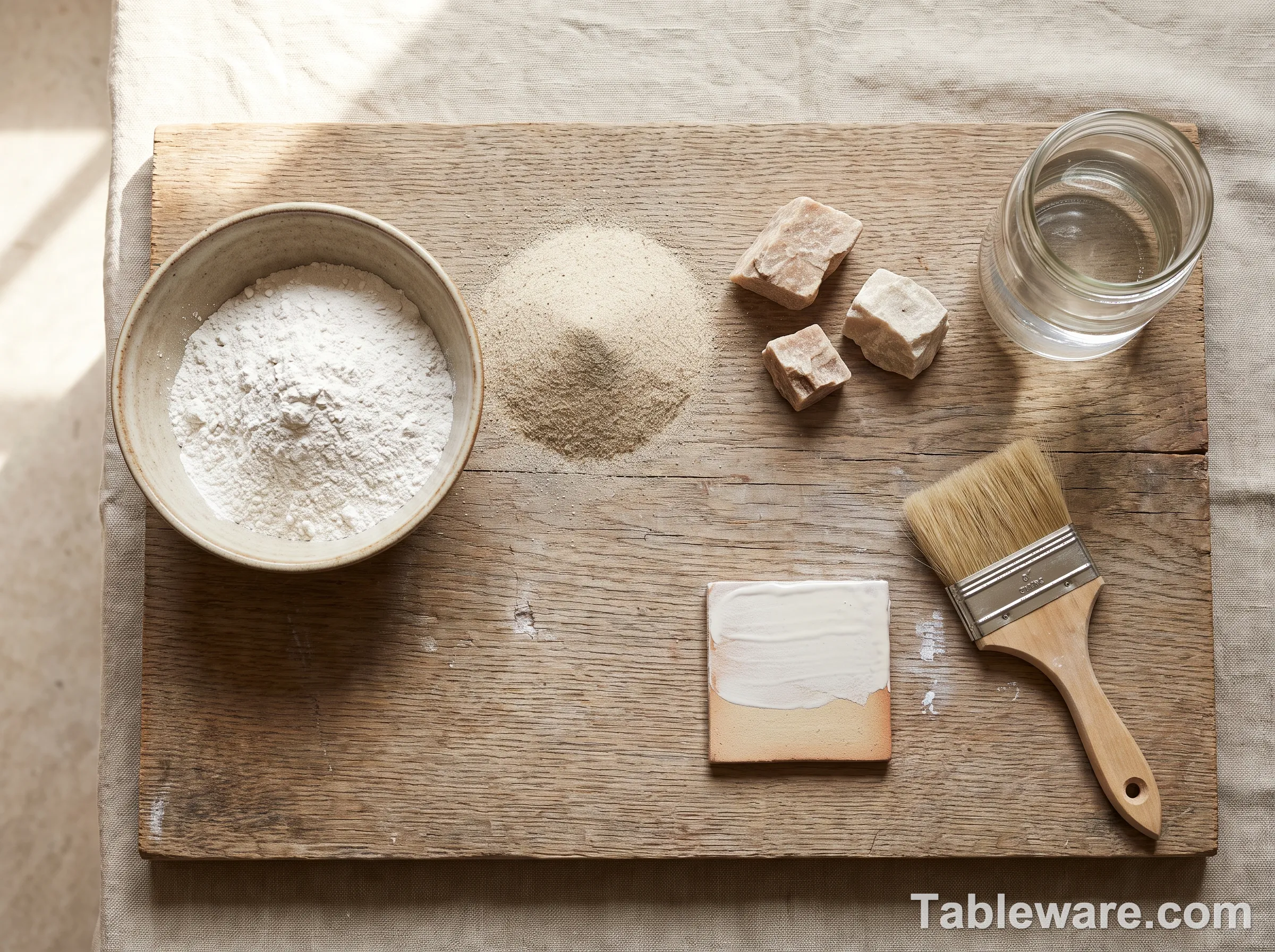
Fig 1. The 3-ingredient engobe setup — kaolin, silica, and a feldspar flux, plus a brush and a bisque tile. The dry materials weigh almost nothing; the recipe control is everything.
The White-Stoneware-That-Is-Really-Red-Clay: How Engobe Fools Buyers
This is the section I wish had existed on every product page in 2020.
The "foot-ring test" is the single most reliable way to spot an engobe on a finished plate, bowl, or mug. Pick up the piece. Look at the unglazed ring on the bottom (the foot ring is where the piece sat in the kiln, and it almost always stays unglazed for stability). The foot ring is the clay body in its raw form. If the foot ring is pale terra-cotta red, orange, dark brown, or warm gray — but the interior and rim are bright white — you've almost certainly got a red clay body with a white engobe and a clear glaze on top.
You'll see this exact pattern on budget-to-mid-tier stoneware from IKEA 365+, Threshold (Target house brand), most of the Gibson Soho line, and a huge amount of the private-label "stoneware" you'll find on Amazon under names like Moss & Maple, Amalfi Coast, or Ainsley. Some of these are honest about it on the back stamp — others just call themselves "stoneware," which technically they are (the body fires in the stoneware range), but the "stoneware-ness" the buyer thinks they're getting is the white slip layer, not the clay.
Why commercial dinnerware uses this
The economics are not evil, honestly. Red earthenware clay (terra rossa, terra cotta) is cheap, abundant, easy to throw or press, and forgiving in the kiln. It fires at a low cone (04–06) without drama. White stoneware clay (like a true porcelain body) is expensive, harder to throw, sensitive to temperature swings, and cracks if you look at it sideways during drying. So a maker who wants a "white" product at a $30 retail price point reaches for red clay + white engobe + clear glaze every single time. It's the rational cost-engineering move.
Where I get grumpy is the marketing copy. When a product page says "premium stoneware, natural white finish, kiln-fired at 1280°C," and the actual body is red earthenware fired at 1080°C with a white slip — that's not a finish, that's a mask. The buyer paid for a property of the clay that doesn't exist in the clay.
The foot-ring test, in one line
If the foot ring is a noticeably different color than the glazed surface, the difference is the engobe. Period.
There's a second test for mugs and cups: hold the piece up to a strong light. If the unglazed foot or rim flashes orange under direct light, but the glaze fires white, same answer.
There's a third test, and this is the one collectors use: tap the piece with a fingernail or a wooden dowel. Red clay + white engobe has a slightly duller ring than a true porcelain or true white stoneware. The clay body controls the resonance more than the glaze does, and red earthenware rings like a muted bell — chalky, short. True white stoneware rings longer and clearer. It's not a perfect test, but if you've handled enough pieces, you can hear the difference.
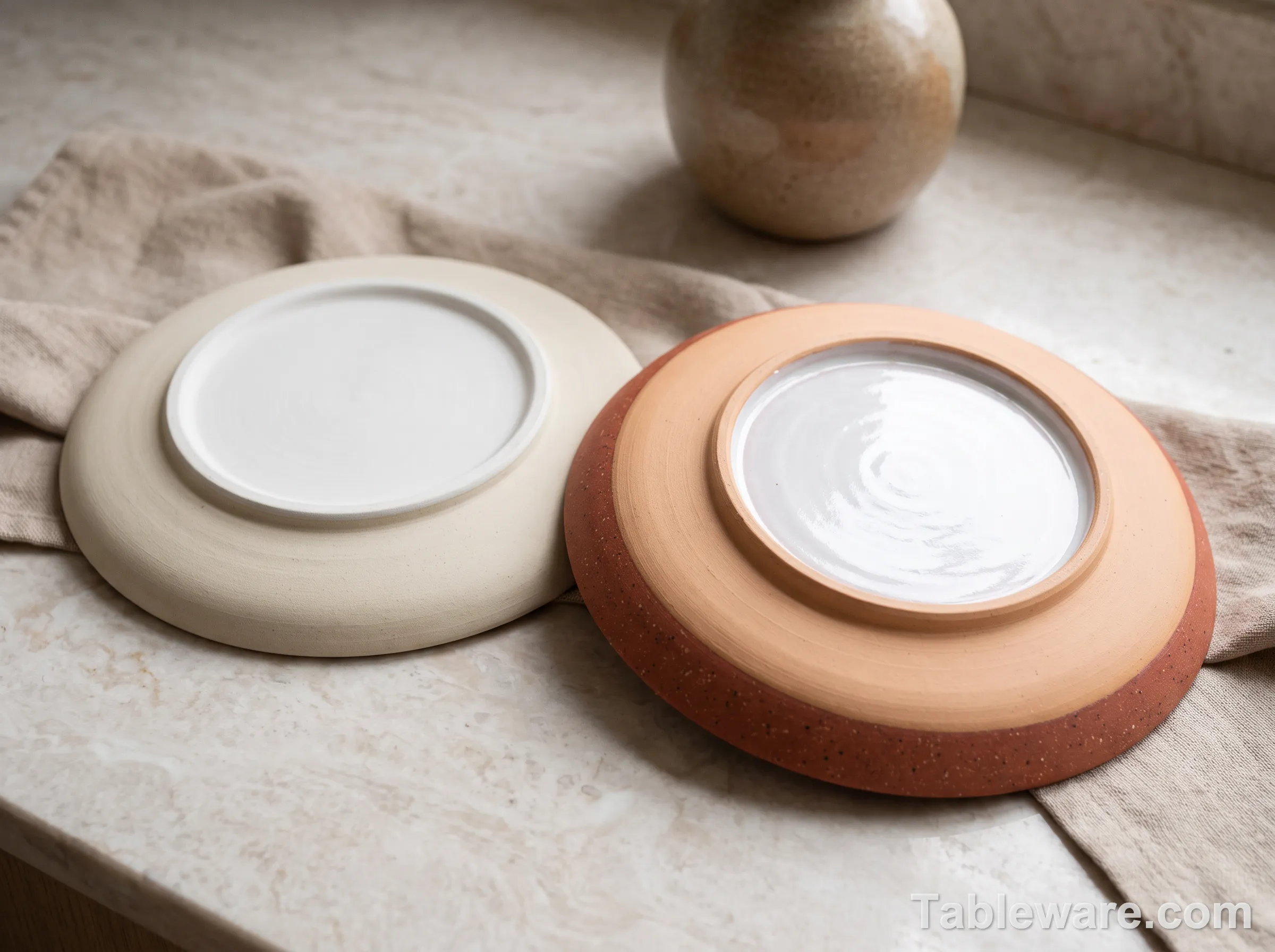
Fig 2. The foot-ring test, side by side. Left: a true white stoneware body — the unglazed foot ring is the same color as the glazed surface. Right: red earthenware body masked by a white engobe and clear glaze — the foot ring gives the game away.
Engobe vs Slip vs Underglaze: How to Tell the Three Apart
People mix these up constantly. Pottery blogs mix them up. Some pottery teachers mix them up. Here's the actual table.
| Property | Slip | Engobe | Underglaze |
|---|---|---|---|
| Clay content (dry) | 90–100% | 50–90% | 10–30% |
| Flux content | 0–5% | 5–15% | 20–60% |
| Colorant content | trace–low | low–medium | high |
| Firing stage | greenware or bisque | bisque | bisque (or greenware for low-fire) |
| Usually covered by glaze? | rarely | yes, transparent | yes (or left matte) |
| Typical use | joining, casting, slip-trailing, sgrafitto substrate | masking body, color base, sgraffito base | decorating, line work, painting |
The clay-content column is the giveaway. If a coating is mostly clay, it's a slip — and slips are usually the same color as the body (because the body and slip are basically the same recipe in liquid form). If a coating is mostly color and flux, it's an underglaze — and underglazes are designed to be the visible decoration layer. Engobes are the things in the middle: enough clay to mask, enough flux to survive, and almost always a clear glaze over the top.
A related term you'll see: slip trailing. That's not a separate material — it's a decorating technique where you use a slip (or a thick engobe) inside a squeeze bottle or a slip trailer to draw lines on the surface before glazing. The Deco-style art pottery you see from the 1920s — Roseville, Weller, Van Briggle — is mostly slip-trailed over a colored body. (Note: sgraffito is the carved version, where you scratch through the layer to reveal the body color underneath. We covered sgraffito in detail in the sgraffito guide — same chemistry, opposite direction.)
How to Apply Engobe in 4 Stages (Without Cracking or Flaking)
If you're a maker — or you're commissioning a custom run — this is the part that matters. Engobe is a friendly material, but it's a friend with rules.
Stage 1: Mix to 1.45–1.50 specific gravity
Mix the dry engobe powder into water until a hydrometer reads 1.45–1.50 SG. That's the standard window for brushing; for dipping, drop to 1.40; for spraying, drop to 1.35. Most beginners make the mistake of mixing to a "milky" consistency and calling it done — the result is a too-thin coat that does nothing for masking, and the maker adds three more coats and then wonders why it's cracking in the bisque. Use a hydrometer. They're $14 on Amazon and they save you from every guess.
If you don't have a hydrometer, the gravity test is: dip a freshly-glazed greenware brush in, pull it out, and watch the drips. One long drip per second from a 1-inch brush is about right for brushing. Faster than that and it's too thin.
Stage 2: Two thin coats on leather-hard or bisque greenware
The "two thin coats" rule is the most-cited rule in ceramic supply manuals, and it's the most-violated one in studio practice. Apply the first coat, let it dry until the color shifts from wet-dark to matte (15–40 minutes depending on humidity), then apply the second coat. Don't try to do it in one thick coat. Thick coats shrink. Engobe shrinkage is the #1 cause of "engobe flaking off" complaints online.
You can apply to leather-hard (the clay is still damp, like firm cheese) or to bisque-fired greenware (the clay has been fired once, around cone 08, to harden it). Leather-hard gives better chemical bonding; bisque gives you more working time. Most commercial operations go bisque because the production line is more predictable.
Stage 3: Carve, sgraffito, or leave alone
If you want a solid white surface that just looks like white stoneware, leave the engobe alone and move to glazing. If you want pattern, this is the moment. Carve through the engobe with a needle tool or a loop tool to expose the body color underneath — that's sgraffito. Paint a second colored engobe over the first and then carve through both — that's Mishima (a Korean tradition, named after the city). Use a slip trailer to draw on the surface — that's slip trailing, again same as sgraffito but additive. All of these are engobe decoration; the only difference is direction of action.
Stage 4: Bisque, then a transparent or compatible glaze
Engobe has to be fired twice: once in the bisque to lock it in, then again under a transparent (or compatible colored) overglaze. The transparent overglaze is what seals the engobe to the body, gives the food-safe surface, and adds the depth that makes the engobe look like part of the body rather than a coat of paint. Without the overglaze, engobe is technically food-safe in a vitrified body, but it stains and scratches. With the overglaze, it lasts decades.
The most common commercial overglaze pairings with engobe are a clear gloss (for that "white stoneware" look) or a satin matte (for the matte-stoneware trend that 2024–2026 has been obsessed with). East Fork's matte glazes over a white engobe is the textbook example — and a good one, because they use a true white stoneware body, so the engobe is decorative insurance, not a body-mask.
5 Ways Engobe Hides the Clay Body (And Why Sgraffito Is the Most Beautiful)
Engobe is a tool, and like any tool it can be used honestly or as a sleight of hand. Here are the five main ways it shows up on finished tableware, in roughly increasing order of "I'm glad they used it."
Solid color masking — the entire body is covered in a single white (or cream, or gray, or black) engobe, then clear-glazed. The piece looks like white stoneware but is actually red clay. This is the most common use and the most argued-about. Cost-driven, but not dishonest if the maker says so.
Sgraffito — the surface is covered in a colored engobe (white on red, black on white, blue on buff), then the maker carves lines or patterns through it to expose the body. The result is a two-tone decorative surface. The classic Mishima is a Korean variant where the carved lines are then inlaid with a contrasting engobe and scraped flush. This is craft. The piece is more beautiful for the engobe, not less.
Marbling — two or more colored engobes are poured, trailed, or swirled together before the overglaze fires them in. The pattern is unique to the piece. This is the technique behind much of the 1960s–70s West German Fat Lava pottery (Scheurich, Ruscha, Bay Keramik) — the colored "fat" glaze is actually three engobes marbled together. The pieces are gorgeous and absolutely not "stoneware" in the body — they're red earthenware with a marbled engobe and a thin overglaze.
Hakeme — a Japanese technique where a thick white slip (technically an engobe) is applied with a wide brush in broad, irregular strokes, leaving patches of the dark body exposed. The result is a textured, painterly surface. Mino ware kilns (see the Mino ware guide) used Hakeme as a signature look on tea bowls in the 16th century. The visual is so strong that modern potters in the same tradition use the same technique on dinnerware in 2026.
Mishima inlay (Kintsugi-adjacent) — colored engobe inlaid into a carved sgraffito pattern, then scraped flush and clear-glazed. The visual is sharp two-color geometric. Modern studio potters like East Fork's studio line and Heaths's older production work use this. It's craft and it shows.
Of the five, sgraffito is the one I'd put on a wall. Hakeme is a close second. Solid color masking is the one I'd want to be told about before I buy.
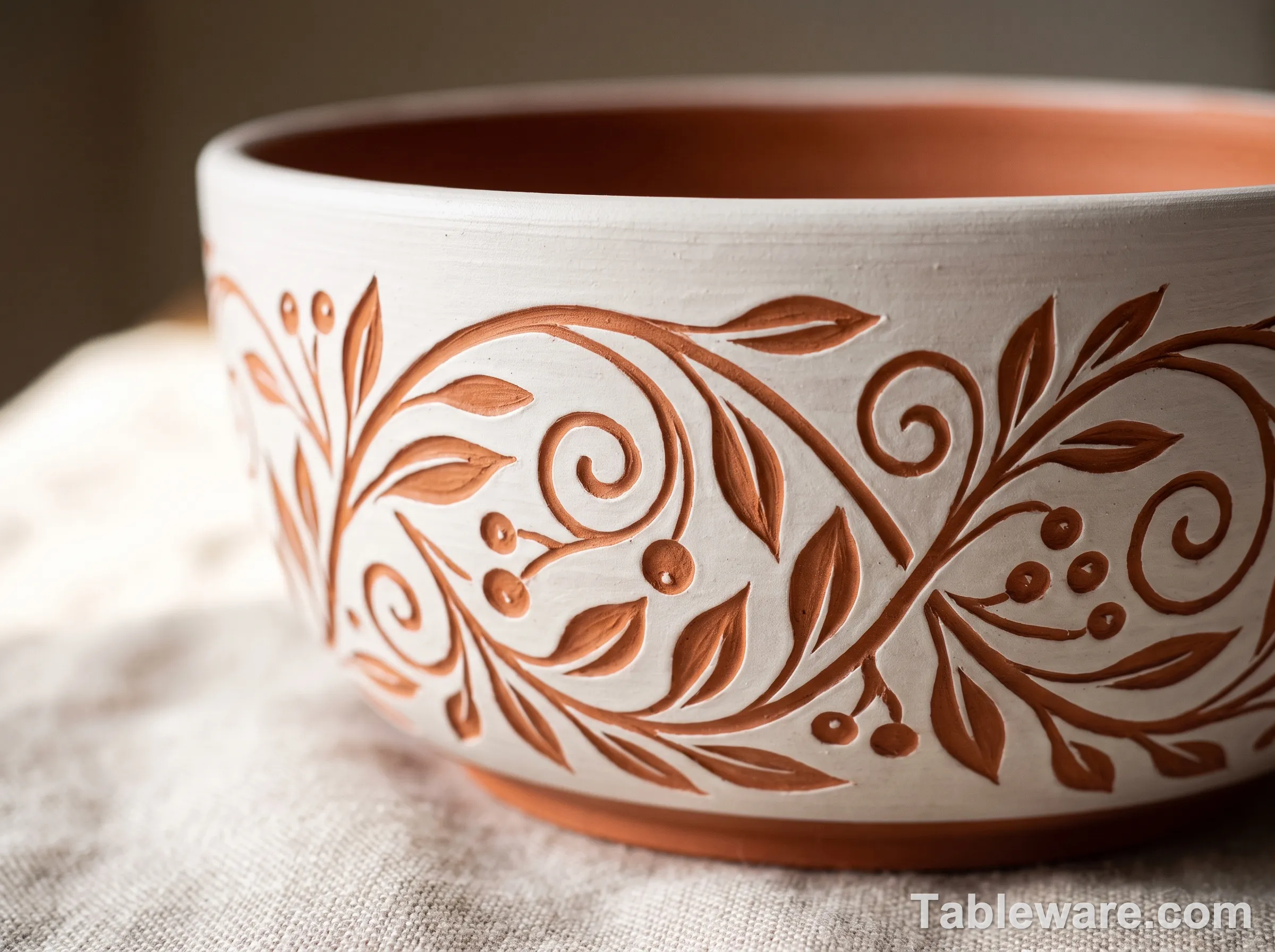
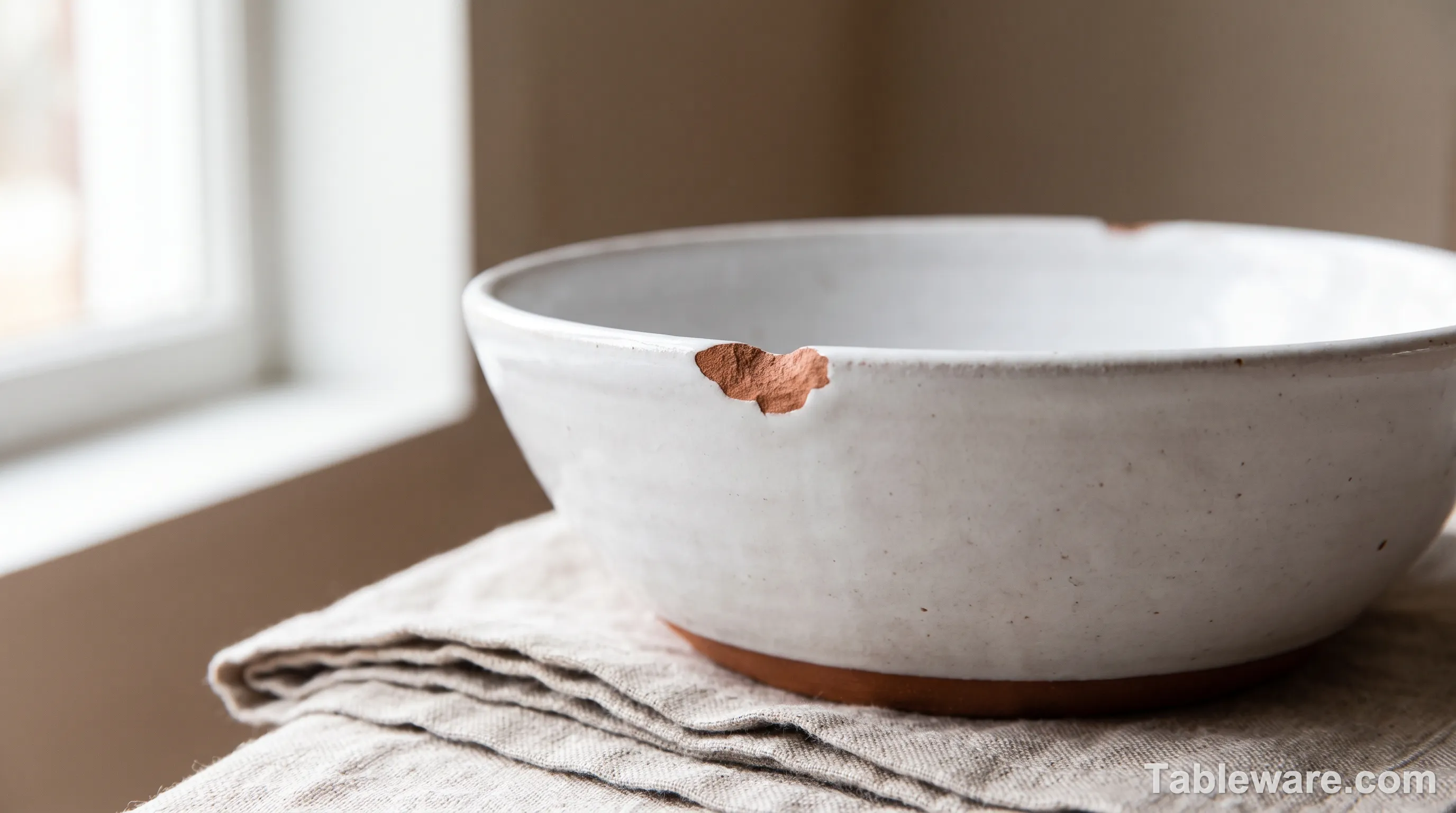
Fig 3. A sgraffito-decorated bowl — hand-carved vines scratched through a white engobe to expose the red body underneath. This is the most beautiful use of engobe, and the easiest way to tell a hand-decorated piece from a decal-printed one.
Why Engobe Cracks or Flakes — And the 3 Fixes That Actually Work
Engobe failures are the single most-discussed topic on r/Ceramics and Studio Potter forums. Three causes, three fixes. This is the diagnosis flowchart.
Cause 1: Mismatched shrinkage. The engobe shrinks at a different rate than the body. The bond breaks. You see the cracks as soon as the piece comes out of the bisque. The fix is to test the match on a small tile before you commit a full set. Mix a small batch, apply it to a 4×4 tile of the body, bisque, glaze, fire to maturity, and look at the tile. If the tile shows cracks at the edges, change the recipe (more kaolin, less ball clay) or change the body. This is the same problem as glaze-crazing but in reverse.
Cause 2: Bone-dry greenware. You applied the coating to greenware that was too dry, and the engobe dried faster than the body underneath. The body still wanted to shrink; the layer was already locked. The fix is to apply to leather-hard greenware, mist the piece lightly with water before applying, and let it dry slowly under loose plastic for 12–24 hours after application. Patience wins.
Cause 3: Wrong firing cone. The recipe is designed for cone 6, the kiln fired to cone 10, and the engobe melted into the overglaze. Or the engobe is designed for cone 04 and the kiln only reached cone 08, so the coating never matured. The fix is to read the spec sheet, use witness cones, and stop trusting the digital kiln controller to be right. Witness cones cost $0.40 each. Buy a pack of 200 and use three per firing.
The general rule: if the engobe is failing across multiple pieces, you have a process problem (mixing, application, or firing). If the engobe is failing on one piece out of a batch of fifty, you have a piece-specific problem (the greenware was too dry on that one, or the kiln had a cold spot). Diagnose from the spread.
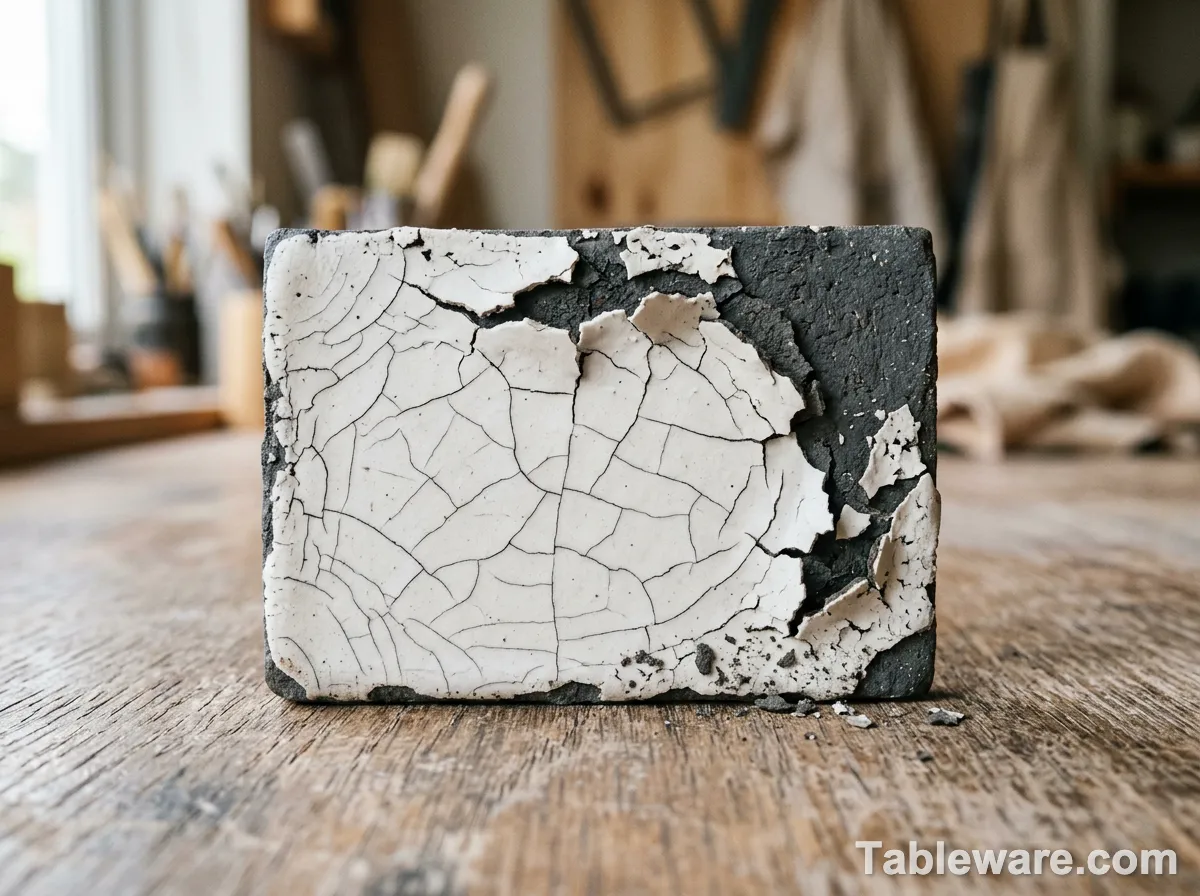
Fig 4. Engobe cracking and flaking on a test tile — the classic result of a clay-content mismatch between the engobe and the body. When you see this on a finished piece, the body and the engobe disagreed on how much to shrink, and the engobe lost.
How to Buy Pottery That Isn't an Engobe Trick in Disguise
Here's the buyer-side checklist. Three questions, in order.
Question 1: What color is the foot ring? If the foot ring is white or pale gray, you're probably looking at a true white body. If the foot ring is orange, red, or warm brown, you're looking at red clay under an engobe. That's the foot-ring test, in buyer form. Most product photos don't show the foot ring, which is itself a tell — the honest makers photograph it.
Question 2: Does the back stamp tell you the body type? A good back stamp says "porcelain," "white stoneware," "red earthenware," or "terracotta." A vague back stamp says "stoneware" (which, legally, can mean anything that fires above cone 04) or "ceramic" (which means nothing). If the back stamp is uninformative, the maker is choosing not to inform you. Move on or ask.
Question 3: Does the price match the body? True white stoneware dinnerware in a 12-piece set starts at roughly $180 retail in 2026. Porcelain starts at $250. Red earthenware with an engobe and clear glaze is $40–$120. If the price is at the low end and the product page says "stoneware" without saying "white," you're looking at the masked-red-clay pattern. Which, again, isn't bad — it's just not what the price implies.
There's an honest version of the red-clay-with-engobe product. Some of the best-looking dinnerware in the world is red clay with a white engobe and a clear glaze. Mediterranean and Portuguese pottery traditions have done this for centuries, and the pieces are gorgeous and durable. The issue isn't the material — it's the marketing. If the maker says "red clay body, white slip coating, transparent glaze," that's transparency, and I will happily pay for the result. If the maker says "white stoneware" and the foot ring is orange, the maker is choosing to hide the material. That's the line.
A small list of makers who use the technique honestly: most of the production stoneware from Portugal (Vista Alegre, Costa Verde, some Bordallo Pinheiro); much of the Mexican and Italian majolica-tradition work; the East Fork studio line; a meaningful chunk of the Japanese Mino ware tradition; and basically every studio potter you'll find at a craft fair who has a stamp on the bottom that says the body type. Look at the bottom. Read the stamp. Buy with eyes open.
That's the whole field guide. Engobe isn't a secret — it's a real material with a real history, used by real potters for real reasons. The trick is knowing it's there.
And yeah, the orange ring on the bottom of that Portuguese set? I still use it. It's a great set. I just paid for what it actually is, not what the listing said.
FAQ: Engobe in Ceramics
What is engobe in ceramics, in one sentence? A clay-based coating applied between the body and the glaze to change the surface color, texture, or working area, without changing the body underneath.
Engobe vs slip — what's the actual difference? Slip is mostly clay (90–100%) and is usually the same color as the body. Engobe is a clay-flux blend (50–90% clay) engineered to mask the body, accept a clear overglaze, and survive firing. Slip joins, casts, or trails. Engobe covers, masks, and decorates.
How do you apply engobe to pottery in 4 steps? Mix the dry recipe to 1.45–1.50 specific gravity for brushing (1.40 for dipping, 1.35 for spraying). Apply two thin coats to leather-hard or bisque greenware, letting the first coat matte-dry before the second. Carve, sgraffito, or leave plain as the surface. Bisque-fire, then fire again with a transparent (or compatible colored) overglaze to cone 04–6 depending on the recipe.
Can you put white engobe on red clay terracotta? Yes — that's the most common commercial use. A red earthenware body, coated in white engobe, covered with a clear gloss glaze, reads as "white stoneware" to most buyers. Look at the foot ring to tell.
Is engobe food safe? An engobe that has matured to its target cone, fully fused to the body and sealed under a food-safe clear glaze, is food safe. A raw, unglazed, or under-fired engobe surface is not.
Why does my engobe keep flaking off the pot? Three usual causes: the recipe and the body are shrinking at different rates (mismatch); the greenware was too dry when you applied it; or the kiln didn't reach the engobe's target cone. Diagnose by firing a 4×4 test tile before committing a full batch.