Mino Ware: Why Most "Japanese" Plates Are Actually Mino Ware (and Why It Matters)
Pop into any mid-range sushi place in Brooklyn, Austin, or Portland. Look at the matte-cream plate your sashimi lands on. Look at the chopstick rest. Look at the soy sauce dish.
There's a solid chance — somewhere between 50% and 70%, by my best estimate — that what you're eating off is Mino ware. Made in Toki City, Gifu Prefecture, fired in kilns that have been running, with a few interruptions, since around 700 AD. Sold under a thousand restaurant supply labels, sometimes stamped with names that have nothing to do with Mino, Arita, or any of the famous pottery towns. It's the most common Japanese dinnerware on the planet, and almost no American buyer has heard the name.
That gap is what this article is for.
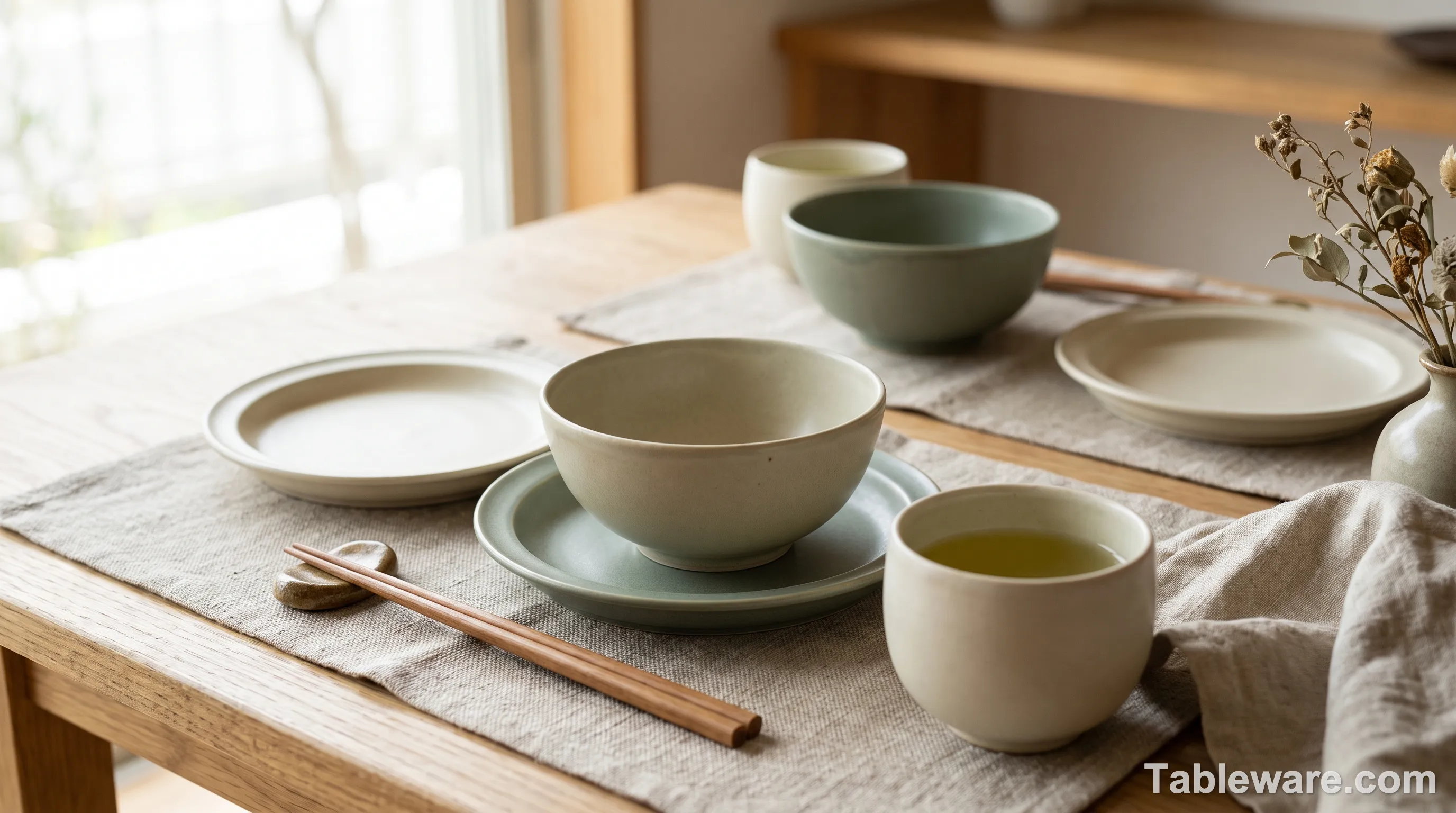
Fig 1. A typical Mino ware table setting — matte cream, soft sage, slightly uneven glaze, the visual signature of Toki City factory production that fills most Japanese restaurant tables.
I've been collecting Japanese pottery for about nine years, and Mino ware is the one I keep coming back to. Not because it's the fanciest — it isn't. Because it does something almost nothing else does at the price: it looks like it was made by a person, holds up to a dishwasher, and costs $6 to $40 a plate instead of $200. If you want the short version: Mino ware is the workhorse of the Japanese table, and the fact that you've probably eaten off it without knowing is a story worth telling.
What Is Mino Ware? (And Why You've Probably Eaten Off It)
Mino ware (美濃焼, minoyaki) is the umbrella name for ceramic tableware, teaware, and tiles produced in the southeastern part of Gifu Prefecture, centered on Toki City. It covers everything from a $4 ramen bowl to a $4,000 antique tea caddy. According to the Toki City Pottery and Porcelain Cooperative, the region produces roughly 60% of all Japanese tableware by volume — that's the "60% stat" you see in industry write-ups, and it's roughly what most producers will confirm off the record.
The reason it dominates isn't romantic. Toki sits on a thick seam of high-quality pottery clay, has easy rail access to Osaka (the wholesale hub), and has a kiln tradition that goes back over a thousand years. When the post-WWII Japanese restaurant boom hit, Mino was the place that could scale. Arita, Kutani, and Kyōto workshops all stayed craft-focused. Toki industrialized. Both decisions made sense for their times, and both still define what you find on shelves today. (For the broader context on why most modern dinnerware is stoneware and what that body composition does for daily use, our stoneware guide covers the same material story in more depth.)
A 1,300-Year Timeline in 90 Seconds
Mino ware is usually dated from the late 700s, when Sue ware kilns (originally from the Korean peninsula) set up in what is now Gifu. The early kilns produced storage jars, not tableware. Tea ceremony arrived in the 1300s and changed everything — Shino and Yellow Seto glazes were developed specifically to please the tea masters of the Muromachi and Momoyama periods. Oribe came next, around 1580, with its wild green glaze and irregular shapes. (Raku was the contemporary of Mino in the same tea-ceremony moment — our Raku firing history piece walks through the same Momoyama era from the other side of the kiln.)
Then, kind of surprisingly, the tradition went quiet for about 200 years. Mass production didn't restart until the Meiji era (1868–1912) opened export markets. By 1955, the region was producing millions of pieces a year for the domestic restaurant industry. Today, there are over 1,500 Mino ware producers in Toki City alone, and about 1,000 of them have been designated dentō kōgeihin — Traditional Craft Products — by the Japanese Ministry of Economy, Trade and Industry (METI).
Where Mino Ware Comes From: Toki City and the Gifu Kilns
Toki City is not on the typical Japan tourist route. No bullet train stop, no major airport. It's an hour south of Takayama by local train, two hours from Nagoya, set in a basin surrounded by low green mountains. The clay seam runs under about a third of the city, and the groundwater chemistry is right for the soft, slightly off-white bodies that Mino ware is known for.
If you've ever wondered why a region this small produces so much of Japan's dinnerware, the answer is: clay, water, fuel, and a head start. The original kilns used pine from the surrounding hills as fuel. Modern kilns use natural gas, but the mineral profile of the local water still affects glaze chemistry in ways that mass producers from Arita can't quite copy.
The Six Ancient Kilns (Rokkoyo) That Started It All
Mino ware is one of the Rokkoyō (六古窯) — the Six Ancient Kilns of Japan — alongside Seto, Tokoname, Echizen, Tamba, and Shigaraki. These are the six medieval kiln sites that kept Japanese ceramic tradition alive between roughly 1200 and 1600. Mino is the only one that became a mass-production center; the others stayed craft-focused. So when you read that Mino ware is "ancient," it's not marketing — it's literally one of the founding six. It just happens to be the one that industrialized.
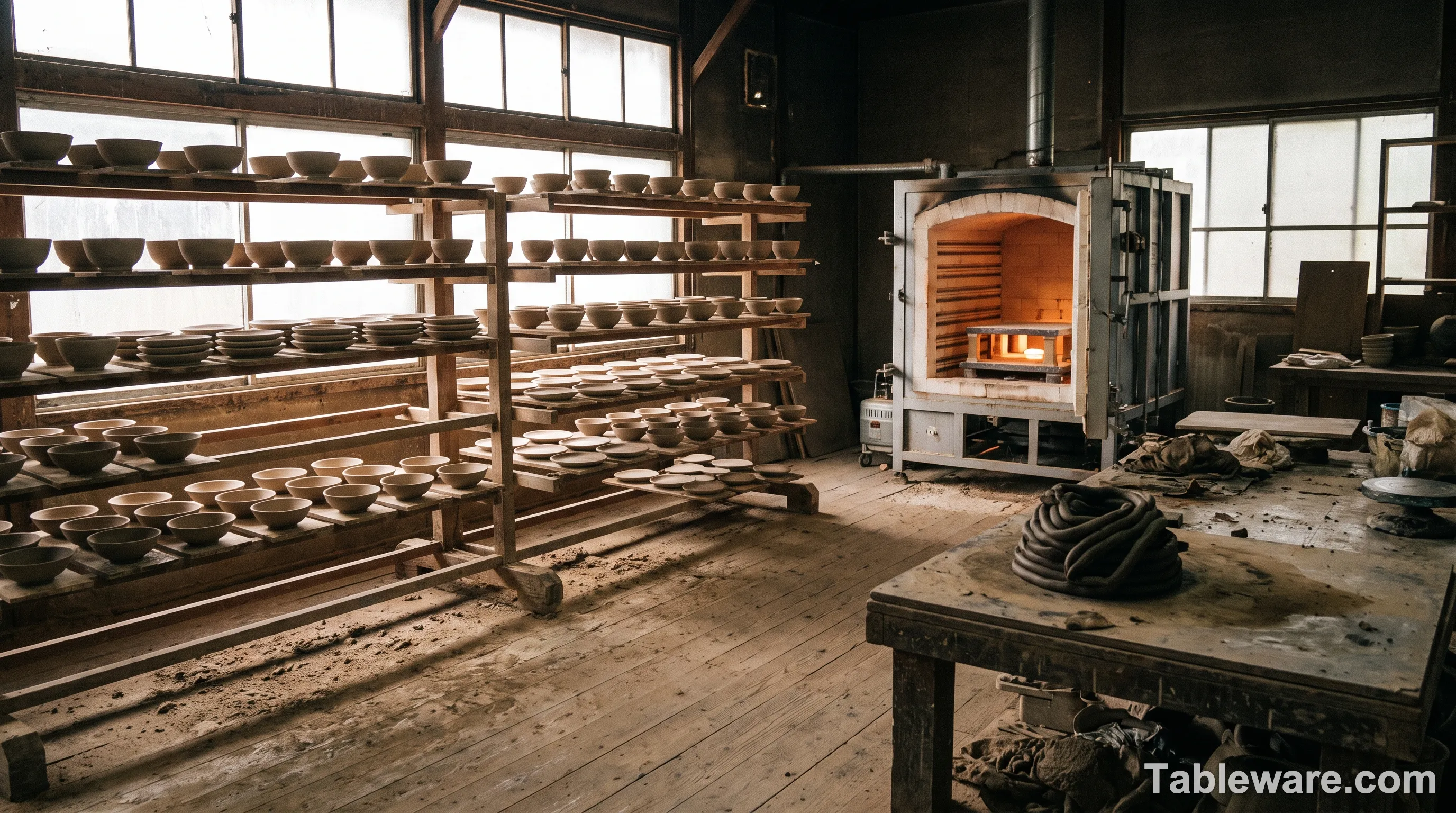
Fig 2. A traditional Toki City pottery workshop — unglazed pieces drying on wooden shelves, a gas kiln in the background. The same basic layout has been used in this region for over 1,000 years.
The 7 Types of Mino Ware: Shino, Oribe, Yellow Seto, and More
This is where most Western guides fall apart. "Mino ware" gets used as a catch-all, and then someone tells you there are "many types" and lists seven Japanese names you've never seen in a sentence. Let me save you some time.
Here are the seven types that actually matter, in the order most collectors learn them:
1. Shino (志野) — A thick, often pinholed white or off-white glaze, originally developed in the late 1500s for tea ceremony. The "Shino" look has slight orange or pink blushes from iron in the clay. Most Shino on the US market is Iro-Shino (colored Shino), which is essentially a 20th-century studio invention. Real Momoyama-era Shino is rare and expensive.
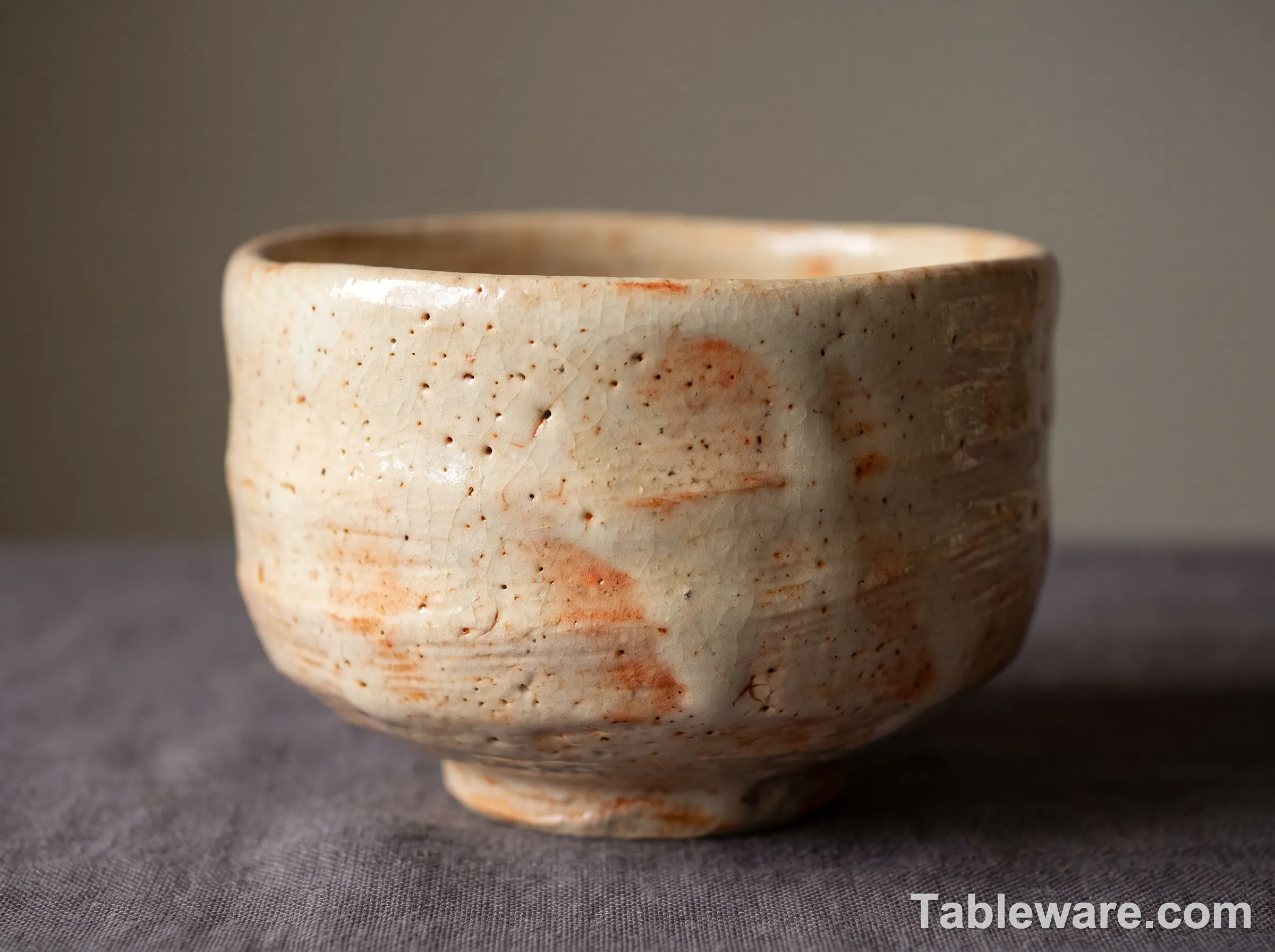
Fig 3. A close-up of a Shino ware bowl — the thick, slightly pinholed off-white glaze with a faint warm blush from the iron in the clay. The brush marks and small pits are not flaws; they're the visual signature of the technique.
2. Oribe (織部) — A copper-green glaze that ranges from dark forest green to almost black, usually with irregular shapes. The original Oribe was a tea master (Furuta Oribe) who wanted teaware that broke all the conventional rules — asymmetry, dripping glazes, rustic forms. Modern "Oribe-style" pieces copy the glaze but use dinnerware forms.
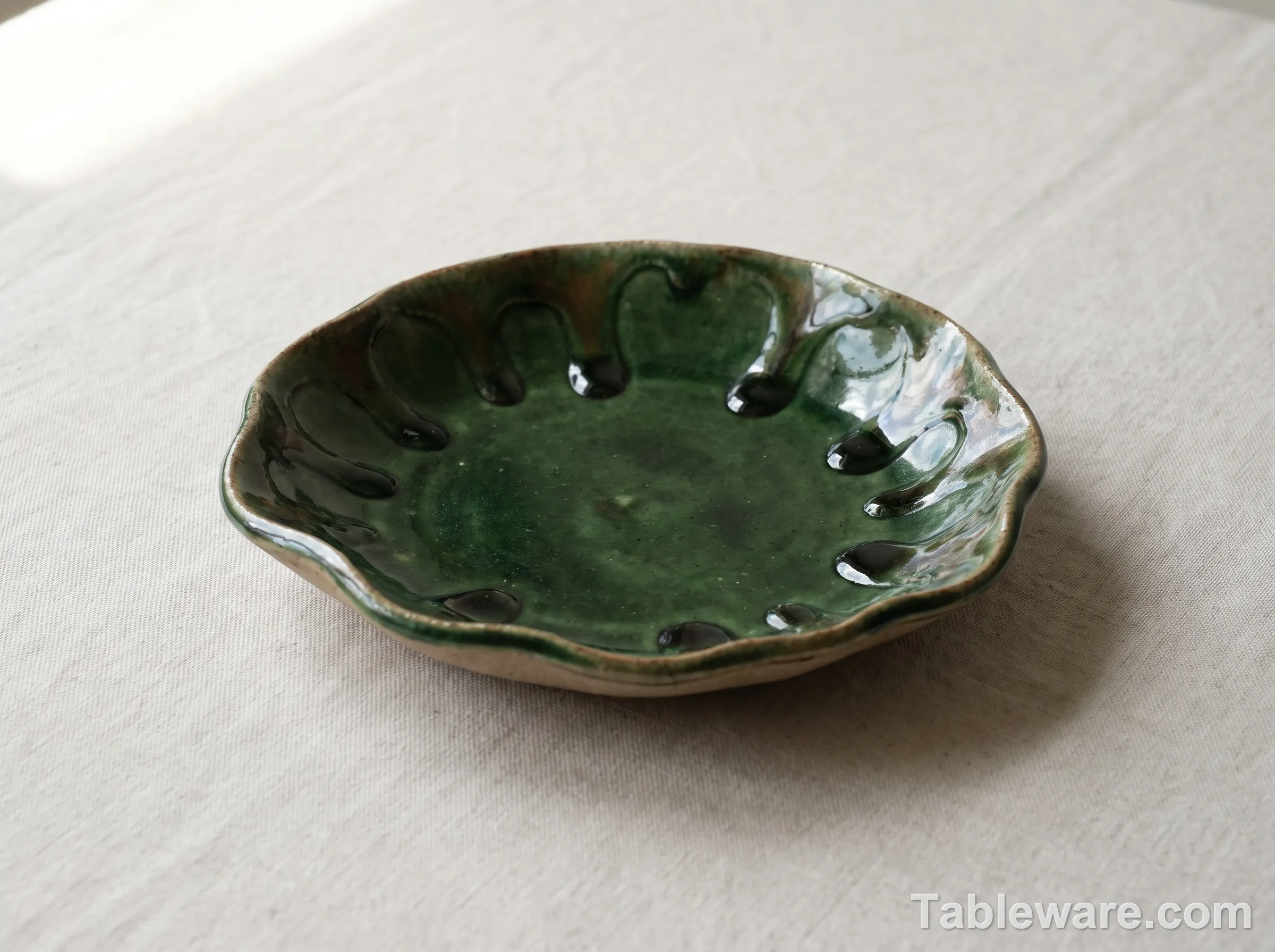
Fig 4. The signature copper-green Oribe glaze, with the dark drips where the glaze pooled during firing. This is the original Momoyama-era aesthetic most "Japandi" dinnerware is trying to copy.
3. Yellow Seto (黄瀬戸, Kiseto) — An iron-amber glaze over a white body. Softer looking than Shino, often with a slightly greenish edge. The "yellow" in the name is more of a warm beige in real life.
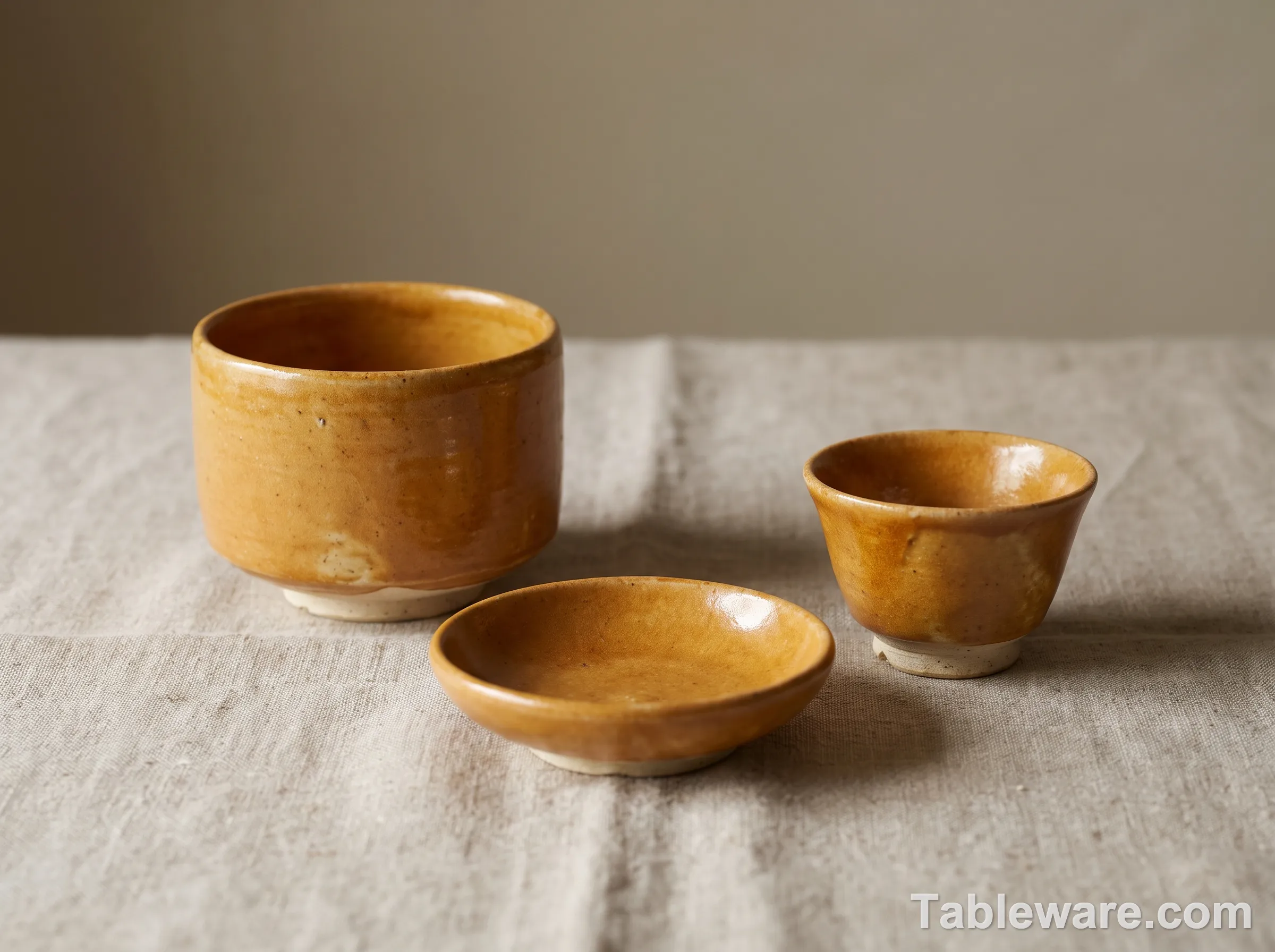
Fig 5. A trio of Yellow Seto (Kiseto) pieces — the iron-amber glaze over a slightly off-white body. The slight color variation between pieces is normal, and it's what collectors look for.
4. Black Seto (瀬戸黒, Setoguro) — A black glaze achieved by pulling pieces out of the kiln while still hot and smothering them in reduction smoke. Looks like wet stone. Used almost exclusively for tea ceremony.
5. Namako (海鼠) — A deep blue-green glaze named after sea cucumber (because the color resembles one). Often paired with white slip patterns. The "Japandi" green plates you see on Instagram are almost all Namako-style.
6. Iro-Shino (色志野) — The "colored Shino" — Iro-Shino takes the original Shino and adds copper, iron, or cobalt for greens, ambers, and blues. This is the dominant Shino variant in modern production.
7. Modern Hybrids / Glazed Stoneware — The biggest category by volume. Factory-produced dinnerware using Mino clay, fired in modern gas kilns, with predictable glazes: cream matte, sage green, indigo, soft pink, charcoal. This is what most restaurants use and what you find at MTC Kitchen, Webstaurant, and most "Japanese-style" importers. (Most of these modern pieces are slip-cast rather than hand-thrown — our hand-thrown vs slip-cast vs pressed breakdown explains why that production method matters for everyday durability.)
That's it. Seven types. The first six are the historic ones; the seventh is what's actually filling restaurant shelves in 2026. If you remember nothing else, remember: matte cream plate with a slightly uneven glaze = almost certainly modern Mino.
Mino Ware vs Arita Ware vs Kutani: How to Tell Japanese Pottery Apart
This is the question US collectors ask most. "I have a Japanese plate, how do I know if it's Mino, Arita, or Kutani?" Honest answer: 90% of the time you can tell in 30 seconds. Here's the test.
Origin and body: Arita (有田焼) and most Kutani (九谷焼) are porcelain — white, translucent, fine-grained. You can sometimes see a faint shadow of your finger through the unglazed foot ring. Mino ware is almost always stoneware — opaque, slightly granular, off-white or gray body. If the foot ring is bright white and feels glassy, you're holding Arita or Kutani, not Mino. If it's slightly off-white and feels like fine grit, it's Mino.
Glaze and pattern: Arita and Kutani are famous for underglaze blue (Arita's sometsuke) and overglaze enamel paintings (Kutani's nishikide). Mino is famous for monochromatic glazes — Shino cream, Oribe green, Yellow Seto amber. So: hand-painted flowers, dragons, geishas, or detailed landscape scenes? Almost certainly Arita or Kutani. Single-color glaze with a slightly imperfect surface? Mino.
A 30-second test: Flip the piece. Look at the unglazed foot ring. Bright white + smooth = porcelain (Arita/Kutani). Off-white + slightly rough = stoneware (Mino). Look at the surface. Hand-painted imagery = Arita/Kutani. Single glaze with possible brush marks = Mino. That's the entire test.
One important caveat: both Arita and Kutani also make stoneware, and Mino does make some porcelain. So the test isn't perfect. But for the price range most US buyers encounter (under $50), the rule holds almost all the time.
Is Mino Ware Dishwasher and Microwave Safe? (The Honest Answer)
Quick answer on Mino ware dishwasher microwave safe behavior: factory pieces from the last 25 years, yes. Antique or handmade, no. The rest of this section explains why.
This is the practical question. You bought a beautiful $28 plate. Can it go in the dishwasher?
Modern Production Mino Ware: 95% Yes
Factory-produced Mino ware from the last 25 years is overwhelmingly dishwasher and microwave safe. The clay bodies are formulated for thermal shock, the glazes are lead-free (Japanese regulations since 1971 are stricter than FDA), and the firing temperatures (1240–1280°C) are well above what a microwave or dishwasher hits. The exception is metallic-trim pieces — gold or platinum edge bands, which can pit in microwaves. Skip those if you microwave.
Handmade and Antique Mino Ware: It Depends
Hand-thrown, wood-fired, or antique Mino ware is a different story. Wood firing creates an irregular thermal profile; old glazes can be soft (meaning they scratch with a fork); and some antique pieces have hairline cracks invisible to the naked eye that can open up in a dishwasher. If you paid over $80 for a piece, hand-wash it. If it's under $40 and modern, throw it in the dishwasher and don't worry.
I run most of my Mino dinnerware through a Miele dishwasher on the "Normal" cycle, and after three years I have one chipped rim out of 36 pieces. That's about a 3% failure rate, comparable to most mass-produced porcelain.
How to Buy Real Mino Ware (and Avoid "Japanese-Style" Knock-Offs)
Here's an uncomfortable truth: a lot of "Japanese-style" dinnerware sold in the US is not Mino ware, not Japanese, and not even Asian. It's Portuguese stoneware, Moroccan tagines, or Chinese terracotta with a green or cream glaze. The aesthetic is right; the origin isn't. The price is usually $15–$30 a plate, which is exactly the Mino price range. That's not a coincidence.
What to Look For on the Back Stamp
Real Japanese-made Mino ware almost always has a back stamp. Common ones:
- 美濃焼 (Mino-yaki) — the most direct
- Made in Japan / 日本製 — required by US customs for the duty exemption, but doesn't specify kiln
- Maker's mark in red underglaze — a stylized character or kanji stamp, often the pottery's logo
- MINO in block letters — usually the modern export version
- Traditional Craft mark (伝統的工芸品, dentō kōgeihin) — a red-and-white hexagonal mark from METI, awarded only to producers who pass their standards
If a piece says "Made in Japan" but has no other mark, it might be Mino — Japanese customs stamps the country of origin but doesn't require a kiln mark. If a piece says "Japanese-style" or "Asian-inspired" anywhere, it's not Mino. (The same back-stamp logic applies to Western makers like Wedgwood, Noritake, and Spode — our guide to reading pottery marks walks through the equivalent process for English and European makers, which is useful when you are also shopping around the secondary market.)
Price Signals: $8 Teacup vs $80 Bowl vs $800 Antique
A rough guide from what I've seen on the US market in 2026:
- $4–$12: mass-produced teacups, rice bowls, small dishes. Almost always modern Mino or Seto.
- $15–$40: standard dinner plates, serving plates, soup bowls. Modern Mino factory production.
- $50–$150: studio pottery, Iro-Shino or Oribe-style, often signed by the maker.
- $200–$800: antique or high-end studio pieces, with a real maker's mark and a provenance paper.
- $1,000+: Momoyama or Edo period Shino, Oribe, or Yellow Seto with documentation.
Anything sold as "antique" for under $200 should come with a red flag. The cheap end is reliable; the "antique" middle market is where you get taken.
Why Most Japanese Restaurant Tables Are Mino Ware (and What That Means for You)
Walk into a sushi restaurant in the US and you're likely eating off Mino ware. Walk into a ramen shop, a teishoku place, a kissaten coffee shop — same story. The reason is boring and structural: a single Mino producer can ship 50,000 identical plates per month at $3–$5 wholesale. Arita producers typically work in batches of a few hundred.
The Gifu → Osaka → Sushi-Place Wholesale Pipeline
Most of the chain goes: Toki City factory → Gifu wholesale warehouse → Osaka importer (the kashishi market) → US restaurant supply distributor (think MTC Kitchen, Webstaurant Store, Katom) → restaurant. By the time the plate lands at a sushi place in Des Moines, it might be stamped with the restaurant's own logo, or a generic "Made in Japan" mark, and the Mino origin is invisible. The restaurant often doesn't know either — they bought "Japanese-style plates" from a catalog. (We mapped the MTC / Webstaurant / Katom side of this pipeline in detail in our Restaurant Supply vs Amazon Tableware Guide — it's the same three distributors, just with very different list prices and minimum orders.)
Restaurant Chains That Quietly Run on Mino Ware
I won't name individual chains (legal reasons), but you can spot Mino ware at almost any Japanese chain with 10+ locations in the US. The signs:
- Matte cream, sage, or charcoal plates with slightly uneven glaze
- "Made in Japan" on the bottom, often with a generic red kanji stamp
- Identical-looking plates across multiple locations (a single wholesale order)
- No kiln mark or named-pottery stamp
If you see the same plate in three different cities, it's almost certainly Mino from a major Toki City producer — most likely Maruwa, Kinka, or one of the big five regional factories.
The Practical Upshot: What Mino Ware Means for Your Table
Mino ware is the pottery you didn't know you had. It's 60% of Japan's tableware by volume, 1,300 years of tradition, and $6 a plate if you want the modern production or $200 if you want the studio stuff. It's dishwasher-safe, lead-free, and almost always a better buy than the "Japanese-style" plates from West Elm and Crate & Barrel, which are Portuguese and cost three times as much.
If you're buying your first piece, my honest recommendation: start with a single modern Iro-Shino rice bowl (around $12–$20 on Etsy, MTC Kitchen, or directly from a Toki City exporter). Use it for a month. If you like the weight, the warmth, the way the glaze catches light at breakfast, then look at plates, serving bowls, and eventually the antique market. If you don't, you've spent $15 and learned something about your own taste.
Either way, the next time someone at a sushi place tells you their plates are "authentic Arita porcelain," smile politely. They might be, but the odds are against them. And the odds are, what you're eating off is Mino — the most common Japanese dinnerware on Earth, and the one nobody talks about.