Vintage Pyrex vs Modern Pyrex vs CorningWare: Which to Buy
My grandmother had one of those 1970s Pyrex casserole dishes — milky white glass, faded turquoise band, a hairline crack she never told anyone about, and a metal serving spoon she used for everything from mashed potatoes to the serving spoon. It survived a decade of dishwasher cycles and looked like a chalk sketch by the time it went in the bin.
Then I bought a modern clear Pyrex dish at a warehouse store for $6, put it in the oven cold, and it shattered into a small pile of cubes on the oven floor. So much for the upgrade.
That is the whole vintage Pyrex vs modern Pyrex debate in one story: the old stuff is tougher against heat, the new stuff is tougher against drops, and the marketing copy on both is dishonest.
I have handled hundreds of pieces over the years, checked backstamps in about a dozen thrift stores and estate sales across New England, and read the litigation. Here is what actually differs, what a vintage piece is worth, and when I would spend $40 on a 1962 casserole instead of $9 on a new one.
Quick verdict: vintage Pyrex vs modern Pyrex
Where vintage Pyrex wins
Thermal shock tolerance. Full stop. A 1950s borosilicate Pyrex dish tolerates roughly a 333°F temperature change before it fractures. Modern US soda-lime Pyrex fails at about a 99°F change. That is not a subtle difference. It is the difference between a dish that survives a freezer-to-oven run and one that does not.
Second, condition of supply. Nobody is making opalware with painted patterns anymore. Not Butterprint, not Snowflake, not the aqua-and-white geometric stuff. The 1986 discontinuation of the Autumn Wheat line basically ended the era of printed opal glass.
Where modern Pyrex wins
Everything about daily life. Modern soda-lime glass is stiffer and more impact-resistant, which matters because the most common way bakeware breaks is not the oven. It is the counter, the sink, the edge of the table. A dropped modern dish usually survives. A dropped borosilicate dish usually cracks.
Modern pieces also have consistent wall thickness, tighter rims, and the dishwasher-safe label that a 1958 dish never had. Modern is cheaper — a full 12-piece storage set runs $25 to $40 right now versus $60 to $200 for the same set in clean vintage condition.
The one-line answer
Cook with modern clear Pyrex. Collect and display vintage opalware. Never put a cold dish in a hot oven, whichever logo is stamped on the bottom.
How to tell if Pyrex is vintage: the 30-second backstamp test
The fastest way to answer "how to tell if Pyrex is vintage" takes about ten seconds and no equipment. Pick the piece up, turn it over, and read the logo.
The capital letter test
PYREX in all caps means vintage. pyrex in lowercase means modern. That is the rule, and it is more reliable than almost anything else you will find online. Every "pyrex logo" guide ever written leads with the same observation.
There is a physical reason it works. The all-caps mark belongs to Corning Glass Works era pieces, when the logo was stamped into the glass along with "Made in U.S.A." and a model number. Sometime in the mid-1970s the mark shifted to lowercase and stayed there. A crisp lowercase logo on a piece that claims to be from 1965 is a reissue, not a vintage dish.
Collectors who memorize the Pyrex symbols and backstamp styles can usually date a piece to within a decade from a phone photo. The backstamps themselves moved through a few eras: 1940s and 1950s pieces carry simple marks, often "PYREX" with "Made in U.S.A." and sometimes a circle around "CG" for Corning Glass Works; the 1950s and 1960s add the model number and the capacity, with an oval "OVENWARE" or "T.M. REG." mark on many pieces; by the mid-1970s the logo reads lowercase and the playful opal patterns wind down.
Read the model number
Every Pyrex shape carries a three-digit code, usually stamped near the logo. These codes are the collector's cheat sheet, because they tell you the exact form and size:
- 401 to 404 — the classic nesting mixing bowls, 1.5 pint, 1.5 quart, 2.5 quart, 4 quart
- 441 to 445 — the Cinderella nesting bowls with tab handles and a pinched pouring spout, introduced 1957
- 471 to 475 — round Cinderella casseroles
- 501 to 503 — refrigerator dishes, the shallow lidded squares
- 232 — the 2-quart green-and-white casserole you have probably seen in a hundred cookbooks
Read the number and you can look up what a complete set of that shape should contain. The same habit works on ceramics, where backstamp codes carry their own meanings — dinnerware symbols explained breaks that side down.
Shape, weight, and the "too perfect" problem
Vintage casserole dishes have rounded corners and softer curves, because they were pressed in older molds. Modern versions are squarer and more compact. Vintage glass also feels heavier and thicker in the hand, and older pieces carry a faint blue tint from the iron in the batch.
Then there is the pattern itself. Hand-printed 1950s floral patterns sit slightly off-center, the color saturation wanders a little, and you may find tiny tool marks along the mold seam. Modern reissues are dead-on repeatable.
If a piece looks factory-perfect and the seller claims 1957, be suspicious. Perfection is the tell.
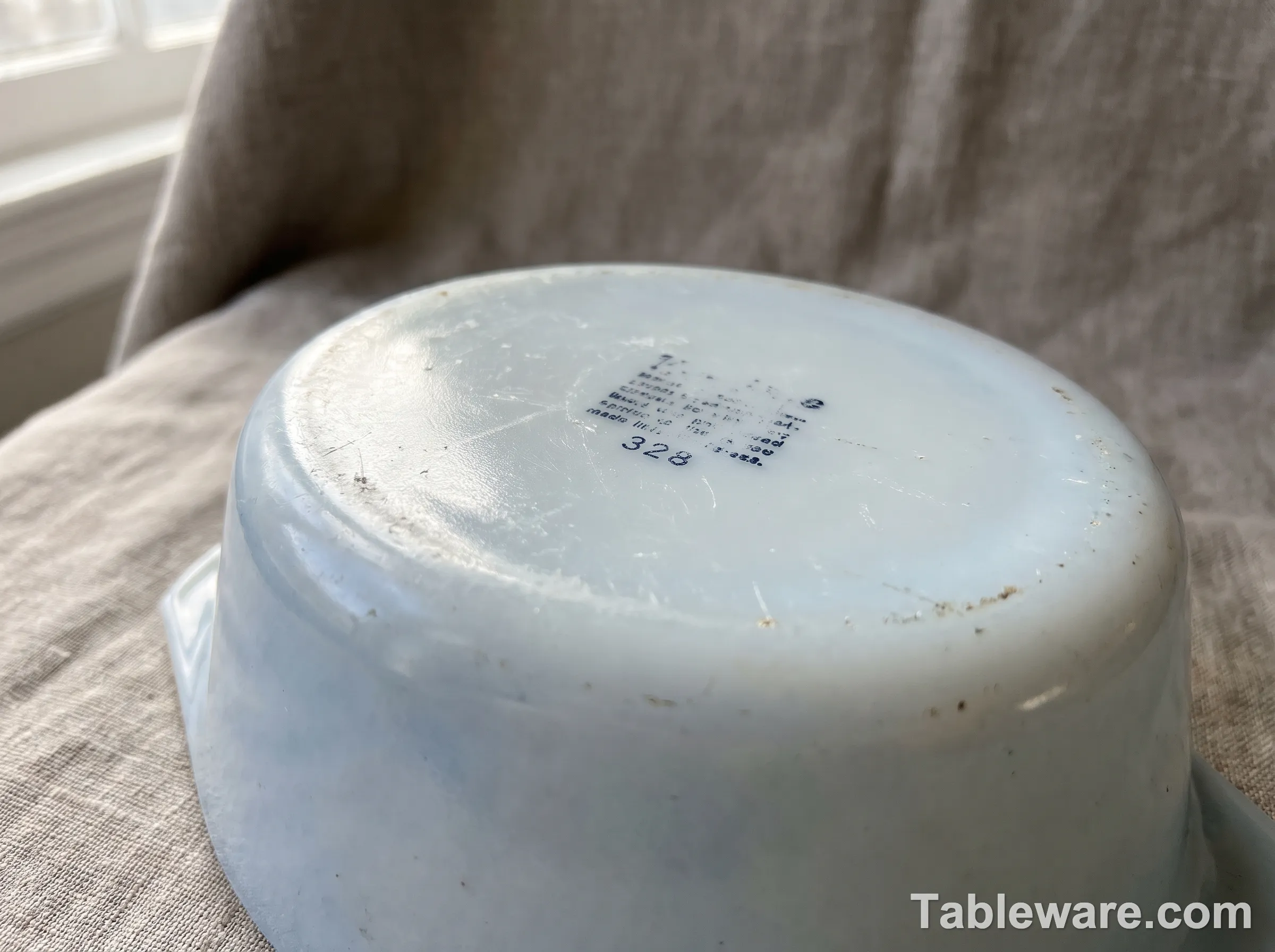
Fig 1. The backstamp is where the real answer lives. Read the caps, read the model number, then check whether the wear on the stamp matches the wear on the rest of the piece.
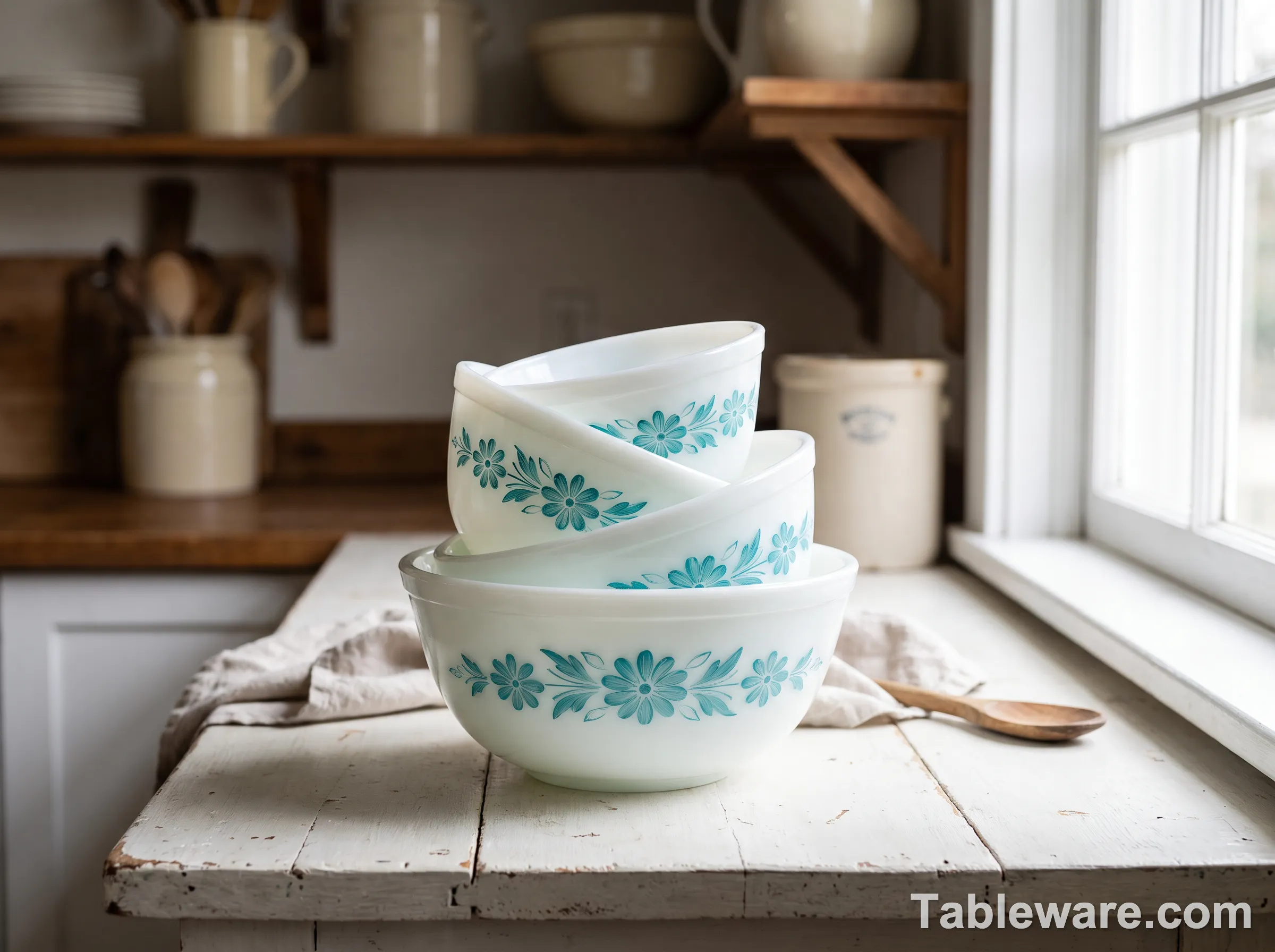
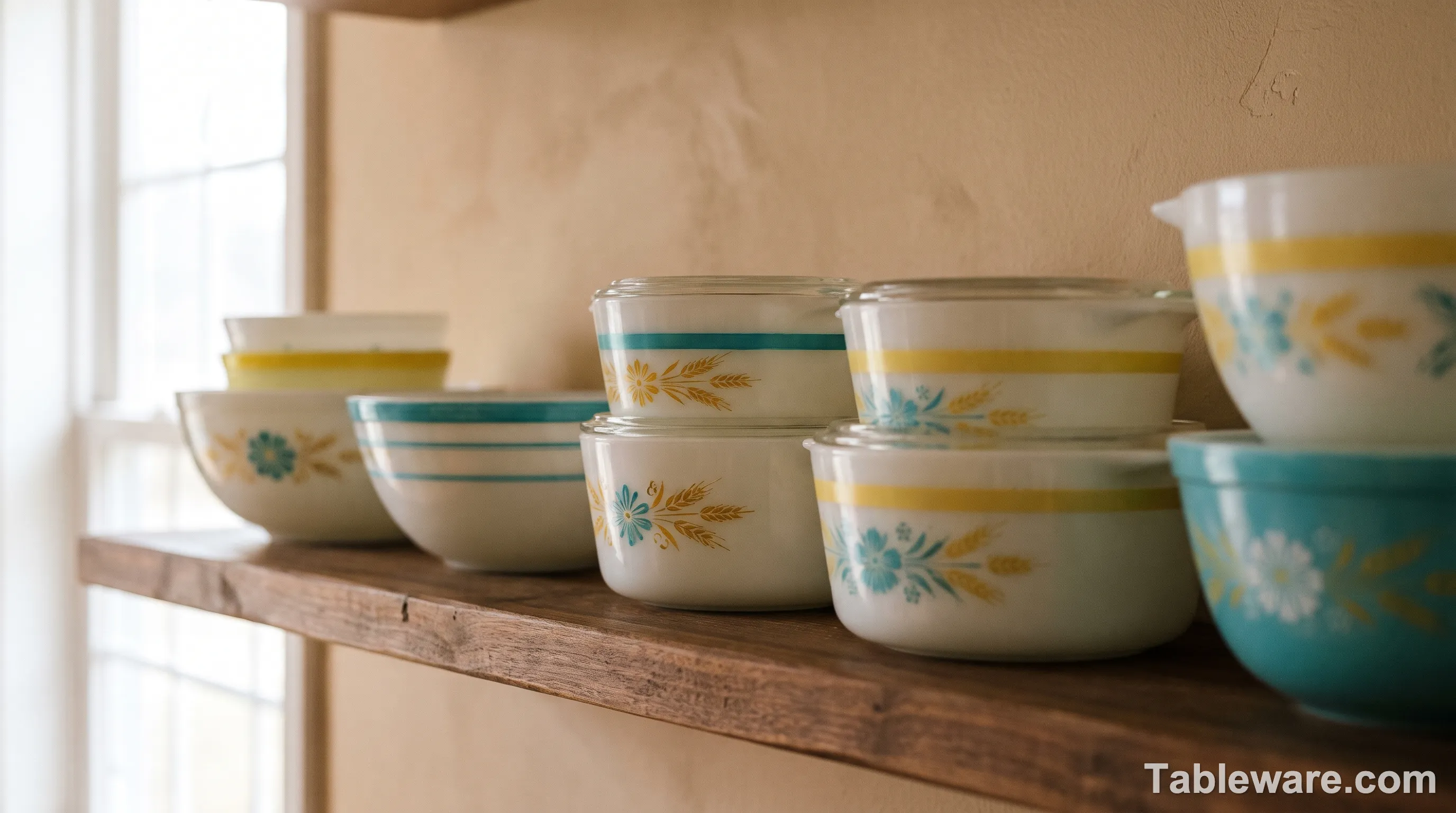
Fig 2. A complete 401-404 nesting set in one pattern is the most practical thing to collect. It stacks, it serves, and it is the version most families actually cooked with.
Borosilicate vs soda-lime: the 333°F vs 99°F difference
This is the part most "vintage Pyrex is better" posts skip.
Is Pyrex borosilicate? The answer depends which Pyrex
Corning introduced Pyrex in 1915 with borosilicate glass, a material developed for railroad lanterns and laboratory beakers because it barely expands when heated. A quick look at the numbers from Corning's own technical specs and the American Ceramic Society: borosilicate has a thermal expansion coefficient of about 3.3 × 10⁻⁶ per kelvin. Tempered soda-lime glass sits near 9 × 10⁻⁶. Soda-lime expands nearly three times as much for the same temperature change, and glass that expands unevenly under stress cracks.
So when someone asks "is Pyrex borosilicate," the honest answer is: it depends which Pyrex, where it was made, and when. If the answer is the "Pyrex borosilicate" phrase you keep seeing in old lab equipment catalogs, that is the original Corning formula and it is still the good stuff.
Materials scientist Richard Bradt put the number plainly in the 2011 American Ceramic Society Bulletin: soda-lime glass tolerates about a 99°F temperature shift, borosilicate handles roughly 333°F.
Then Consumer Reports ran a year-long investigation covering more than 160 shattering incidents. The test: fill a dish with dry sand, which gets hotter than food, and hold it at 450°F for 80 minutes, then move the dish onto a wet granite counter. American-made soda-lime bakeware broke ten out of ten times. The borosilicate version — European Pyrex and Arcuisine — survived until the test temperature was raised to 500°F.
If you want the full mechanics of why glass fails at temperature, including the coefficient of thermal expansion table for ceramics and glass, our guide to oven-to-table bakeware engineering goes deeper than any brand blog will.
The switch was not a conspiracy. It happened in stages through the 1970s and 1980s, and Corning sold the consumer Pyrex line to World Kitchen in 1998. World Kitchen, now Corelle Brands, has argued in court that soda-lime has higher mechanical strength and is cheaper and greener to produce. They are not wrong about the drop resistance. They are notably vaguer about the thermal side.
Europe never made the switch. Pyrex sold through pyrex.co.uk and by International Cookware is still borosilicate today, which is why a $40 European baking dish often outlasts a $30 American one.
Is Pyrex oven safe? It depends which Pyrex
"Is Pyrex oven safe" gets a different answer depending on the decade of the dish, and the marketing blurs that badly.
Oven, broiler, microwave — the rules that never changed
Both generations go into a conventional or convection oven up to 425°F. Neither goes under the broiler, ever. The broiler's direct radiant heat is the fastest way to crack a glass dish, and that has not changed since 1958. Both are microwave safe, with one caveat: do not microwave popcorn in a Pyrex dish, and do not leave high-fat foods like oil or tomato sauce overheating in one.
Can Pyrex go from fridge to oven?
The real difference between old and new is what happens at the temperature edges, and the pyrex from fridge to oven question is where most of the breakage happens.
- Fridge to oven. A make-ahead casserole straight from the cold fridge into a preheated 400°F oven is the single most common way modern soda-lime bakeware shatters. This is the question behind "can Pyrex go from fridge to oven," and the answer for any Pyrex, new or old, is no. Let it sit out until it loses the chill.
- Oven to counter. Hot glass on a cold, wet granite slab is the second most common. Always use a dry cloth or potholder.
- Liquid into hot glass. Deglazing a hot baking dish with cold broth creates the same thermal gradient. Add liquid before cooking, not after.
- Chips and cracks. Any existing flaw is a crack waiting to grow. Never cook in a piece that has a chip on the rim or a hairline fracture.
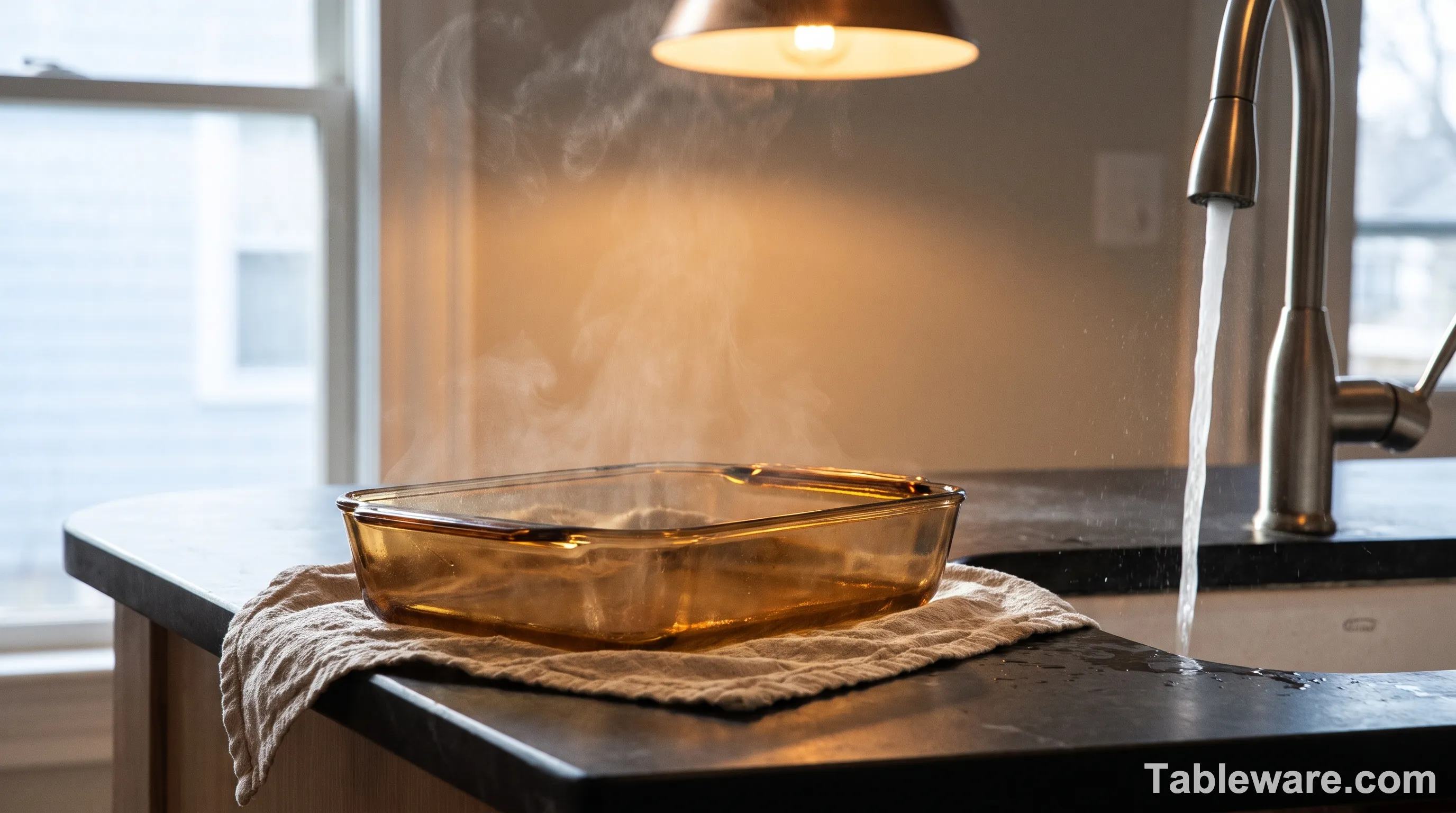
Fig 3. This is the whole safety conversation in one picture. Hot glass on a dry cloth, cold water kept far away. The cotton towel is not fussy — it is the single habit that prevents most breakage.
The safety record — CPSC data and the Consumer Reports test
On the safety data, the numbers are less alarming than the internet suggests but not trivial. The CPSC has recorded roughly 950 emergency room visits related to glass cookware shattering between 2011 and 2020, and consumer investigators have logged about 850 reports of glass bakeware breakage over seven years. Corelle Brands puts the Pyrex failure rate below 0.1%, and no recall for shattering has ever been issued. ConsumerAffairs has collected more than 300 complaints since 2006, and the Pachirat v. Corelle Brands litigation has pressed the point in federal court in Illinois, most recently in 2023, over a plaintiff injured when a dish shattered during normal use.
The pattern in those filings is consistent: sudden temperature change, a chip that was already there, or direct heat.
My rule for a vintage piece I actually want to cook with: no chips, no cracks, all caps logo, hand wash only, and it goes into a preheated oven but never comes out of the fridge first. For a chipped piece, it becomes a display object. That is not a loss, it is a demotion.
If you are deciding between glass and plastic for the family table, our post on is melamine dinnerware safe covers the other side of that trade-off.
Pyrex vs CorningWare: two brands that stopped making the same thing
Corning made both, and they were always different materials. CorningWare launched in 1958, developed by Corning chemist S. Donald Stookey, in Pyroceram — a ceramic that tolerates stovetop heat because its expansion is close to zero.
Pyroceram vs soda-lime vs stoneware — what changed and when
Pyroceram production ended around 2000. By 2001 the mainstream CorningWare line had moved to stoneware, which lost stovetop compatibility. Corelle Brands brought a Pyroceram line back briefly in 2008, but most of what you can buy today under the CorningWare name is stoneware.
| What changed | Vintage Pyrex | Modern Pyrex (US) | Vintage CorningWare | Modern CorningWare |
|---|---|---|---|---|
| Material | Borosilicate | Tempered soda-lime | Pyroceram | Stoneware (mostly) |
| Thermal shock tolerance | ~333°F shift | ~99°F shift | Very high | Moderate |
| Stovetop safe | No | No | Yes | No |
| Drop resistance | Lower | Higher | Moderate | High |
| Era | 1915 to late 1970s | Late 1970s onward | 1958 to 2000 | 2001 onward |
| Best use | Oven baking, display | Everyday baking, storage | Stovetop, oven | Casserole serving |
People lump CorningWare in with Pyrex because they sat in the same cupboard, but they were never the same material. If you want the broader glassware primer, our guide to drinking glass types covers the soda-lime and borosilicate split in tumblers, and Anchor Hocking vs Libbey vs Crate & Barrel is the closest comparison on the drinkware side.
The collectible CorningWare patterns: French White and Blue Cornflower
Two patterns carry most of the collector interest. CorningWare French White is the plain white body with a thin blue band around the rim, and it was one of the most heavily produced patterns Corning ever made, which is exactly why it still turns up in thrift stores for $5 to $15 a piece and around $40 to $120 for a complete 4-piece set. CorningWare Blue Cornflower is the blue version with the small white floral spray, and it has a narrower following, which usually puts a single piece somewhere in the $15 to $60 range depending on condition and whether it has its glass lid.
Both are still widely available today. The collectible CorningWare values live further up the ladder — in the one-season promotional pieces and in complete sets with original lids, in much the same way they do with Pyrex.
If you want to know what is the rarest CorningWare, the answer is almost always a promotional piece made for one retailer or one holiday season, the same way it works with Pyrex patterns. They are genuinely hard to find, which is exactly what makes them interesting.
Is CorningWare worth anything? And is it Pyroceram?
"Is CorningWare worth anything" is a fair question given how much of it is still being made, and the honest answer is: yes, in small numbers, and the pieces worth having are the vintage ones.
"Is it Pyroceram" is the question that actually decides whether you can put it on the stove. Look at the bottom stamp. Vintage Pyroceram pieces carry the CorningWare logo with "Made in USA" and usually the word Pyroceram in the backstamp; pieces from the 2001-onward stoneware era and after carry Corelle Brands-era markings instead. A weight-and-sound check helps too. Pyroceram is dense and dead when you tap it, while lighter stoneware rings.
One caution before you test an old piece on a burner: if you do not know the material, do not put it on direct heat. "How to tell if CorningWare is Pyroceram" matters for collectors, but the only safe use for an unidentified piece is the oven, and only with a dry cloth underneath when it comes out.
And if you end up wanting the lightweight laminated alternative instead of heavy stoneware, our Corelle Vitrelle review covers the third way Corning's descendants made glass cookware.
What vintage Pyrex is actually worth: a price guide
This is where people get financially stupid, so let me be blunt: most vintage Pyrex is not rare, and most of what you find in a thrift store is not valuable. It is still lovely, still useful, and still better than nothing in the cupboard. If you want the broader benchmark for what old dinnerware is really worth, our heritage dinnerware brands ranked post covers the same question across ceramics.
Pattern rarity sets the ceiling. Condition sets the price.
The most valuable Pyrex patterns are almost never the ones with the prettiest colors. They are the one-season promotional pieces that a regional retailer ordered by the thousand and then never re-ordered — and that nobody in 1959 could have guessed would matter sixty years later. The Fiestaware color history covers the same American logic, where the pattern that was everywhere in 1974 is the one nobody can find now.
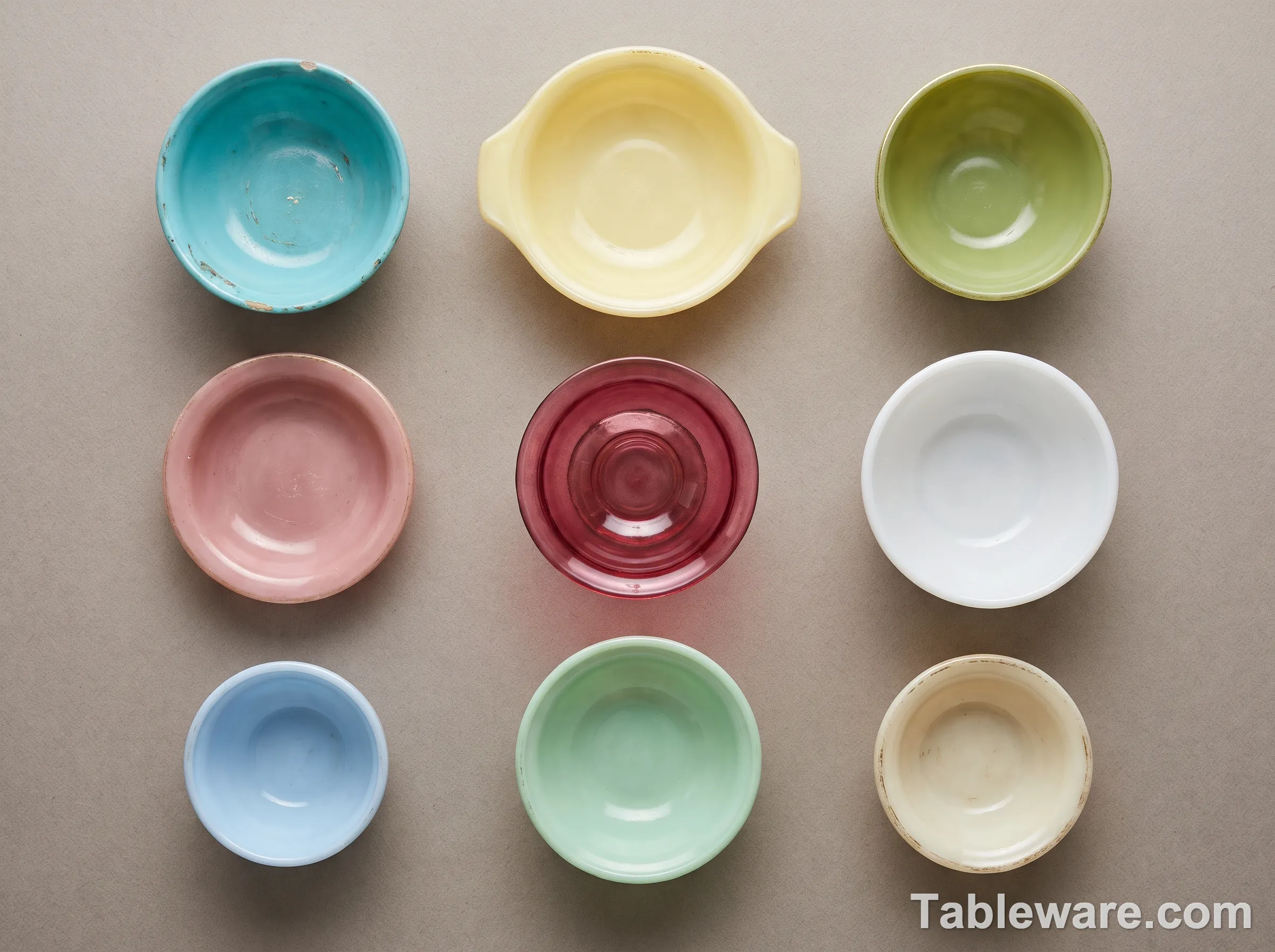
Fig 4. Nine pieces, nine eras of wear. The turquoise and butter yellow bands have held up better than the pinks, which is exactly why pink patterns command the money.
Approximate auction and resale ranges for pieces in decent condition:
| Pattern | Years made | Typical range |
|---|---|---|
| Primary Colors plain sets | 1945-1949 | $85-$150 |
| Butterprint (Amish) nesting set | 1957-1968 | $30-$80 typical, up to $200 |
| Snowflake | Mid-1950s to late 1960s | $75-$600 |
| Turquoise Diamond | 1953-1960 | $100-$600 |
| Cinderella sets | 1957-1966 | $50-$350 |
| Bluebelle Delphite bowl | 1960 | $100 single, $300+ set |
| Atomic Eyes | 1950s-1960s | $200 |
| Hot Air Balloons | 1958 | $100 |
| Pink Duchess | 1959 | $1,800+ |
| Blue Dianthus Cinderella bowl | 1957 | $2,000 |
| Lucky in Love | 1959 | $4,000+ |
| Turquoise Golden Birds | 1960s | $5,000+ |
For scale, a plain primary color bowl sold for $2.50 when it was new in 1946. Lucky in Love is the grail — hearts and four-leaf clovers on white opal — and one mint-condition casserole has drawn a reported $22,000 bid that the buyer walked away from.
Four condition rules will save you from overpaying:
- The dishwasher is the number one value killer. Faded, hazy, chalky patterns mean decades of machine washing and the damage is permanent. Glossy means hand-washed all its life.
- Chips cut value by 40 to 60 percent. On the rim or the base, it is a serious hit.
- An original matching lid adds 30 to 50 percent to a casserole.
- A complete set beats a lone piece. Five nested bowls in one pattern are worth more than the same bowls sold singly.
Marketplaces disagree constantly, and the pattern is predictable. The same Snowflake bowl can list at $40 on eBay, $75 on Etsy, and $240 on Amazon marketplace. That spread is where the money is, or the losses are.
One thing worth knowing before you spend: vintage Pyrex bowls and nesting sets move in bundles with collectors, not with dishware shoppers. If you want the practical set, buy the 401-404 in one pattern and use it. If you want the investment, buy the pattern, not the quantity. Our guide to handmade pottery investment rules works through the same logic for ceramics, and it applies here.
Buying vintage Pyrex without getting burned
Five checks, twenty seconds, in this order:
- All caps or lowercase? That decides vintage or modern before anything else.
- What is the model number? It tells you the shape and what a full set looks like.
- Do you recognize the pattern? If you have never seen it before and the shape is unusual, slow down — that is how promotional pieces hide.
- Does it have the lid, and does it have the box? Both add money.
- Glossy or hazy? This is the price.
The things that actually catch buyers out are not counterfeits. Real counterfeit Pyrex barely exists. The problems are modern reissues sold as vintage, married lids (a modern clear glass lid fitted to an opal dish), misnamed patterns, and damage tucked out of frame in a flattering photo. Heritage patterns get re-released regularly, and a 2020s Butterprint with a lowercase logo is a reissue, not a 1960s original.
Also check the seller. The marketing copy for vintage kitchenware is brutal — "rare," "investment grade," "heirloom" all appear on listings of a $12 bowl that sells by the carton at Walmart.
Estate sales are where unrecognized pieces still surface, because a family clearing out a kitchen has no idea which casserole is the grail. Thrift stores still work, though collectors have taken most of the obvious ground.
Cleaning and care
Hand wash. Warm water, mild dish soap, a soft cloth. That is the entire routine, and it protects both the pattern and your sanity.
- Never the dishwasher. Modern detergent etches the print permanently.
- Baking soda paste for baked-on food, rubbed gently. Mild enough not to scratch.
- Equal parts white vinegar and water to clear hard-water cloudiness on clear glass only. Keep acidic or abrasive cleaners off the painted surface.
- No steel wool, no scouring pads, no Magic Eraser on a pattern.
- Wood, plastic, or silicone utensils. Metal forks leave scuff marks that look like scratches.
- Discard chipped or cracked pieces from the kitchen. Mosaic trivet or a Lazy Susan, if you want to keep it.
- Paste wax for display-only pieces restores lost gloss. Never wax a piece you will heat, and do it in a ventilated space.
We have covered the broader care mistakes in dinnerware care: 7 mistakes, and if you are wondering about hairline cracks rather than chips, crazing on dishes explains how to tell a craze from a real fracture.
So which should you actually buy?
| If you... | Buy |
|---|---|
| Bake two or three times a week and want zero drama | Modern clear Pyrex, plus a metal pan for the broiler |
| Collect and want color you cannot buy new | Vintage opalware in a known pattern, in glossy condition |
| Need stovetop-to-oven performance | Vintage Pyroceram CorningWare, enameled cast iron like Le Creuset, or stainless steel |
| Serve cold salads and desserts | Modern glass storage with clip lids |
| Want a thrift-store find that is still useful | Vintage borosilicate, no chips, hand wash only |
My own kitchen has both. A modern clear 9x13 for weeknight chicken and a 1960s aqua Butterprint casserole that lives on the shelf, used for nothing except the good salad. I am not exaggerating when I say the good salad gets compliments on the bowl.
Vintage Pyrex vs modern Pyrex is not really a contest. Modern glass is better at surviving your kitchen floor. Vintage glass is better at surviving your oven, and it is the only version with a pattern worth arguing about at dinner.
Sources and further reading
- Consumer Reports investigation into shattering glass cookware (2010-2011)
- American Ceramic Society Bulletin, Vol. 90 (2011), Bradt on thermal shock in glass cookware
- Consumer Product Safety Commission incident data and glass cookware safety guidance
- Pachirat v. Corelle Brands LLC, N.D. Ill.
- Corning technical specifications for borosilicate expansion coefficients