4 Types of Glass for Drinking Glasses (Soda-Lime, Crystal, Tempered, Borosilicate)
There's one photo that ruined a set of glasses for me. Four intact crystal tumblers on a dinner table, one empty, and a half-inch of missing base on the carpet where a fifth used to be. Nobody dropped it. It walked off the table edge with a nudge from a cat, and the entire piece left the building in a single ring of small cubes.
The thing nobody tells you about drinking glasses is that "glass" is not one material. It's four, with wildly different chemistry, and the difference matters the next time a kid reaches for your good tumblers, or you want to pour coffee into a glass at the stove, or you're buying a gift set that has to survive a shipping truck.
This is the buyer's guide to the types of glass for drinking glasses — soda-lime, lead crystal, tempered, and borosilicate. What each one is made of, what each one actually does well, and which one to buy for the job in front of you.
Ninety seconds version:
| Glass type | Main additive | Thermal shock tolerance | Dishwasher | Price tier | Best for |
|---|---|---|---|---|---|
| Soda-lime | Sodium + calcium | ~100°F swing (40°C) | Yes | $ | Everyday tumblers, restaurant service |
| Lead-free crystal | Barium / zinc oxide | ~100°F swing | Hand-wash | $$$ | Formal settings, wine service, gifts |
| Tempered soda-lime | Surface compression (same body) | ~100°F swing, but 3–5× impact strength | Yes | \(–$\) | Kids, outdoor use, high-traffic kitchens |
| Borosilicate | Boron oxide (13%) | ~330°F swing (180°C) | Yes | $$ | Hot drinks, cold drinks, lab-ish durability |
If you only buy one type for a normal kitchen, make it soda-lime. Everything else is a specialization.
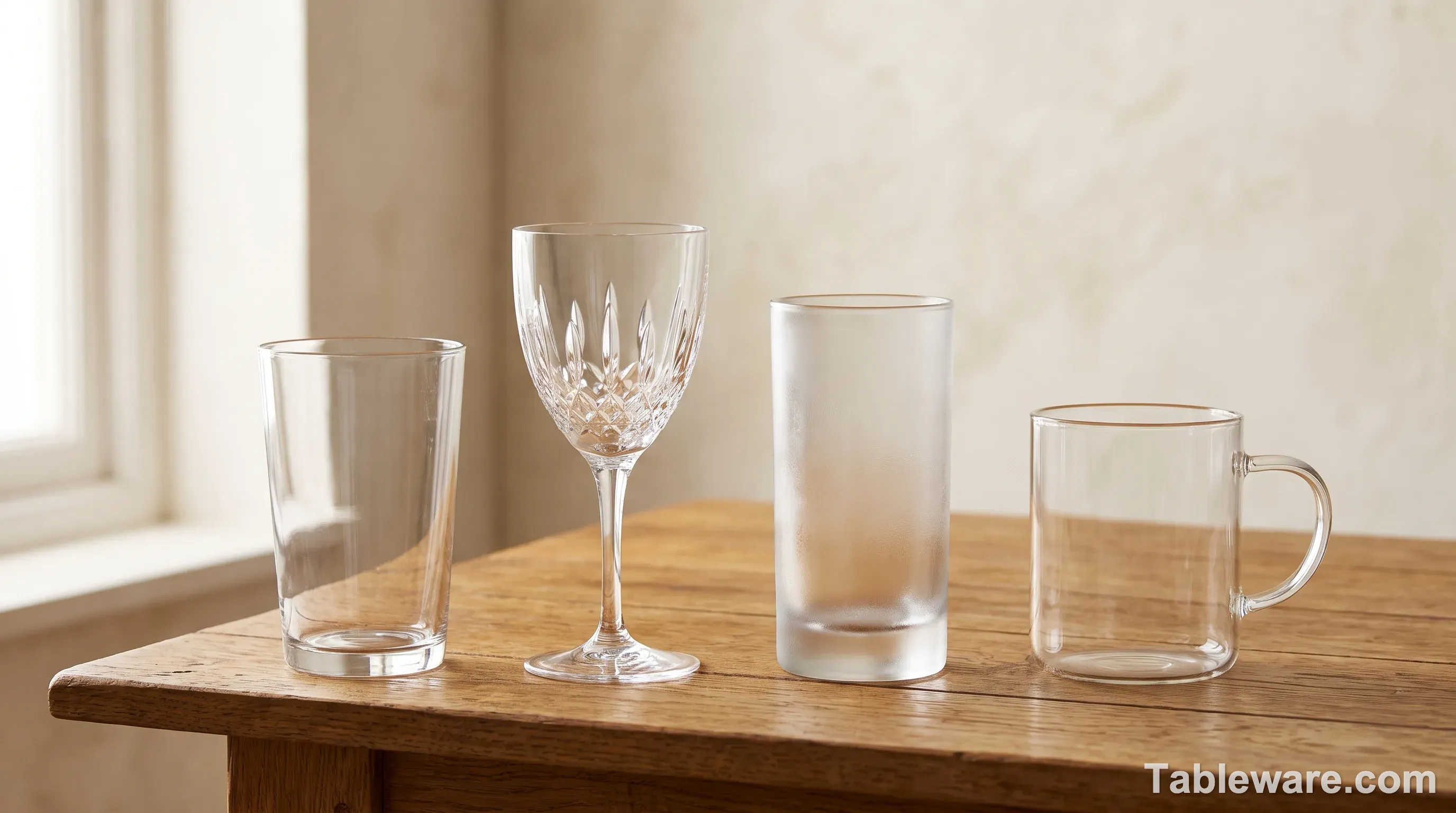
Four drinking glass types lined up side by side on a warm oak table — a plain soda-lime tumbler, a cut lead-free crystal wine glass, a thick-walled tempered highball, and a borosilicate mug. Soft north-facing window light, neutral background, editorial product photography.
Types of Glass for Drinking Glasses: What the Labels Actually Mean
Before the four types make sense, one piece of vocabulary. When the packaging says "glass," the law is looser than you'd hope. ASTM C148 defines glass as a noncrystalline inorganic material — that's it. The recipe can swing wildly between manufacturers and nobody from the government is coming to inspect your tumbler.
So the useful categories come from chemistry, not law. Every glass is mostly silica — fused quartz sand melted at around 1400°C. What separates the types is the additive, the stuff mixed into the silica that changes how the finished piece behaves. Two additives do most of the work in drinking glasses:
- Sodium oxide and calcium oxide make soda-lime glass. These are essentially table salt and limestone. Soda-lime is roughly 74% silica, with the rest split between those two. It is cheap, it is easy to make, and it is what roughly 90% of the glasses in your cabinet are.
- Boron oxide (B₂O₃) makes borosilicate. Boron is the star of laboratory glassware because it builds a network that resists thermal shock. A soda-lime glass is a loose arrangement; a borosilicate is a tighter, more stubborn lattice.
Which is exactly why the soda-lime vs borosilicate glass question is a question about the lattice and not about marketing. One framework is loose and cheap. The other is tight and expensive. Everything downstream of that choice — heat tolerance, price, weight, dishwasher survival — falls out of it.
Lead oxide, barium oxide, and zinc oxide sit in a third family. They don't meaningfully change how the glass handles heat. What they change is optics — how the glass bends and scatters light. That refraction is what "crystal" is selling you. It's an appearance upgrade, not a durability one, and understanding that is the single most useful thing in this whole article.
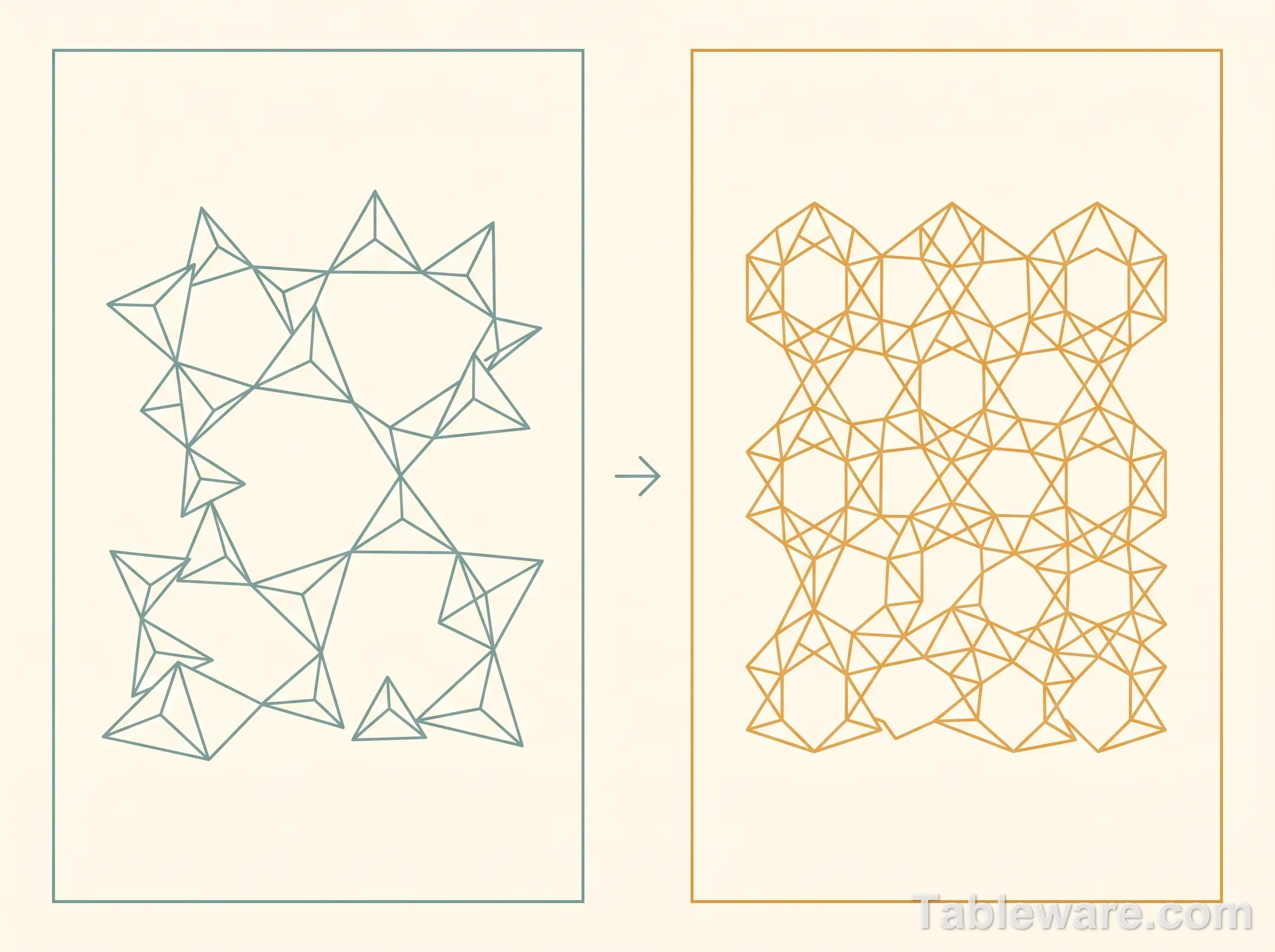
Side-by-side structural diagram: soda-lime glass shows a loose, open molecular arrangement with gaps; borosilicate glass shows a tighter boron-linked lattice with far fewer gaps. Clean technical illustration, warm cream background, muted teal and amber line work.
Soda-Lime Glass: The Default in Almost Every Kitchen
Soda-lime glass is the baseline. If a glass has no marketing language about crystal, borosilicate, or tempered construction, it is soda-lime. That covers essentially all the flatware-adjacent tumblers from the big box stores, most restaurant water glasses, and a depressing amount of the glassware in your dishwasher.
Here's the honest tradeoff. Soda-lime's coefficient of thermal expansion is about 9 × 10⁻⁶ per kelvin — roughly 2.7 times that of borosilicate. In practical terms, a soda-lime glass tolerates a temperature swing of around 100°F before it risks fracturing. Which sounds generous until you remember what 100°F actually covers.
Room temperature water at 68°F into a glass that just came out of a hot dishwasher, fine. Fresh-brewed coffee at 200°F into a room-temperature soda-lime tumbler, that's a 130°F swing. The glass can survive it. Whether it survives it twice in a row, with a chipped rim, in February, is a different question.
Do not pour boiling liquid into soda-lime glass. That's not superstition, it's the 100°F number.
Where soda-lime genuinely wins: cost, availability, weight, and the fact that it's the only one of these four that comes in a truly endless range of shapes. When a restaurant buys 400 water glasses, soda-lime is the only economically sane choice. That's not a compromise; it's why the material exists.
Tempered Soda-Lime: Same Body, Compressed Surface
Here's the part that confuses people, and it's worth ten seconds because it changes how you shop. Tempered glass is not a fifth material. It's soda-lime glass — the same silica, sodium, and calcium — that has been heat-treated so the outer skin sits in permanent compression and the core sits in tension.
That treatment does nothing for heat. A tempered soda-lime glass still shatters if you take it from the fridge to a 400°F oven. But it does extraordinary things for impact. Tempered glass carries roughly 3 to 5 times the impact strength of annealed glass of the same thickness. The cat that killed my crystal tumblers would have left a mark on a tempered highball and possibly nothing more.
Tempered glass has a second quirk that matters for safety. When it does fail, it doesn't shatter into long dagger shards. It dices into small, blunt cubes — typically 3/8 to 1 inch on a side. That's why tempered glass is the standard for car side windows, shower doors, and the glass in a lot of restaurant doorways.
Anchor Hocking's DuraTuff line is the one you'll actually see on shelves in the US, sold at Target and most big-box housewares aisles. It is tempered soda-lime, it's a legitimate durability upgrade over a plain tumbler, and it costs maybe 40% more. For a kid's glass, a rental, or a house full of people who don't treat things gently, it's the right call.
One warning: never chip a tempered glass rim and keep using it. The surface compression is what makes it safe. Damage that skin and the piece is now ordinary fragile glass with none of the benefits. If you find chips, replace it.
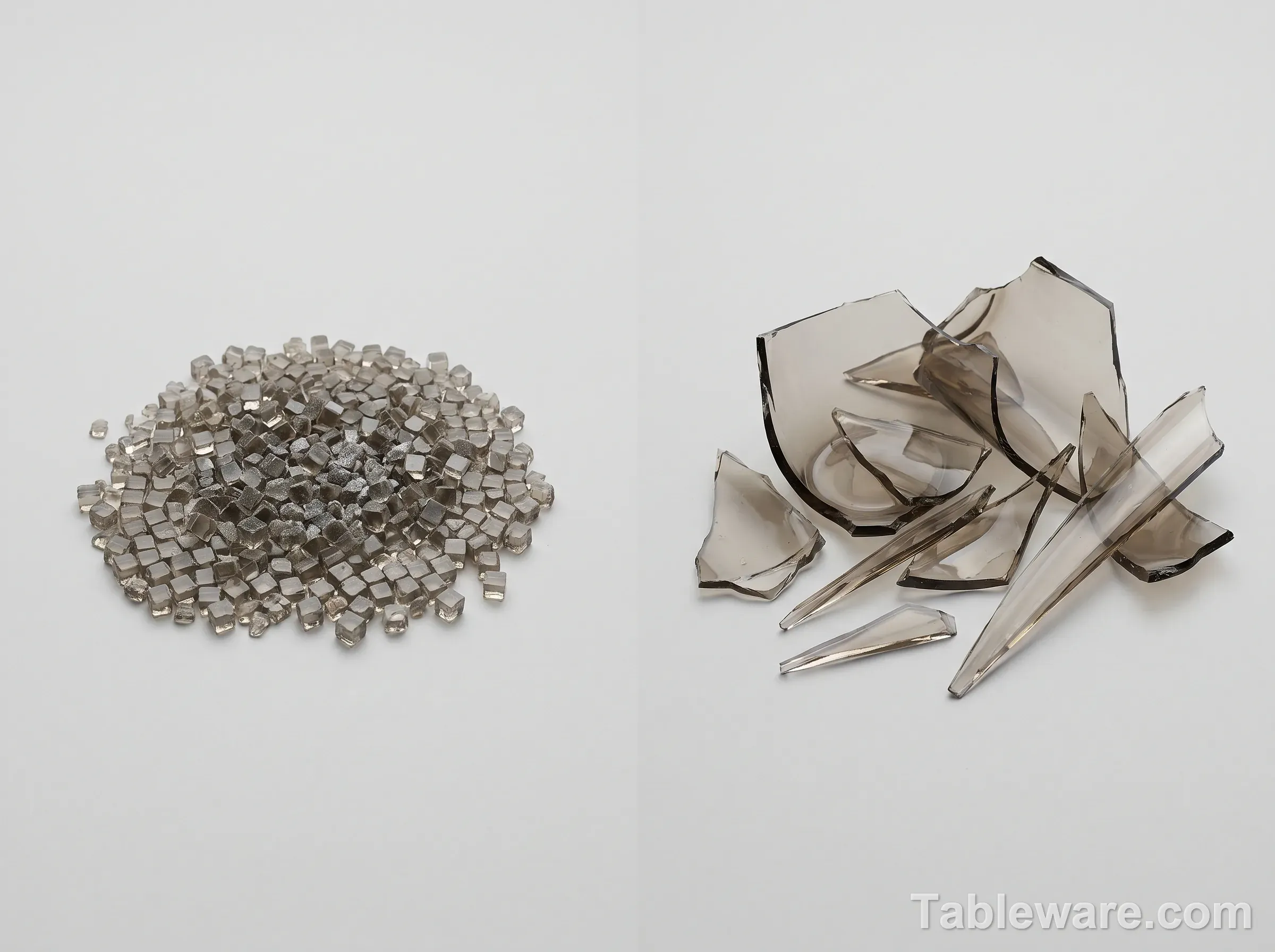
Two panels side by side: on the left, tempered glass broken into small uniform blunt cubes scattered in a contained pile; on the right, annealed soda-lime glass broken into long sharp irregular shards. Neutral studio background, soft even lighting, forensic product photography.
Crystal Glass vs Glass: Brilliance Versus Brittleness
Crystal is the one where marketing and reality diverge most, so let's be precise.
Under ASTM C962, "crystal" requires either at least 24% lead oxide, or — for the lead-free variant — a specific recipe weighted toward barium oxide. That's it. Lead crystal is a refractive glass, not a stronger one. The lead oxide increases the refractive index, so light bends more as it passes through, and edges and cut facets throw more sparkle. That's the whole effect. It's optical, and it's real, but it has nothing to do with durability.
Lead-free crystal swaps the lead oxide for barium oxide, zinc oxide, or potassium oxide. It looks nearly identical. It is also the only version you should be buying new. Modern lead-free formulations are excellent, and if you're buying crystal today, buy the lead-free — there's no performance left on the table and you skip the lead question entirely.
On lead safety, the honest answer: the US EPA limits lead migration in glassware, and lead-free crystal has been the standard for decades. Vintage lead crystal is generally considered safe for daily beverage use because lead leaching requires acidic liquid held at temperature for extended contact — the lemon-stand-in-a-museum scenario. If you're serving a 4-year-old orange juice out of a 1970s goblet every morning, buy them a new glass. Otherwise, the risk is genuinely low. Our longer piece on lead and cadmium in ceramic glaze covers the same chemistry from the pottery side.
The practical downsides of crystal are real, though:
- Hand-wash only. The dishwasher's thermal cycling plus the mechanical jostling will micro-fracture lead-free crystal over time, and it dulls the cut surfaces that make it sparkle. Crystal is the one material here that you actually have to care for.
- More expensive. Good lead-free crystal runs several times the price of soda-lime for the same volume.
- No thermal advantage. Same ~100°F swing tolerance as soda-lime.
Where it earns its money: a wedding registry, a formal table, a restaurant pour program, or a gift. The visual difference is genuinely noticeable under a table setting with a proper tablecloth. Where it doesn't: weekday water glasses.
For the brand-level comparison of what's actually buying well, I did a hands-on roundup of Anchor Hocking vs Libbey vs Crate and Barrel everyday glassware — that's the shelf-picking companion to this material guide.
Borosilicate: The One That Handles Heat
Borosilicate is the odd one out, because it's the only type here built around a physical limitation rather than an appearance.
If you've shopped for bakeware or storage containers, you've probably already run into the soda-lime vs borosilicate glass question without knowing it. Same aisle, same shelf, wildly different material, and the price gap is usually about 40%. My oven-to-table bakeware guide runs the same thermal-shock math for baking dishes if you want the numbers for that category. Here's what the difference buys you in a drinking glass.
Adding 13% boron oxide to silica creates a material with a coefficient of thermal expansion of about 3.3 × 10⁻⁶ per kelvin, against soda-lime's 9. That translates to a thermal shock tolerance of roughly 330°F — over three times soda-lime's. The reason is structural: the boron atoms bond into the silica network itself, leaving no room for the lattice to flex when temperature changes.
In practice: pour boiling water into a borosilicate mug, put it under a tap, stick it in the dishwasher, freeze it with liquid in it, heat it with a microwave. It'll take all of it. Soda-lime will not.
And here is the trap that costs people money. The Pyrex brand in the United States is no longer borosilicate. When Corning moved consumer production to a cheaper soda-lime formula, the tempered version took over the Pyrex name for American ovenware. European Pyrex, made in France and Italy, is still borosilicate. Same brand, same logo, different material — and the US version is the one that famously shattered in consumer ovens.
So if you're buying a Pyrex-style baking or storage dish and your entire reason is "Pyrex means heat resistant," verify it's the European line. Most of what's on a US shelf today is tempered soda-lime pretending to be its old self.
The honest downside: borosilicate is lighter than soda-lime, roughly 2.23 g/cm³ against 2.5, and light weight reads as cheap in the hand. It also has that unmistakable slightly greenish tint at the rim, and it dents rather than dings. Aesthetic tradeoffs for a genuine capability you may not use.
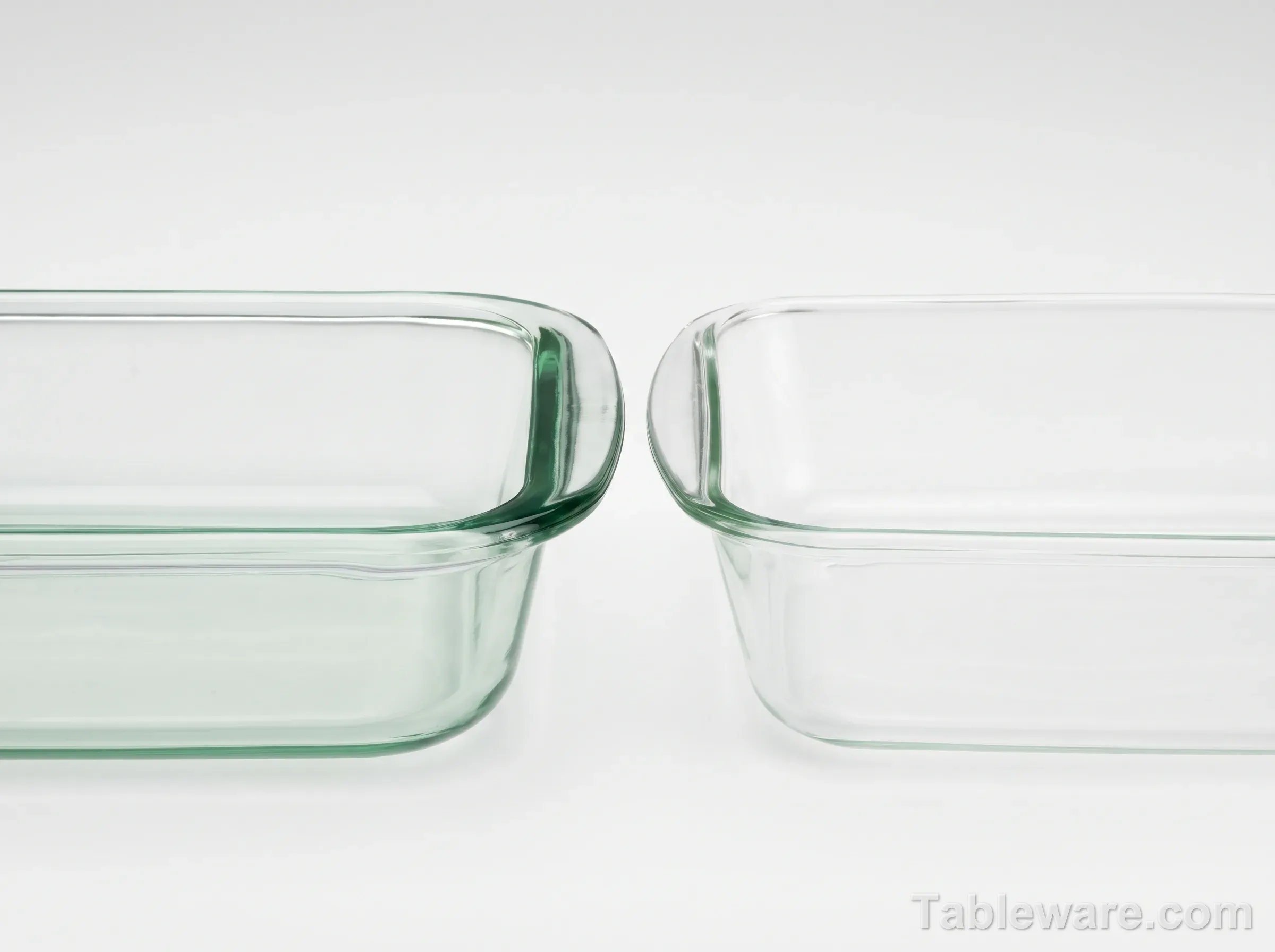
Two oven-safe glass dishes side by side under bright studio light — the US-market version on the left with a slight green edge tint and a thick rim, the European borosilicate version on the right noticeably lighter with a thinner, clearer wall. Label cards beside each. Clean white seamless background.
The 4 Types of Glass for Drinking Glasses at a Glance
| Soda-Lime | Tempered Soda-Lime | Lead-Free Crystal | Borosilicate | |
|---|---|---|---|---|
| Silica | ~74% | ~74% | ~70–76% | ~81% + 13% B₂O₃ |
| Key additive | Na₂O + CaO | same + surface compression | BaO / ZnO | B₂O₃ |
| CTE (×10⁻⁶/K) | ~9 | ~9 | ~9 | ~3.3 |
| Shock tolerance | ~100°F | ~100°F | ~100°F | ~330°F |
| Impact strength | Baseline | 3–5× baseline | Baseline | Baseline |
| Break pattern | Long shards | Small blunt cubes | Long shards | Long shards |
| Density (g/cm³) | 2.5 | 2.5 | 2.6–3.0 | 2.23 |
| Dishwasher | Yes | Yes | Hand-wash | Yes |
| Microwave | Yes (empty only) | Yes | No | Yes |
| Typical price | \(|\)–\(|\) | $$ | ||
| Feels like | Standard | Solid, chunky | Fine, resonant | Thin, light |
The row that decides most purchases: microwave. Crystal should not go in a microwave. A crystal piece with any metallic content in the cut decoration can throw an arc, and even without it, the uneven heating of a leaded glass can build a stress point. Borosilicate and soda-lime are both fine, as long as the glass is empty of liquid when you do it.
My dinnerware care guide covers the habits that kill a set regardless of material, but the crystal hand-wash rule is the one people break most often.
How to Tell What You're Actually Holding
The useful test, in order of reliability:
- Look at the label and the base stamp. "Borosilicate," "Pyrex" with a European mark, "DuraTuff," "crystal," "lead-free crystal." This is by far the most reliable method and it costs nothing. My dinnerware symbols guide covers the backstamp codes you may hit here.
- Weight. A borosilicate piece feels distinctly light for its size. A crystal piece feels dense.
- Light test. Hold a printed page behind the base. In heavily leaded crystal, the text blurs noticeably. In lead-free crystal the distortion is subtle. This tells you something about optics and nothing at all about safety.
- The tap. Flick the rim with a fingernail. Good crystal rings for a couple of seconds. This one is pure theater — cheap soda-lime with a thin rim can also ring, and expensive lead-free crystal can sound flat. Do not make a purchase decision on it.
The one test to ignore entirely: the "radiation" test. The idea that you can hold lead crystal to a Geiger counter to detect radioactivity is a hoax with a ten-decade-old origin. Lead is not radioactive, lead crystal contains no radioactive material, and the number of people who own a Geiger counter and also need to buy drinking glasses is approximately zero.
Which Type Should You Buy?
Everyday water and iced drinks, a normal household: soda-lime, 8–10 oz, from whatever you like. It is the material that exists to do this job.
A kid's glass or a house with a lot of drop risk: tempered soda-lime. Same look, same price class, dramatically better survival rate, safer break pattern. This is the most under-adopted upgrade in the category.
A formal table, a wedding registry, a gift: lead-free crystal. Buy it knowing you're buying light refraction, not strength, and plan to hand-wash it.
Anything that touches a hot liquid, or a piece you'll freeze: borosilicate. This is the only category where the material difference is not cosmetic.
Mixed household, general purpose, want one decision: a tempered soda-lime set for daily use plus two or three borosilicate mugs for coffee and tea. That covers 95% of real life without a single fragile thing in the dishwasher.
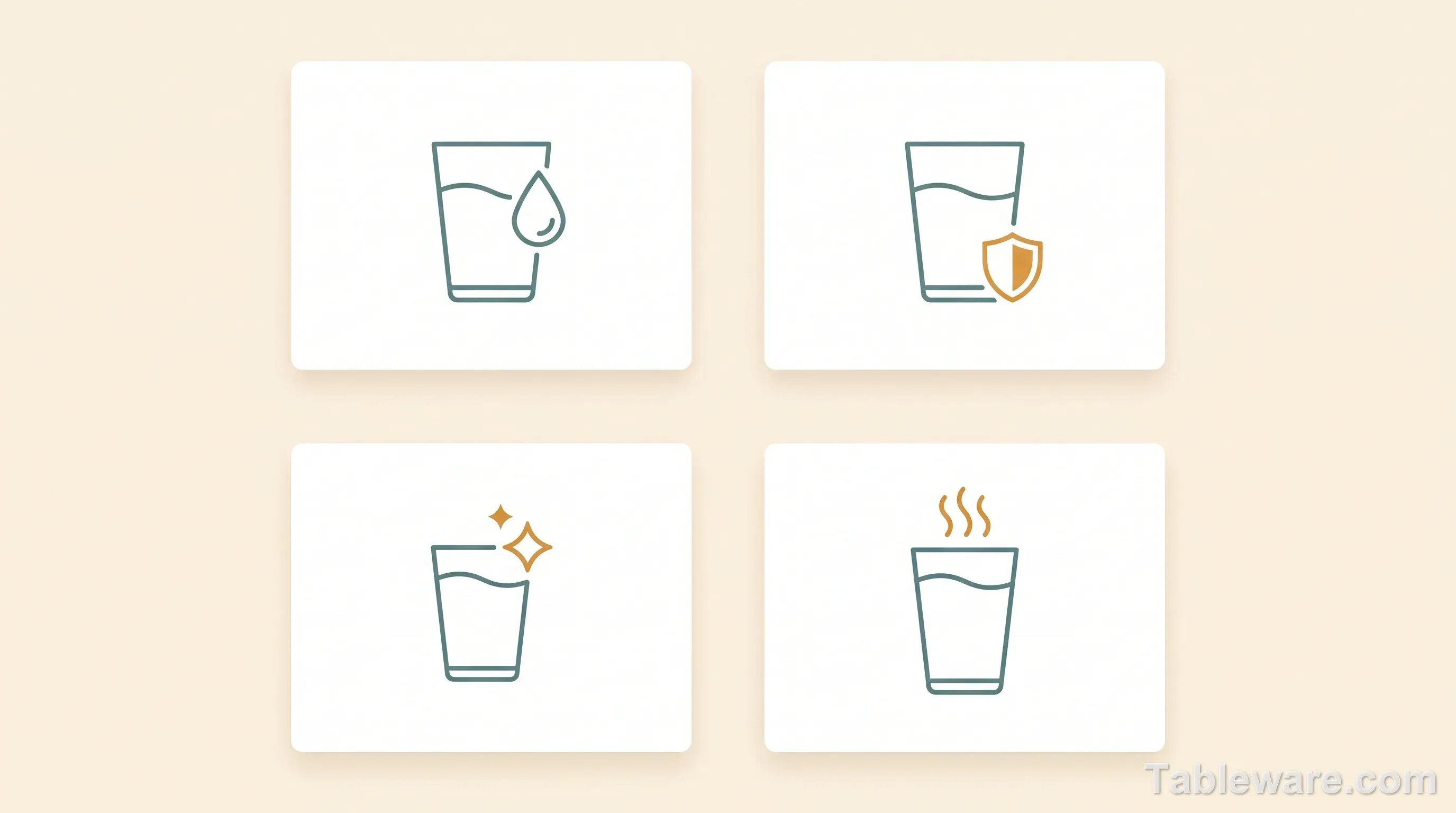
A clean four-panel infographic on cream background mapping use cases to materials: everyday water to soda-lime, kids and high-traffic kitchens to tempered, formal dining to lead-free crystal, hot liquids and freezing to borosilicate. Minimal flat illustration, warm neutral palette, thin line work.
FAQ
Is crystal glass worth the price? For a formal table, yes — the refraction is real and a room notices. For a Tuesday, no. You're paying 3–4× for optics and the obligation to hand-wash.
Is lead crystal safe to drink from? New lead-free crystal, absolutely — that's what you should be buying. Vintage lead crystal poses low risk for normal beverages but is a poor choice for hot acidic liquids like tea or juice, especially for children. Buy new and the question disappears.
Is borosilicate better quality than crystal? Different, not better. Borosilicate wins on heat tolerance and lightness, loses on brilliance and heft. Kitchen utility versus table presence.
Can crystal go in the dishwasher? No. Thermal cycling and mechanical jostling will micro-fracture it and dull the cut. Hand-wash with warm water and a soft cloth, dry standing up.
Which is the most durable overall? It depends what you're surviving. For impact, tempered soda-lime by a wide margin. For heat, borosilicate by about 3×. For a combination of both, none of these four is designed to excel — a borosilicate body with a tempered surface would be, and very few products do that.
The short version: soda-lime for everything ordinary, tempered if things get knocked around, borosilicate if heat is involved, lead-free crystal if the table matters more than the dishwasher. Pick the physics that matches your kitchen and the glasses will stop being fragile.