Is Melamine Dinnerware Safe? What Actually Leaches
I owned a set of cream-colored melamine plates for about six years. They were the ones you buy in a four-piece stack for $18 at the big box store, they lived on the patio table through two winters and one very bad hail storm, and they never broke. Then I moved them into a cabinet and one day I pulled out a plate that had been sitting next to the coffee maker for a week and thought: what actually is in this thing?
Is melamine safe to eat off of? The honest answer is more interesting than either the alarmist take or the dismissive one. Melamine dinnerware safety depends almost entirely on two variables you can control — how hot the food is, and how long the piece has been in service. Get those right and melamine is a perfectly reasonable material for daily use. Get them wrong and you're eating a resin that is quietly shedding both melamine and formaldehyde into your tomato soup.
Let me be precise about what the research actually shows, because most of what circulates online is either recycled from a 2008 milk scandal or written by someone who never opened a paper.
What melamine dinnerware actually is
Melamine is a synthetic organic compound made from urea. Combine it with formaldehyde and you get a thermoset resin — a hard, heat-resistant plastic that molds beautifully, takes color well, and costs a fraction of what porcelain does to manufacture. It also cannot be melted down and remade, which is a real environmental downside, but more on that later.
Two resin families matter when you are shopping, and the difference shows up on the bottom of the piece as a stamp.
MF stands for melamine-formaldehyde. This is the harder, more heat-resistant version. It handles boiling liquids and short microwave exposure better than its cheaper cousin, though "better" is a relative term we're about to qualify.
UF stands for urea-formaldehyde. It's the budget version, it uses less expensive filler, and it is genuinely not a piece you want to hold soup in. Formaldehyde migrates from UF resin at a meaningfully higher rate. If you see UF on the back of a plate, that plate is for dry food and cold food only. If you see MF, you have a little more latitude.
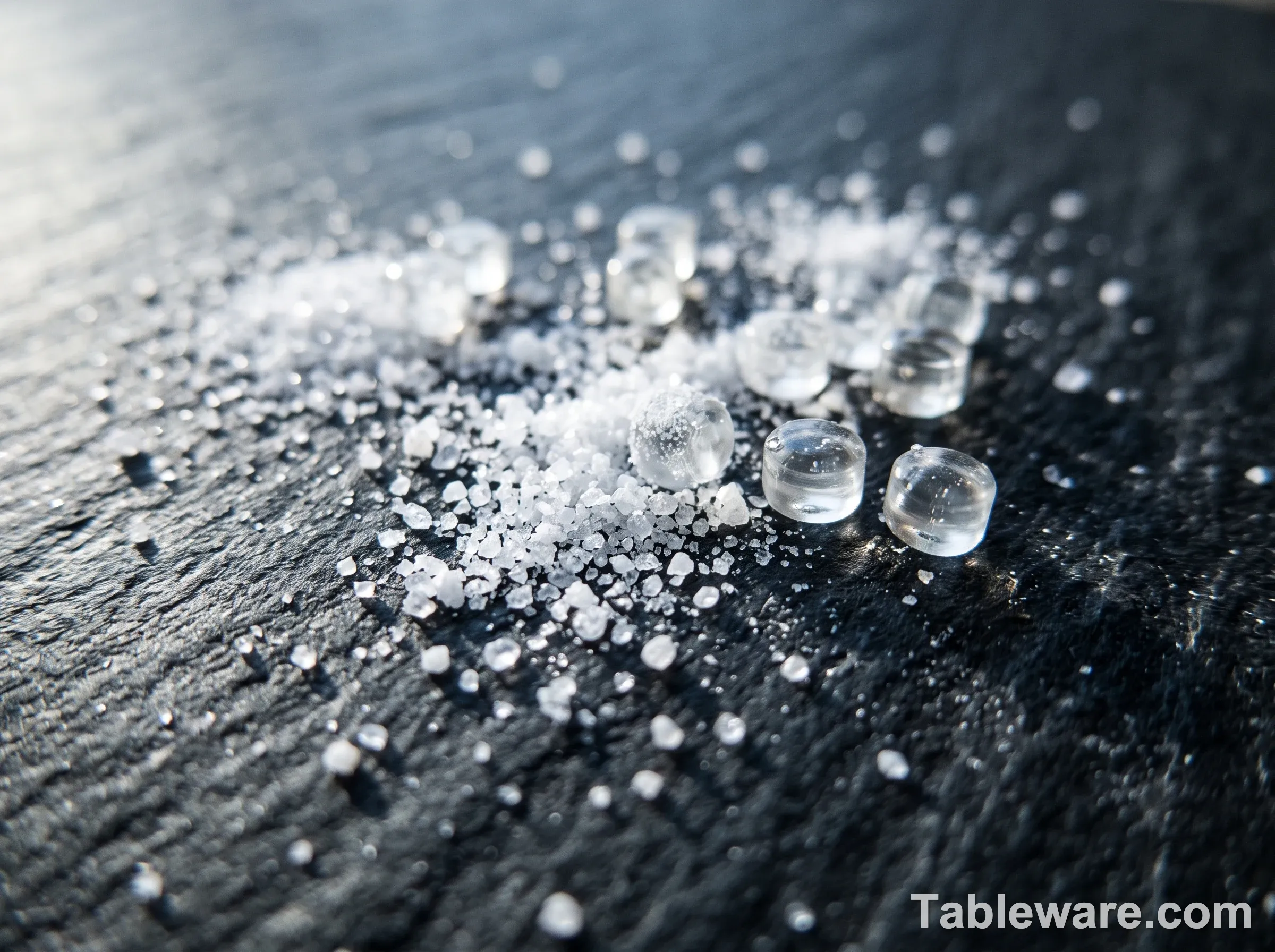
Fig 1. Melamine starts as a crystalline powder and ends up as a molded, fully cross-linked thermoset. That cross-linking is why it will not melt and cannot be recycled — and also why it degrades in a specific, predictable way when you heat it repeatedly.
If you have ever wondered what the little numbers and letters stamped on the back of your plates mean, our guide to dinnerware symbols breaks down the full alphabet, including how to read the recycling triangle and what "PP" versus "MF" tells you about heat tolerance.
Is melamine safe to eat off of?
Short answer: yes, for its intended purpose, within limits that are narrower than most people assume.
The regulatory position is reasonably settled. Melamine resins are authorized as food-contact materials in the US and the EU, and the EU enforces a specific migration limit for melamine of 2.5 mg/kg. When Italian researchers tested 44 melamine tableware samples pulled from retail shelves, they measured melamine concentrations ranging from 0.00773 to 3.0 mg/kg — and only 2 of the 44 exceeded the legal limit. Ninety-six percent of what was for sale was compliant.
That is the baseline. Now for the part that matters more than the baseline.
Melamine migration is not a fixed property of the material. It is a function of temperature, acidity, and time. Test the same dishware at different conditions and the numbers move by an order of magnitude.
Researchers in Malaysia tested 41 retail melamine products under three temperatures using both distilled water and 3% acetic acid, which is a standard stand-in for acidic food like tomato sauce, vinegar, or citrus. In distilled water, median migration was 22.2 ng/ml at room temperature, 49.3 ng/ml at 70°C, and 84.9 ng/ml at 100°C. In acetic acid, it climbed to 31.5 ng/ml cold, 81.5 ng/ml at 70°C, and 122.0 ng/ml at 100°C.
Read those two rows again. Heating roughly quadrupled migration in water and nearly quadrupled it in acid. Adding acid roughly doubled it at every temperature. Heat and acidity multiply each other. That is the single most useful thing to internalize about melamine dinnerware safety.
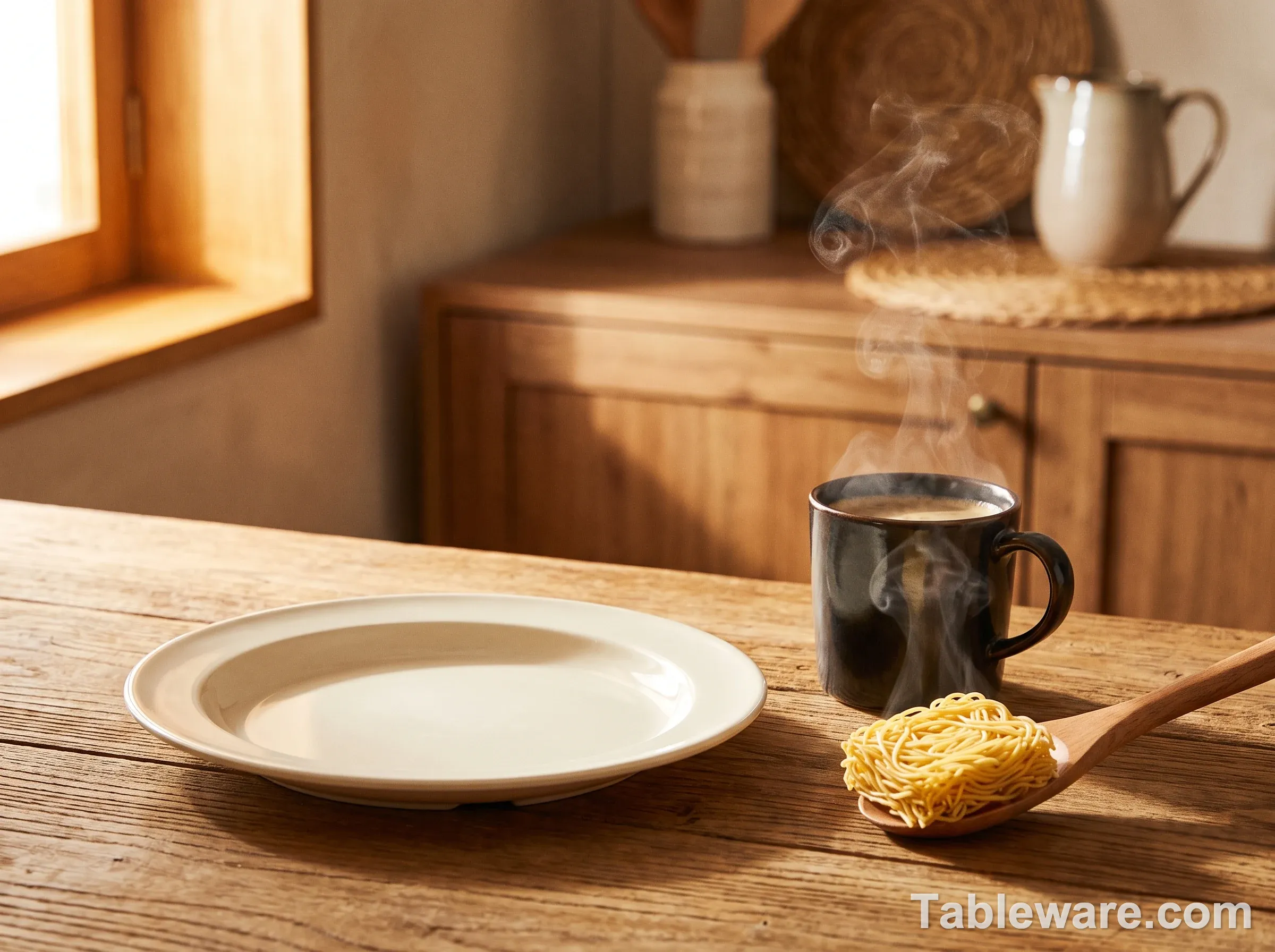
Fig 2. Hot and acidic is the worst case, and it is a very ordinary Tuesday night. Tomato sauce in a bowl that came out of the dishwasher hot, reheated leftovers, coffee with milk — these are the meals that push migration hardest.
The 2008 milk scandal is not about your plates
You will hear melamine and immediately think of the 2008 scandal in China, where melamine was deliberately added to milk powder to fool a protein assay and six infants died. That was fraud — illegal, deliberate, catastrophic, and a completely different mechanism from anything happening in your kitchen.
The reason it matters here is that it poisoned the public conversation about melamine for a decade. It made people think of melamine as a toxin that is either present or absent, like a switch. The actual science is dose, time, and temperature. A regulatory body does not set a migration limit for a substance because every exposure is fatal. It sets one because exposure is real, measurable, and manageable.
For reference, the World Health Organization's tolerable daily intake for melamine is 0.2 mg/kg body weight. That is the number that makes the migration data above meaningful — it tells you what quantity of exposure a person can sustain daily without ill effect, so you can compare it against what your dishes actually release.
What actually leaches — heat plus acid
Let me separate two substances that get constantly conflated.
Melamine is the polymer backbone itself. Under heat and acid, the cross-linked resin degrades and releases melamine monomer. More degradation means more melamine.
Formaldehyde is the binder used to create the melamine-formaldehyde resin. It is not fully consumed in the reaction, so residual free formaldehyde remains in the finished plate and can migrate into food.
Both are present. They move together, which is why they keep showing up in the same studies.
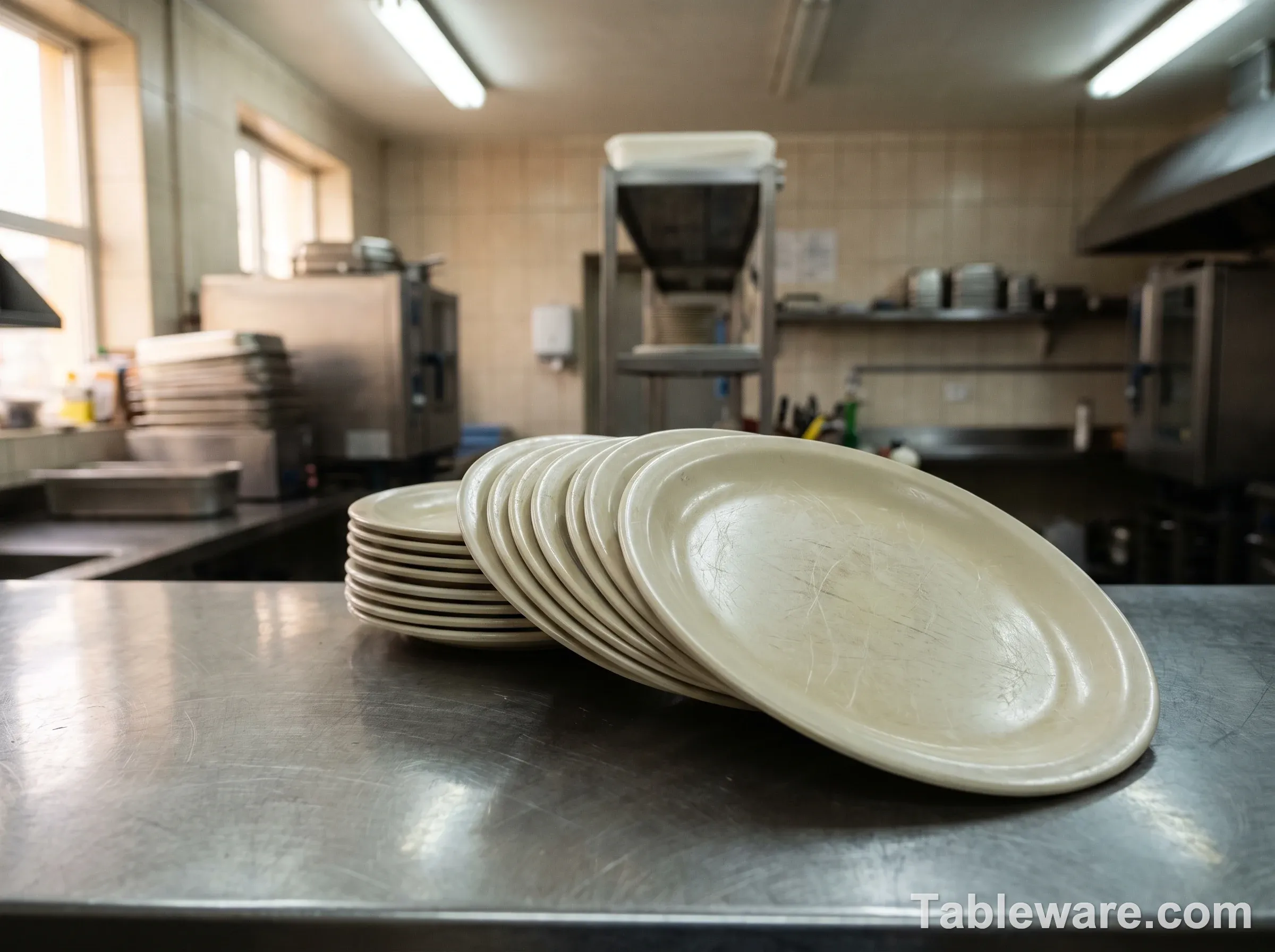
Fig 3. Institutional melamine takes a beating that never touches home dinnerware. Scratches from fork tines and spatulas roughen the surface, and roughened surface means more area for resin to degrade — which is exactly what drives migration upward over a piece's life. Our guide to restaurant supply versus Amazon tableware covers why food service standardized on this material in the first place.
A 2017 study that tested 90 samples of plastic tableware — new, used, and artificially aged — found that migration of both monomers tracked with progressive degradation of the resin. The critical finding: the melamine specific migration limit was exceeded after ageing. Not before. After.
That is the sentence I would put on a sticker inside the cabinet. Melamine dinnerware is not a fixed quantity of risk. It is a countdown, and the clock is surface roughness.
Is melamine dinnerware microwave safe? Dishwasher and oven limits
This is where melamine dinnerware microwave safe claims get tested, and the results are stark.
What the microwave actually does to the resin
A 2014 study put melamine-formaldehyde tableware through repeated microwave cycles — 1, 2, 3, and 5 minute heating programs — and measured overall migration into acetic acid after each cycle. The European Union overall migration limit of 10 mg/dm² was exceeded after just 25 cycles in the 1-minute series, 29 cycles in the 2-minute series, 67 cycles in the 3-minute series, and 37 cycles in the 5-minute series.
Look at what is happening. A single one-minute microwave run does more damage than a longer one. The authors explained why in the paper: microwave heating allowed demethylolation, addition, and condensation reactions to occur that conventional heating did not. The FTIR spectra of the microwaved plastic showed the material was never fully cured, and most of the migrating compounds were low molecular weight methylol melamine derivatives.
The headline conclusion was blunt. Service terms for melamine ware under microwave heating were drastically reduced — by more than tenfold — compared to service terms under conventional heating.
So if you run the same plate through the microwave twice a week for a year, you are not using it for two years. You are using it for a few months of microwaved food, and the material is degrading faster than any reasonable person would guess.
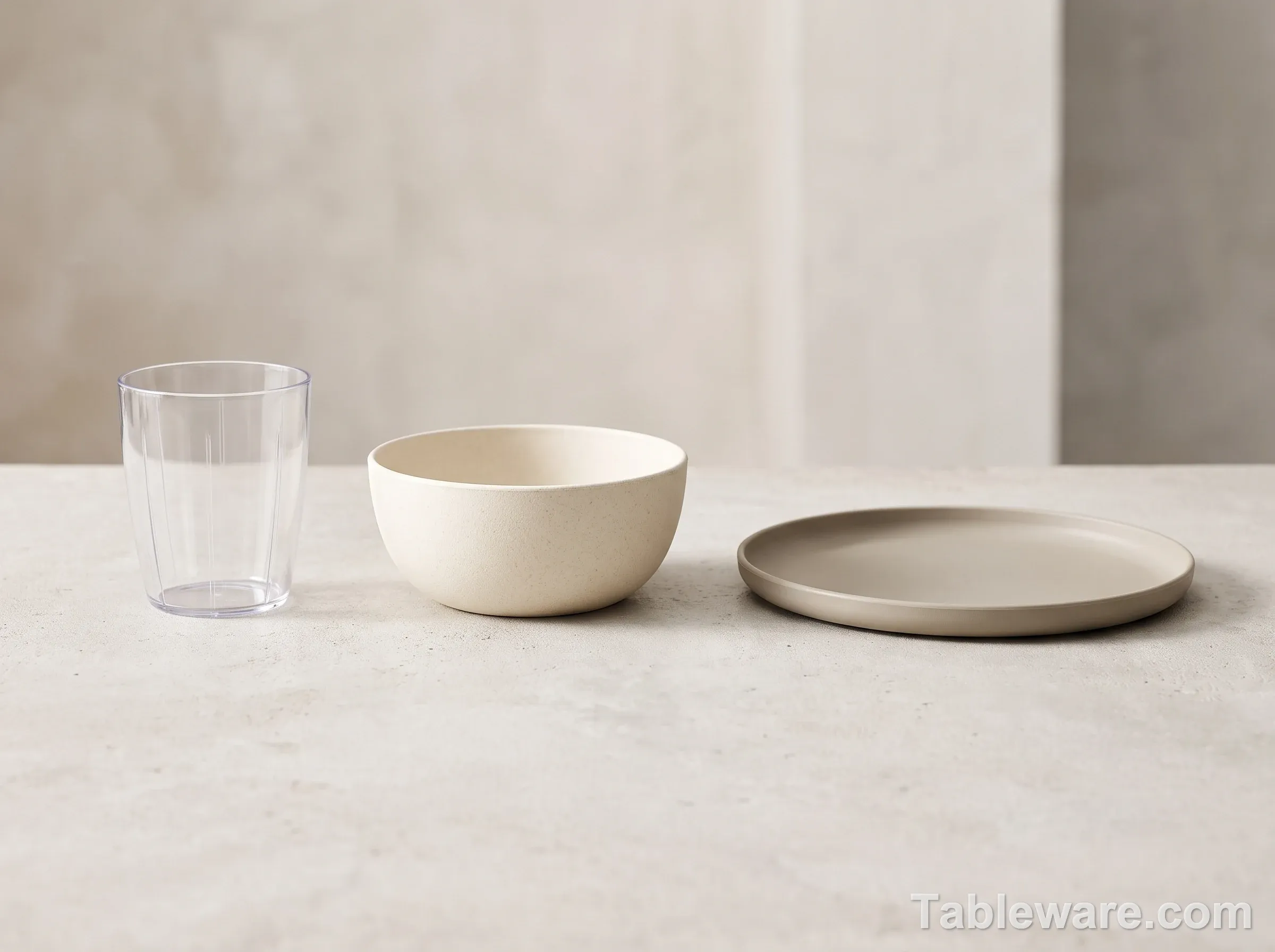
Fig 4. The modern alternatives are genuinely better. Tritan, polypropylene, and bamboo-fiber composites each trade away something, but none of them carry the melamine-formaldehyde degradation problem.
The dishwasher: gentler, but the sponge matters
For the dishwasher, the finding is gentler but still real. Researchers following formaldehyde release through the use phase found that real melamine tableware conformed to the formaldehyde migration limit across 1500 successive washings, giving an estimated service term of about 750 days — roughly two years. But surface roughening during customary use changes the math. With a soft sponge, urea-formaldehyde samples eventually fractured. With a scrubbing pad, formaldehyde migration rose continuously until it exceeded the limit.
That is the real dishwasher story. Not that the dishwasher ruins melamine overnight. That an abrasive sponge is what pushes it over.
The oven: no number exists
And the oven? Melamine does not belong in an oven. Full stop. No manufacturer prints an oven-safe temperature on melamine because there isn't one.
Here is the summary of all three, because manufacturers bury this information on the bottom of the box:
| Use | Verdict | Why |
|---|---|---|
| Microwave | Do not use | Service life cut by more than 10x; migration limit exceeded after 25 cycles at 1 minute |
| Dishwasher, top rack | Acceptable | Conforms to limits across ~1500 washings, roughly 2 years of service |
| Daily hot food contact | Shortens service life | Hot fill rather than ambient use cuts the estimated service term by a factor of 1 to 3 |
| Scrub pad | Avoid | Surface roughening pushes formaldehyde migration over the limit |
| Oven or broiler | Never | No safe temperature exists for the material |
| Cold and room-temperature food | Fine | Lowest measured migration, and the lowest real-world exposure |
Is it safe to eat on plastic plates? BPA and formaldehyde
This is where most "toxic plastic" messaging goes sideways, because it lumps all plastics into one bucket.
BPA is not in melamine. Bisphenol A is a monomer used to make polycarbonate — think hard clear plastic water bottles, baby bottles, and the epoxy resin that lines the inside of metal food cans. Roughly 65 to 70% of all BPA produced goes into polycarbonate. It is not a component of melamine-formaldehyde resin.
Formaldehyde IS in melamine, as the binder. That is structural, not an impurity someone failed to screen out.
So the practical question "is it safe to eat on plastic plates" has a different answer depending on which plastic you mean. Melamine's issue is its own degradation products under heat and acid. Polycarbonate's issue is BPA under heat and acid. Tritan, copolyester, and polypropylene do not carry either of those specific problems.
One more wrinkle worth knowing, because the marketing around it is genuinely misleading. Bamboo fiber tableware is not bamboo. It is melamine-formaldehyde resin with bamboo flour added as filler. A 2024 study testing 46 bowls and cups ranked total migration as bamboo-made higher than melamine-made, which ranked higher than wheat straw-made, which ranked higher than glass and ceramic controls. The same study advised that both adults and infants should refrain from using tableware made with melamine or bamboo fiber.
European regulators reached a similar conclusion. Bamboo is not authorized as an additive in plastic food contact materials under EU Regulation 10/2011, and the Netherlands, Belgium, and Luxembourg banned these products from their markets. A Dutch retail survey of 46 bamboo and melamine cups found 88% complied with the formaldehyde migration limit of 15 mg/kg — but some cups measured over 200 mg/kg. Applying a realistic worst case of drinking 0.4 liters of beverage daily from these cups, the health-based guidance value is exceeded at migration levels of 19 mg/kg and above. For baby and young-child food utensils, exposure is higher because body weight is lower. The authors noted plainly that the limit as written does not provide sufficient protection for babies and young children.
Bamboo tableware marketed as eco-friendly, biodegradable, and sustainable is none of those things. It is a melamine product with a bamboo label on the box.
Melamine vs ceramic: shatterproof vs inert
So where does that leave the actual buying decision?
Ceramic — stoneware, porcelain, bone china — is inert. A fully vitrified ceramic body has been fired at temperatures between 1,200 and 1,400°C. There is no organic binder left to degrade because there was never much organic material in it to begin with. What you eat from is glass with a glaze on it. It will chip and it will break, but it does not migrate. Our stoneware reference covers why that category is the safest default, and vitreous enamel is the third inert option worth putting on your shortlist.
Melamine wins on exactly one axis that matters: it does not break. For a family with toddlers, a restaurant patio, a rental apartment, or a house where things get dropped, that is not a trivial advantage. Our notes on mixing and matching dinnerware cover the toddler set case in more detail.
What it costs you is the heat tolerance ceiling and the gradual surface degradation. Roughly two years of normal dishwashing service, less if you microwave it.
If you want to understand why the material rules differ, our explanation of oven-to-table bakeware and its failure modes covers the same thermal-shock logic from the ceramic side, and bone china breaks down what makes that category weaker than stoneware. For a specific warning sign, crazing on dishes covers the ceramic equivalent of "the surface is degrading" — and the safest comparison of all is against lead and cadmium in ceramic glazes, which is a genuinely different hazard profile with a different set of rules.
What to buy if you want one set for everything
If you want a single answer, here it is.
Buy ceramic if your plates will be used for hot food, reheating, or acidic sauces. Stoneware is the sweet spot for daily use — it takes thermal shock better than porcelain, it is chemically inert, and it is repairable with food-safe epoxy when it chips. Bone china is lighter and more translucent but thinner, which means it handles heat less gracefully. The Corelle Vitrelle review is worth a read if you are weighing a material that looks like glass but is not.
Buy melamine if breakage risk outweighs heat risk. Kids' plates, outdoor dining, a boat, a rental unit. Treat it as a consumable with a service life of roughly two years rather than a forever piece. Replace when the surface goes matte and rough, because that roughness is the degradation clock.
Never microwave melamine. Not once, not "just to reheat 30 seconds." The data on tenfold service-life reduction is not ambiguous, and the cost of being wrong is a plate that has to be thrown out and probably a fork too.
Skip bamboo-fiber tableware entirely. It is melamine with better marketing.
If you want plastic, choose a specific polymer and know why. Tritan — a copolyester from Eastman Chemical used for shatterproof drinkware and baby bottles — is BPA-free by design and handles heat far better than melamine. Polypropylene is the workhorse of takeout containers and is microwave-safe as a material. Both age more gracefully than melamine-formaldehyde.
And replace metal-trimmed pieces regardless of material. Gold, silver, and platinum rim decoration is a wear hazard on any substrate. A scuffed gold band on a melamine plate means the band is metal and the plate is plastic, and neither one deserves your pasta sauce. Our dinnerware care guide covers the full replacement schedule if you want to be systematic about it.
The honest summary: melamine dinnerware safety is a set of conditions rather than a verdict. Is it safe to eat on plastic plates? Usually — the exposure comes from heat and acid acting on an old, scratched surface, not from the plastic sitting there being inherently dangerous. Cold and room-temperature food in a relatively new piece is a low-exposure scenario. Hot, acidic food in a scratched, microwaved, five-year-old plate is the opposite. Most people live in the first world and never think about it, and that is fine — that is what the material is for.
But if you have a melamine set in a cabinet right now, that is the one thing to take from this: put a date on it. If it predates 2024 and it has been through the dishwasher a few hundred times, replace it.