Fiestaware Color History 1936–2026: Why Homer Laughlin Killed Red in 1943
In the spring of 1943, a pottery in Newell, West Virginia, stopped pouring its most famous glaze. There was no public announcement, no press release. Homer Laughlin simply killed the orange-red that collectors now call "Radioactive Red" and watched the workforce shift to wartime contracts.
The reason had nothing to do with taste, fashion, or even safety. The U.S. government had just taken every usable pound of uranium oxide in the country for the Manhattan Project, and the company's signature color walked out the door with it.
That single wartime decision is the reason the Fiestaware color history looks like a patchwork. Red shows up, disappears, comes back reformulated, then disappears again for thirteen years. The same logic — uranium, then depleted uranium, then nothing — gives vintage Fiestaware one of the strangest timelines in American ceramics.
This is the full chronological reference, from the five original colors launched in January 1936 through the 60-plus Post-86 colors still rolling out of Newell today. I've cross-checked production years against three independent collector databases and the Oak Ridge Associated Universities radiation surveys, and I'll show you what the colors actually looked like, when they ran, and what they're worth on the secondary market in 2026.
If you've ever picked up a bright red plate at a flea market and wondered whether it was the real thing — or if you're trying to figure out what that chartreuse bowl in your grandmother's cabinet is — this is the article I wish someone had handed me in 2009.
For a broader look at how Fiestaware stacks up against other long-running American dinnerware (Wedgwood, Denby, Noritake, Le Creuset), the 5 heritage brands stress test covers the durability, warranty, and resale side of the equation.
Origins: The Original 5 (1936) and the 6th That Almost Didn't Happen
Homer Laughlin launched Fiestaware on January 1, 1936, at the Pittsburgh China and Glass Show. The designer was Frederick Hurten Rhead, an English-born ceramicist who had worked at Roseville and brought a modernist sensibility to a factory that mostly produced institutional white china.
Rhead's radical idea was simple: sell dinnerware by the piece, in solid colors, and let the buyer build a table setting however they wanted. No matched set, no floral transferware, no gilt edges. Five colors, all flat, all mixable.
The Original 5:
- Red — the headline color and the most expensive in the catalog. Glazed with uranium oxide at concentrations up to 14% by weight, roughly 4.5 grams of uranium per dinner plate. (More on this in the next section.)
- Cobalt Blue — a deep, almost navy blue. Slightly more muted than the modern "Cobalt" reissue.
- Yellow — a warm golden yellow that ran longer than any other original color.
- Green (often called "Light Green" today to distinguish it from later greens) — a bright jade-like shade.
- Ivory (later known as "Old Ivory") — a creamy off-white that pulled double duty as a neutral mixer.
A sixth color, Turquoise, joined the lineup in 1937. It became one of the longest-running vintage colors, sticking around until 1969. By 1939 the original Ivory was being marketed as "Old Ivory" to distinguish it from a slightly different formula, but the visual difference is so subtle that most collectors don't bother with the distinction.
One detail most guides get wrong: the original Red from 1936 to 1943 is not the "red" people picture when they think of a red plate. It's an orange-red — closer to a burnt tangerine than a stop sign. Under daylight it looks vivid but not unusual. Under a blacklight, the same plate glows a startling chartreuse green, which is the uranium fluorescing. If you've ever watched a Fiestaware collector wave a UV flashlight over a stack at an estate sale and seen plates light up, you were looking at the pre-1943 red or the 1959–1972 depleted-uranium red.
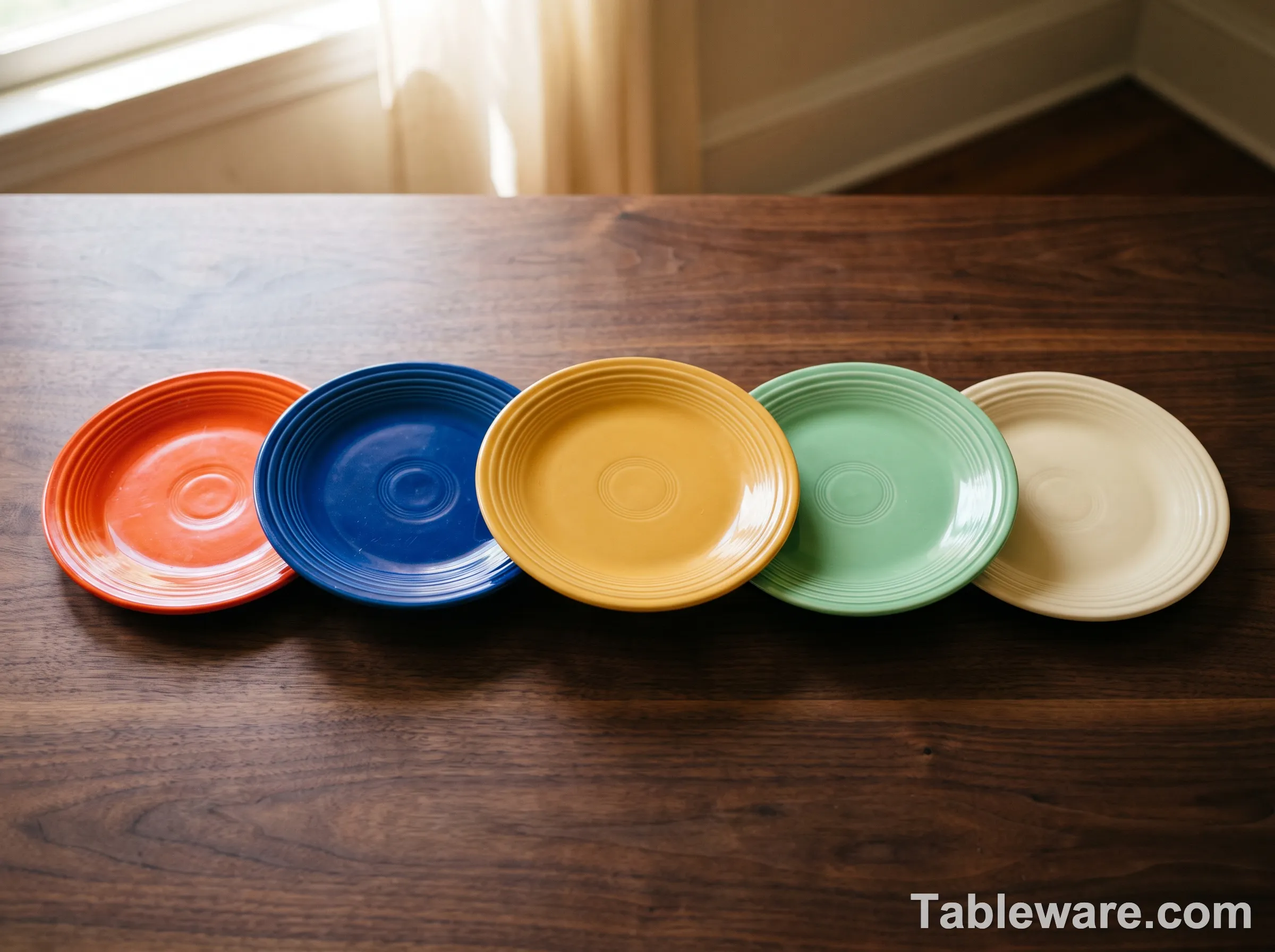
Fig 1. The original five 1936 colors, shown left to right: red, cobalt blue, yellow, green, ivory. The orange-red of the original Red is more saturated than a typical modern red glaze.
The Radioactive Red Era (1936–1972) and Why 1943 Was the Year Everything Stopped
Here's the part most "is Fiestaware radioactive" articles get half right.
The original Red glaze contained uranium oxide, which gave it that distinctive glassy depth and orange-red hue that no iron-oxide or cadmium-selenium formulation could match at the time. According to Oak Ridge Associated Universities measurements, an undamaged original red plate registers between 0.5 and 15 milliroentgen per hour on a Geiger counter held at the surface, and the beta dose at the rim of a teacup can hit 32 millirem per hour.
In late 1942, the federal government requisitioned civilian uranium stocks for the Manhattan Project. Homer Laughlin lost access to the ingredient. Red was discontinued in 1943, and the company pivoted to military contracts. Navy officer's mess dinnerware, mostly. The color stayed dead for the rest of the war.
Two things happened after the war:
The Atomic Energy Commission eventually released restrictions on the sale of uranium oxide for non-military use, but only the depleted-uranium byproduct of the enrichment process — material roughly 60% less radioactive than natural uranium. Homer Laughlin reformulated the red glaze and reintroduced it in 1959. This second-run red is the one that ran from 1959 to 1972, when production of the original Fiesta line ended entirely.
A 1992 Health Physics study by Landa and Councell measured uranium leaching from both formulations. The numbers are not zero. The researchers found 470 to 31,800 micrograms of uranium per liter migrating into acetic acid after 24 hours of contact, which is the realistic worst case for a plate that's been holding tomato sauce or citrus. The estimated effective ingestion dose for someone eating every meal off original red Fiestaware came out to around 40 millirem per year from leaching alone.
So is it safe? The honest answer: an intact pre-1943 or 1959–1972 red plate is generally considered safe to display, to handle, and to occasionally serve dry food on. The radiation dose from incidental contact is low. The dose from daily acidic-food contact is the part most safety references tell you to avoid, especially for kids. If you have a piece, you don't need to panic, but you also probably shouldn't be eating oatmeal off it every morning.
For a deeper look at how uranium oxide behaves inside a ceramic glaze, the reactive glaze chemistry explainer walks through the same kind of metal-oxide color chemistry that made the original Red possible.
The most common confusion I see at estate sales: a bright red plate in a stack of Fiestaware that is NOT pre-1943. From 1986 onward, Post-86 Fiesta Red (also called "Fiesta Red" or sometimes "Paprika" or "Poppy" depending on the year) contains no uranium at any concentration. It is a completely reformulated glaze. The way to tell them apart: pre-1943 and 1959–1972 red fluoresces chartreuse green under a UV flashlight. Post-86 red does not. If you don't have a UV light, the backstamp will tell you — but the blacklight is the single most reliable trick in the kit.
The 1950s Color Shift: Rose, Gray, Chartreuse, Forest Green (1951–1959)
By 1951, postwar American kitchens were changing. The chunky Art Deco cheer of the original 1930s palette felt dated. A new art director at Homer Laughlin — I'd love to name him, but the company is famously quiet about internal hires from this era — pushed a softer, more sophisticated range into production.
Four new colors dropped in 1951:
- Rose — a mauve-pink that became a mid-century icon. Ran until 1959.
- Gray — a true medium gray, surprisingly cool-toned for 1950s tableware. Ran until 1959.
- Chartreuse — the yellow-green that shows up in every "vintage Fiestaware" thumbnail on Etsy. Ran until 1959.
- Forest Green — a darker, slightly muted green. Distinct from the 1936 Light Green. Ran until 1959.
At the same time, three of the original colors were quietly retired: Cobalt Blue, the original Green, and Old Ivory. The reasons were partly commercial (the new colors were the marketing focus) and partly technical (the new glazes fired more cleanly in the updated kilns).
This 1951–1959 window is one of the most interesting collecting zones in the entire Fiestaware timeline. The "50s colors" had a distinct mid-century character, the range was modulated toward the softer palette that 1950s interior design was favoring, and the production runs were short. Gray, chartreuse, forest green, and rose were all retired by 1959, just eight years of production each.
Short run plus genuine collector demand equals premium prices. A chartreuse saucer in good condition will run you $25 to $50 today. A full 50s color place setting — all four colors, matched pieces, no chips — can clear $400 at auction. Compare that to yellow, the longest-running original color, where a dinner plate in nice shape is $10 to $20.
The collector's rule of thumb that holds up: if a vintage Fiestaware color was produced for less than ten years and is currently out of production, the secondary-market price is meaningfully higher than colors with 20+ year runs. Production scarcity is the single biggest price driver, not the "prettiness" of the color.
Medium Green and the Last Vintage Years (1959–1973)
In 1959, Homer Laughlin introduced what would become the most legendary Fiestaware color of all: Medium Green.
The shade is a vivid, slightly grayed Kelly green. Production ran from 1959 to 1969, a 10-year window, but in significantly lower volumes than other colors of the period. To this day, no one has fully explained why. The prevailing theory from the Fiestaware collectors I trust is that Medium Green was simply less popular with consumers at the time, and Homer Laughlin reduced production accordingly. What 1960s housewives didn't want on their tables is now the most sought-after color in the entire vintage Fiestaware canon.
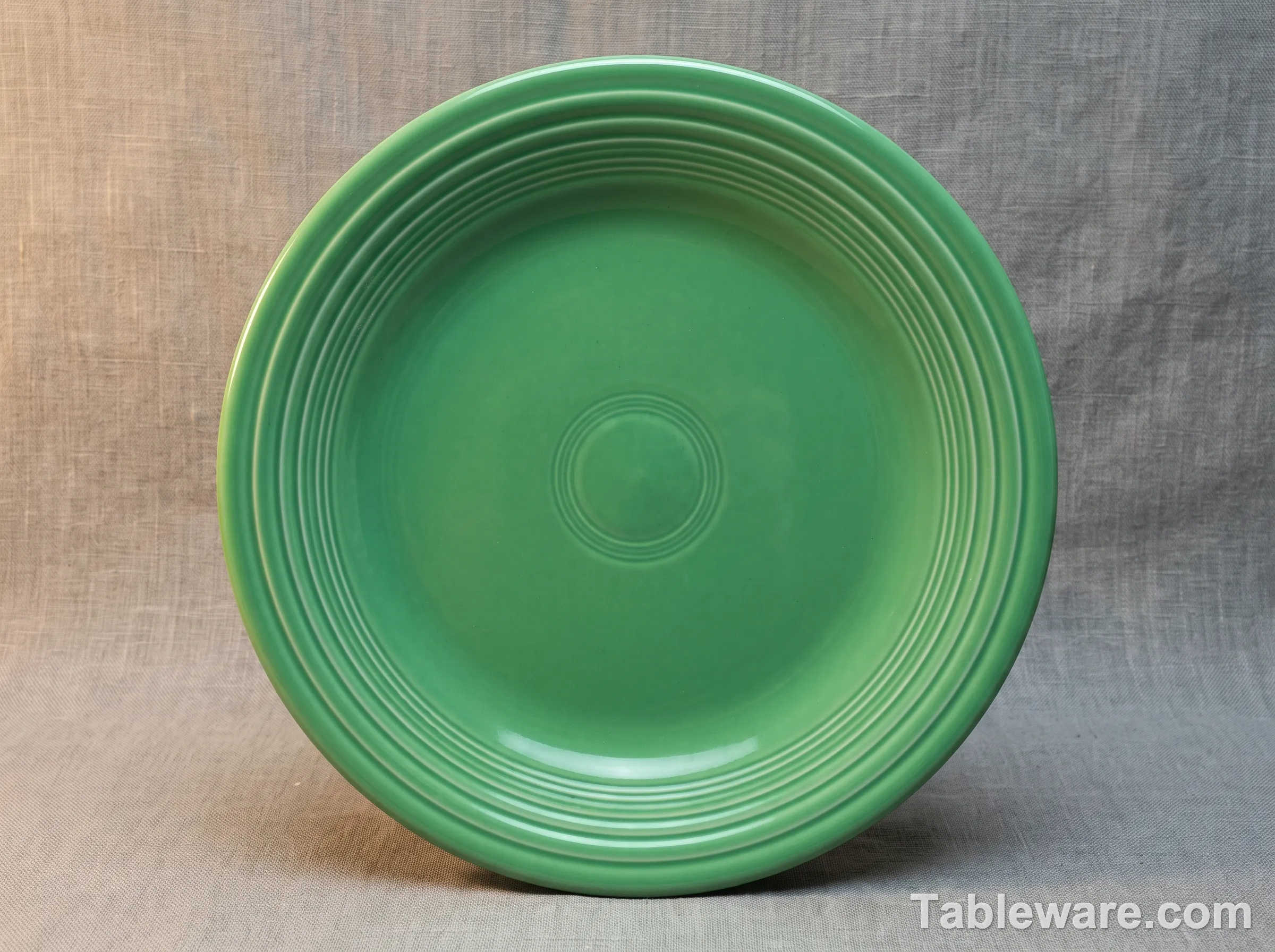
Fig 2. A Medium Green dinner plate. This is the color collectors pay the most for in the vintage line — 10-year production run, lower volumes, distinctive hue that's hard to fake.
The Medium Green value story in 2026:
- Common pieces (saucers, bread plates, fruit bowls): $25 to $50 each.
- Dinner plates: $60 to $120 each.
- Serving pieces (covered onion soup bowls, large platters, carafes): $150 to $400 each.
- Rarer shapes (the 12-inch chop plate, the 4-quart mixing bowl, the disc pitcher): $300 to $800 each.
If you have a stack of Medium Green in your cabinet and the backstamps say "Fiesta HLC USA" with concentric rings on the underside, take it to a specialty auction house, not eBay. A full Medium Green service for eight in good condition can clear $3,000 at the right house.
By the late 1960s, Fiestaware was losing market share. The chunky retro appeal of the 1930s and '40s was out of fashion in the era of Mod aesthetics and Avocado Green kitchen appliances. Homer Laughlin tried to adapt with two restyled sub-lines:
- Amberstone (1967–1973) — used existing Fiesta shapes in a warm brown/amber colorway targeted at the "harvest" kitchen aesthetic.
- Casualstone (1970–1972) — an antique gold variation of the same shapes with a stylized geometric underglaze pattern.
In 1969, the original line was also restyled as Fiesta Ironstone, with new shapes (handles added to cups, redesigned finials, modified bowl contours) and a new palette of Turf Green (close to Avocado), Antique Gold (close to Harvest Gold), and Mango Red (the same red, renamed). These pieces have modest collector interest today — they're genuine Homer Laughlin pottery on original Fiesta shapes, and they're worth picking up at thrift-store prices, but they sit well below the 1950s colors in demand.
In January 1973, all Fiesta production ceased. The molds went into storage. The great American dinnerware line that had graced millions of tables for 37 years simply stopped. Collectors call the 1973–1985 gap the "Dark Period."
The 1986 Relaunch: New Palette, Same Name
In 1986, on the 50th anniversary of the original launch, Homer Laughlin reintroduced Fiestaware. The relaunch used the original semi-vitreous clay body on shapes taken mostly from the last incarnation of vintage Fiesta (1969–1973), then switched to a fully vitrified clay for durability. The new line was marketed as "Fiesta" (no "ware") and was sold open stock at department stores.
The 1986 launch colors:
- Rose — a pink, not the same as the 1951 vintage Rose. Discontinued 2005.
- Black — a flat matte black. Discontinued 2015.
- Cobalt — a deep navy, similar to but brighter than the vintage Cobalt. Discontinued 2021.
- White — a bright stark white, the new neutral. Still in production.
- Apricot — a pale pinkish-tan. Discontinued 1998.
Since 1986, Homer Laughlin has released over 60 additional colors, with seasonal introductions and retirements creating intentional scarcity. Notable drops include Lapis (2017), Marigold (a frequent seasonal), Poppy (2018), Turquoise (re-introduced 2003 and still in), and a rotating "Color of the Year" marketing program that started around 2023.
The Post-86 line is well-made American pottery. It holds up to daily use, it looks great, and the colors are intentionally bright. But in terms of collector value, most Post-86 pieces are worth what you paid for them new. The exceptions are a handful of retired Post-86 colors with limited production runs, specifically:
- Lilac (2001–2006) — a soft lavender. Modest secondary-market premium; dinner plates $30–$50.
- Sapphire (2013–2016) — a deep blue similar to but distinct from Cobalt. Modest premium; dinner plates $25–$45.
- Plum (2010–2013) — a dark purple. Smaller premium; saucers $10–$20.
- Pearl Gray (2007–2010) — a soft gray; secondary market prices in the $20–$40 range for dinner plates.
- Chartreuse (re-released 2015–2017) — distinct from the 1950s vintage chartreuse, more yellow-green. Minor premium.
The key takeaway for anyone sorting through a Post-86 collection: Original Fiesta (1936–1973) is the collector market. Post-86 Fiesta (1986–present) is the use-it-and-enjoy-it market. A few specific retired Post-86 colors have small premiums, but the dollars are in vintage.
For the longer arc of how American casual-dining restaurants and chefs drove earthenware back into the mainstream, the earthenware fine dining revival covers the parallel track the 1986 Fiestaware relaunch was riding.
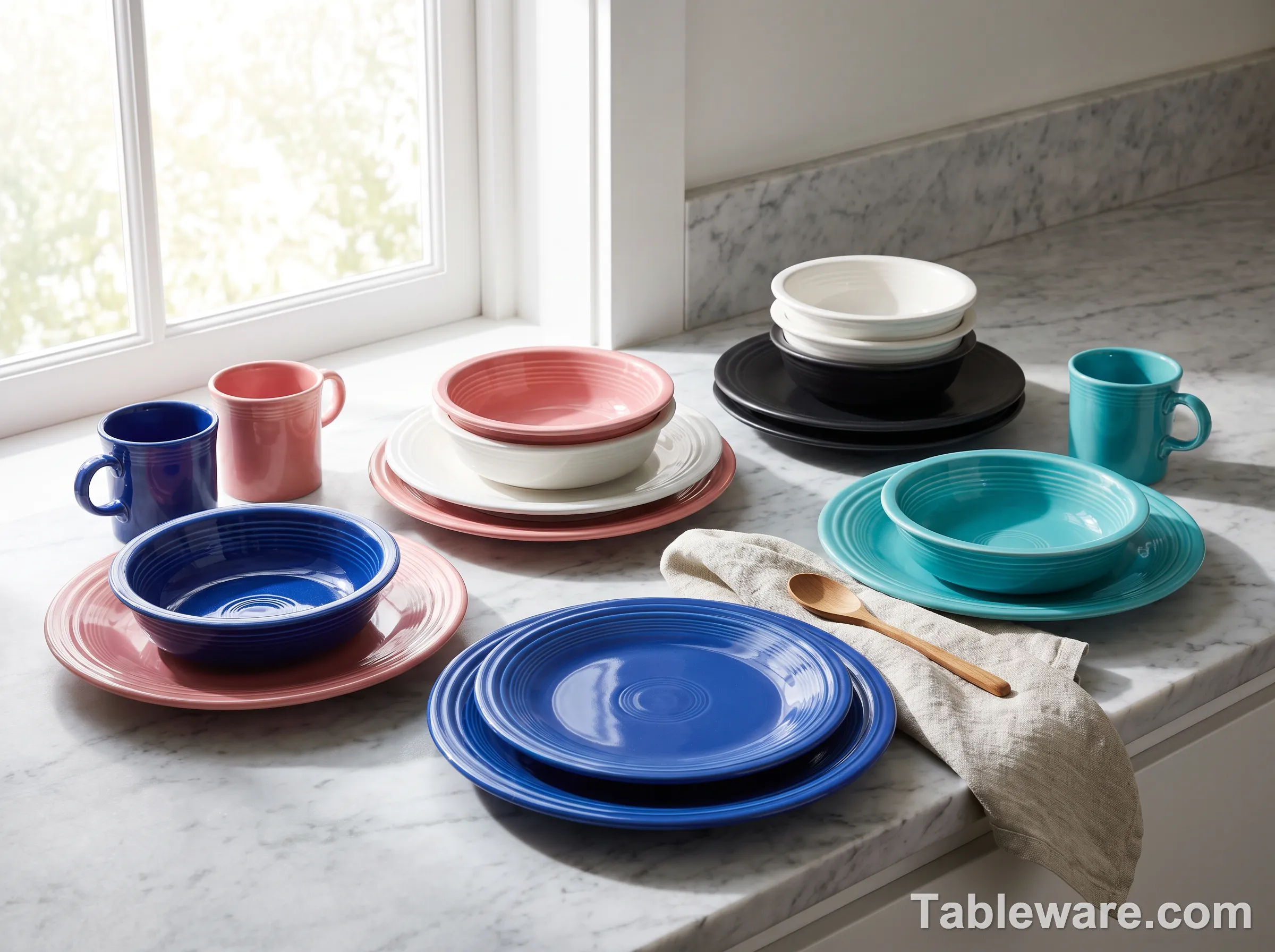
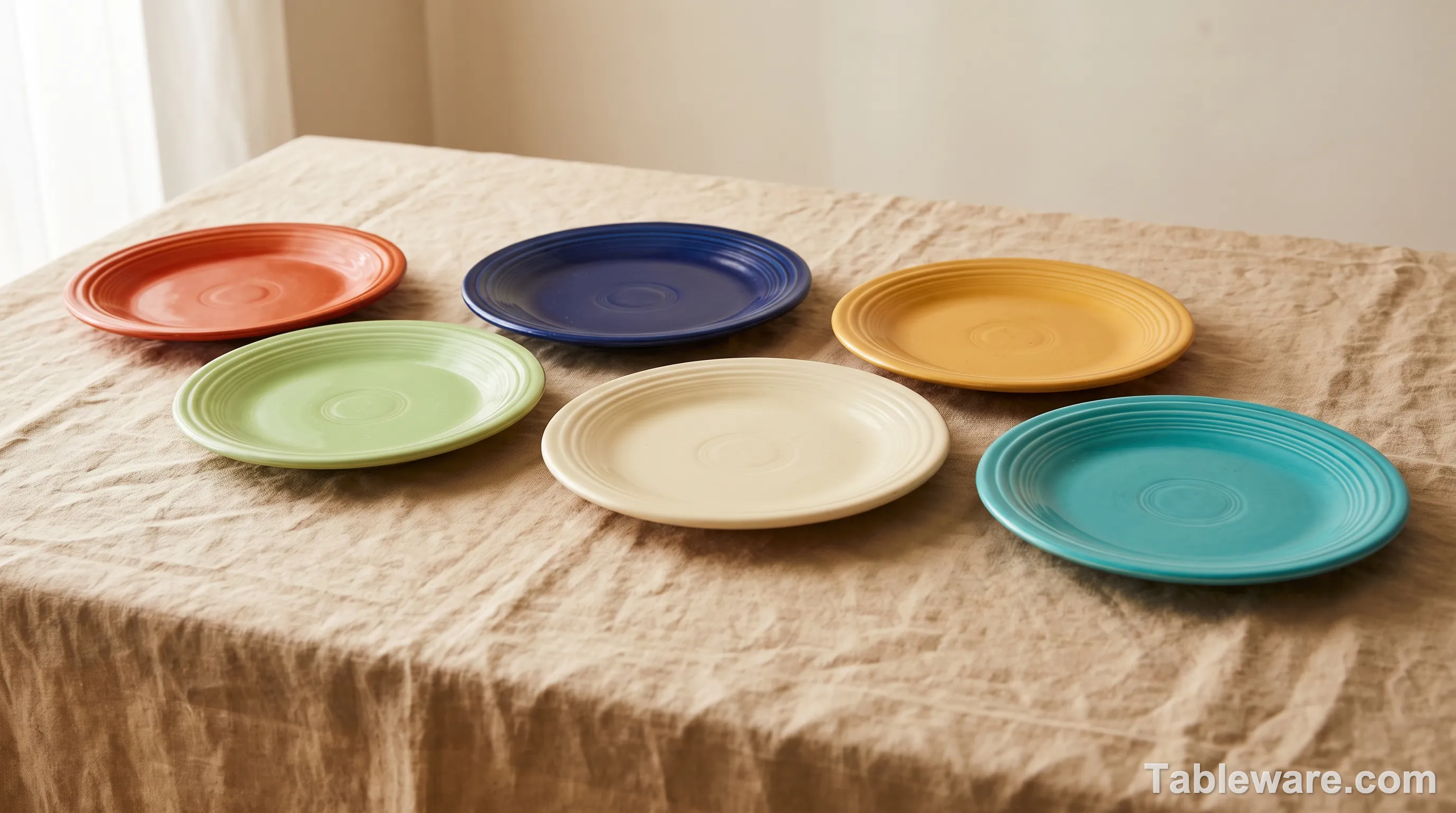
Fig 3. The Post-86 line from 1986 onward. The shapes are recognizable, but the glazes are completely different formulations, lead-free, no uranium, and much harder to confuse with vintage once you've handled both.
Vintage Fiestaware Color Chart by Year (1936–1973)
If you've inherited a stack of brightly colored plates or picked up a few at a thrift store, the single most useful diagnostic is a vintage Fiestaware color chart by year. Each color was tied to a specific production window, and once you know the window, you can usually date the piece, identify the era, and decide whether it's worth taking to a specialty auction.
The original 1936 lineup (Red, Cobalt Blue, Yellow, Green, Ivory) all date to 1936–1951 with the exception of Yellow, which kept going to 1969. Turquoise joined in 1937 and ran to 1969. The 1951 vintage color refresh swapped in Rose, Gray, Chartreuse, and Forest Green, retiring the original Cobalt, Green, and Ivory in the process. Medium Green arrived in 1959, the depleted-uranium Red came back in the same year, and both ran until 1969 (Medium Green) and 1972 (Red). The 1969 Fiesta Ironstone restyling closed out the original line, ending all production in January 1973.
For quick reference, if you find a color not in the 1936–1973 vintage palette, it's Post-86 (Lilac, Pearl Gray, Sapphire, Plum, and the 60+ other contemporary colors). The reverse also holds: if a color name doesn't appear in the Post-86 catalog, it's vintage-only. A wall chart or printable table like the one below is the easiest way to keep this straight.
Discontinued Fiestaware Colors: The Full Retired List
A discontinued Fiestaware color is one that was produced, then retired, and not currently part of the active Post-86 palette. The complete list as of 2026:
Vintage (1936–1973, no longer in production in any form):
- Original Red (natural uranium, 1936–1943)
- Cobalt Blue (1936–1951, reissued 1986 in a different formulation)
- Original Green / Light Green (1936–1951)
- Old Ivory (1936–1951, reissued 2008–2024 in a slightly different formula)
- Yellow (1936–1969)
- Turquoise (1937–1969, reissued 2003 in a different formulation)
- 1951 Rose (1951–1959)
- Gray (1951–1959)
- Chartreuse (1951–1959, briefly reissued 2015–2017 in a different formula)
- Forest Green (1951–1959)
- Medium Green (1959–1969) — the headline collectible
- Red (depleted uranium, 1959–1972)
- Mango Red (1969–1973, Fiesta Ironstone)
- Turf Green (1969–1973, Fiesta Ironstone)
- Antique Gold (1969–1973, Fiesta Ironstone)
Post-86 (1986–present, retired from the active line):
- Rose (1986–2005)
- Black (1986–2015)
- Cobalt reissue (1986–2021)
- Apricot (1986–1998)
- Lilac (2001–2006)
- Pearl Gray (2007–2010)
- Plum (2010–2013)
- Sapphire (2013–2016)
- Poppy (2018–2022)
- Lapis (2017–2024)
- Scarlet reissue (2024, briefly reissued then retired again)
The list keeps growing because Homer Laughlin's whole business model depends on color rotation. Every discontinued drop creates artificial scarcity, which keeps the collector market active and drives the secondary-market prices you see in the table below. If you're trying to figure out whether to keep or sell a piece, the question is rarely "is it valuable in absolute terms" — it's "how many of these are still in production today?" When the answer is zero, the price goes up.
Color Reference Table 1936–2026
The full chronological reference, every color Fiestaware has ever shipped, in one place. Prices are 2026 secondary-market ranges for a dinner plate in good condition (no chips, no cracks, no crazing). Auction results for rarer shapes run higher.
| Color | Production Years | Era | Approx. Plate Value (2026) |
|---|---|---|---|
| Red (natural uranium) | 1936–1943 | Vintage | $30–$150+ |
| Cobalt Blue | 1936–1951 | Vintage | $20–$45 |
| Yellow | 1936–1969 | Vintage | $10–$20 |
| Green (Light Green) | 1936–1951 | Vintage | $12–$25 |
| Ivory / Old Ivory | 1936–1951 | Vintage | $12–$30 |
| Turquoise | 1937–1969 | Vintage | $15–$30 |
| Red (depleted uranium) | 1959–1972 | Vintage | $25–$80 |
| Rose (1951) | 1951–1959 | Vintage | $20–$40 |
| Gray | 1951–1959 | Vintage | $30–$60 |
| Chartreuse | 1951–1959 | Vintage | $30–$75 |
| Forest Green | 1951–1959 | Vintage | $25–$50 |
| Medium Green | 1959–1969 | Vintage | $60–$120 |
| Mango Red (Fiesta Ironstone) | 1969–1973 | Vintage Ironstone | $15–$35 |
| Turf Green (Fiesta Ironstone) | 1969–1973 | Vintage Ironstone | $15–$30 |
| Antique Gold (Fiesta Ironstone) | 1969–1973 | Vintage Ironstone | $15–$30 |
| Rose (1986) | 1986–2005 | Post-86 | $5–$15 |
| Black | 1986–2015 | Post-86 | $8–$20 |
| Cobalt (reissue) | 1986–2021 | Post-86 | $5–$20 |
| White | 1986–present | Post-86 | $5–$15 |
| Apricot | 1986–1998 | Post-86 | $15–$30 |
| Lilac | 2001–2006 | Post-86 | $30–$50 |
| Pearl Gray | 2007–2010 | Post-86 | $20–$40 |
| Plum | 2010–2013 | Post-86 | $15–$30 |
| Turquoise (reissue) | 2003–present | Post-86 | $5–$15 |
| Sapphire | 2013–2016 | Post-86 | $25–$45 |
| Poppy | 2018–2022 | Post-86 | $10–$25 |
| Lapis | 2017–2024 | Post-86 | $15–$35 |
| Scarlet (re-introduced 2024) | 2024–present | Post-86 | $5–$15 |
A quick note on the spread in some of the prices. Uranium red and the 1950s short-run colors can swing wildly based on shape, size, and the specific market. A 12-inch chop plate in Medium Green is going to be $400-plus. A Medium Green saucer is $25. The dinner plate is the most-traded piece and the most reliable price benchmark, which is why I'm using it for the table.
What Collectors Pay in 2026: Value by Color and Era
A few patterns are worth flagging if you're trying to figure out what you have.
Vintage Red (both pre-1943 and 1959–1972) has held its value through every market wobble since 1980. It's the "blue chip" of Fiestaware collecting. The 14% uranium oxide content isn't something you can fake, the production records are well-documented, and the population of surviving pieces is finite and slowly shrinking (every chip, every break, every lost piece removes a unit from the available pool). If you have an original red dinner plate in good condition, the 2026 price floor is around $30 and the realistic retail ceiling is closer to $150 for a single plate. Rare shapes go higher.
The 1951 "50s colors" — Rose, Gray, Chartreuse, Forest Green — are the most underrated. These are the colors I tell new collectors to look for first, because they have a meaningful premium over common yellow or turquoise plates, they show up at estate sales for less than their true value, and the 8-year production run is well-documented enough to authenticate.
Medium Green is the headline number. A full Medium Green service for 8 in good condition can clear $3,000. The single most-asked question I get from people cleaning out a parent's house is "is this Medium Green worth anything?" The answer is almost always yes, more than you think.
Cobalt Blue vintage (1936–1951) is the sleeper. Most people assume the post-1986 cobalt is the same as the vintage cobalt. It isn't. The vintage cobalt is deeper, slightly more muted, and was produced for only 15 years. A vintage cobalt dinner plate in nice shape runs $20 to $45; a 10-inch cobalt platter can be $200-plus.
The shape matters as much as the color. A 4-quart mixing bowl in Medium Green is a serious find. A Medium Green saucer is a fun find. The same color, very different prices. The vintage shape catalog included onion soup bowls, carafes, tall vases, 12-inch chop plates, and disk pitchers — shapes that were discontinued decades ago and are the most-collected individual pieces.
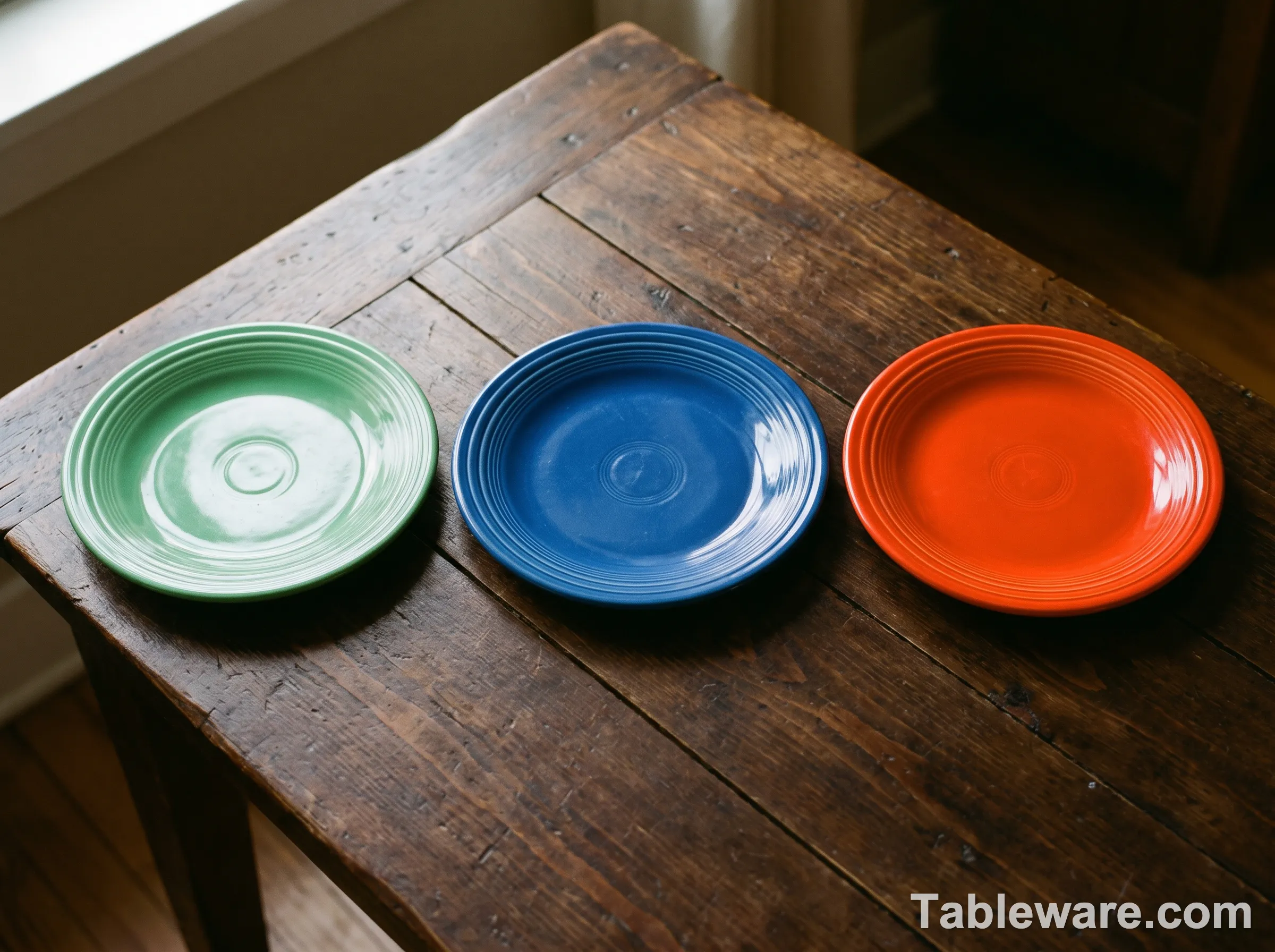
Fig 4. The three highest-value vintage colors in 2026: Medium Green (left, dinner plate $60–$120), Cobalt Blue (center, $20–$45), and original Red (right, $30–$150+). All three are 1936–1973 production.
FAQ: Dating, Authentication, and Safety
How do I tell if my Fiestaware is vintage (1936–1972) or Post-86 (1986–present)?
Flip it over and look at the base. Vintage pieces have an embossed or ink-stamped "Fiesta HLC USA" or "GENUINE Fiesta" mark, often with concentric rings on the underside. Post-86 pieces almost always have an impressed lowercase "fiesta" or the "H" logo (Homer Laughlin China), and "LEAD FREE" is usually stamped somewhere on the base. Many early pieces, especially small saucers and tumblers, have no backstamp at all — in which case the color and shape do the dating work.
For a complete walk-through of how to read pottery backstamps across brands (not just Fiestaware), see the pottery marks guide.
Is Original Red Fiestaware Radioactive? Safety Facts
The short version, in case you scrolled here from a search result: yes, the original Red glaze is measurably radioactive, and the levels are documented in detail by the Oak Ridge Associated Universities surveys and the Landa–Councell 1992 Health Physics study. Surface gamma readings on an intact pre-1943 or 1959–1972 red plate run 0.5 to 15 milliroentgen per hour. The bigger concern is leaching into acidic foods: 470 to 31,800 micrograms of uranium per liter of acetic acid after 24 hours of contact. For a piece you plan to display or handle occasionally, that's not a panic-button number. For a piece you plan to eat off every day, especially with citrus, tomato, or vinegar, that's a reason to retire the piece to a shelf. Post-86 red contains no uranium at any concentration and is safe for daily food contact.
Why is Medium Green so much more valuable than other vintage colors?
Three reasons, in order of importance. First, the production volume was genuinely lower than other vintage colors — Homer Laughlin made less of it, and no one has ever fully explained why. Second, the 10-year production window (1959–1969) is short compared to the 17+ year runs of yellow, turquoise, and some of the original colors. Third, the color is genuinely hard to confuse with anything else. Once you see Medium Green next to a regular Post-86 shamrock or a 1930s Light Green, the difference is obvious, which means authentication is reliable and forgery is rare.
Can I still use my vintage Fiestaware for everyday meals?
For colors that are not the original red — yes, mostly. The non-red vintage glazes are lead-bearing but at concentrations that modern safety references consider acceptable for occasional food contact, especially with non-acidic foods. For original red, treat it as display-only or for dry foods. If you have a piece you're worried about, a home lead test kit will give you a qualitative answer in 24 hours, and the ORAU Fiestaware fact sheet has more detailed radiation context.
How do I find out what my specific piece is worth?
Three reliable paths, in order of how much money you can expect to make:
- Specialty auction houses (Skinner, Cowan's, Heritage Auctions) — best for rare shapes, full sets, and Medium Green or original red pieces. They take a commission but they know the market.
- eBay sold listings (filter by "sold items" not "active listings") — best for common pieces. Look at the last 90 days of comparable sales, not asking prices.
- Facebook Fiestaware collector groups — the Homer Laughlin Collectors Association (HLCCA) maintains a database and the community is genuinely helpful. Post a photo with a clear shot of the backstamp and the color, and you'll get an experienced read within hours.
A piece you inherited is almost always worth more than you think. The exception is a Post-86 piece in a common current color, which is worth what you paid for it. If you have a stack of Post-86 Fiestaware from the 2000s and you're not sure whether to keep or sell, the answer is to keep it and use it. The secondary market is not going to give you back what you paid.
Will Fiestaware keep appreciating?
For specific high-demand colors (original red, Medium Green, 1950s short-run colors), the long-term trend is up. The population of surviving vintage pieces is finite, the population of new collectors is not, and the cultural cachet of 1930s American industrial design has only grown since the 1986 relaunch. For Post-86 colors, the only ones with real upside are the limited-run retired colors (Lilac, Pearl Gray, Sapphire, Plum) — and even those are modest premiums, not investment-grade. Treat Fiestaware as something to use, to look at, and to enjoy, and any financial upside is a bonus.
That's the full color history. If you want to go deeper on the radioactive-red angle — including the actual Geiger counter readings and the Landa-Councell 1992 leaching study — the Oak Ridge Associated Universities fact sheet is the single best public source. The Homer Laughlin Collectors Association (HLCCA) maintains the most accurate color and backstamp database for collectors. And the 1986–2026 Post-86 color catalog, which I summarized in the reference table, is officially documented in the Homer Laughlin factory archives if you're trying to authenticate a specific year.