Most people pick a dinnerware set the same way they pick a paint color: they hold a single plate up, decide whether they like the color, and walk to the register. They never ask the deeper question—how was this thing actually made?
That question matters more than you might think. The manufacturing method that turned your lump of clay into a finished plate determines nearly everything you care about as an owner: the weight in your hand, the uniformity of a 12-piece set, the price you paid, the texture your fork glides over, and even how the plate will fail if you drop it. Two identical-looking plates from two different brands can behave like completely different products because they were formed on different machines, by different hands, two centuries apart in technique.
This wiki entry is a field guide to the three dominant forming methods used to make the ceramic dinnerware you buy today: hand-throwing on a potter's wheel, slip-casting in plaster molds, and mechanical pressing or jiggering. Once you understand how each one works, you can read a plate the way a jeweler reads a gemstone—and you will never look at a $400 artisanal bowl the same way again.
1. The Big Picture: Three Forming Families
Before we dive into the details, here is the cheat sheet. Every piece of ceramic dinnerware you have ever eaten from belongs to one of these three families.
| Method | Material commonly used | Typical product | Price tier | Production volume |
|---|---|---|---|---|
| Hand-Thrown | Stoneware, porcelain, raku | Studio bowls, mugs, vases, restaurant signature pieces | \($–$$\) | 1–50 per day per potter |
| Slip-Cast | Porcelain, bone china, fine stoneware | Fine china, intricate shapes, hotel-grade sets | \(–$\) | 100–10,000+ per day |
| Pressed / Jiggered | Earthenware, stoneware, porcelain | Mass-market plates, mugs, bowls | \(–$\) | 10,000+ per day per line |
These are not just three factories running side-by-side. They are three different philosophies of how a plate should come into being. One assumes the human hand is the source of all value. One assumes the mold holds the knowledge. The third assumes the machine does.
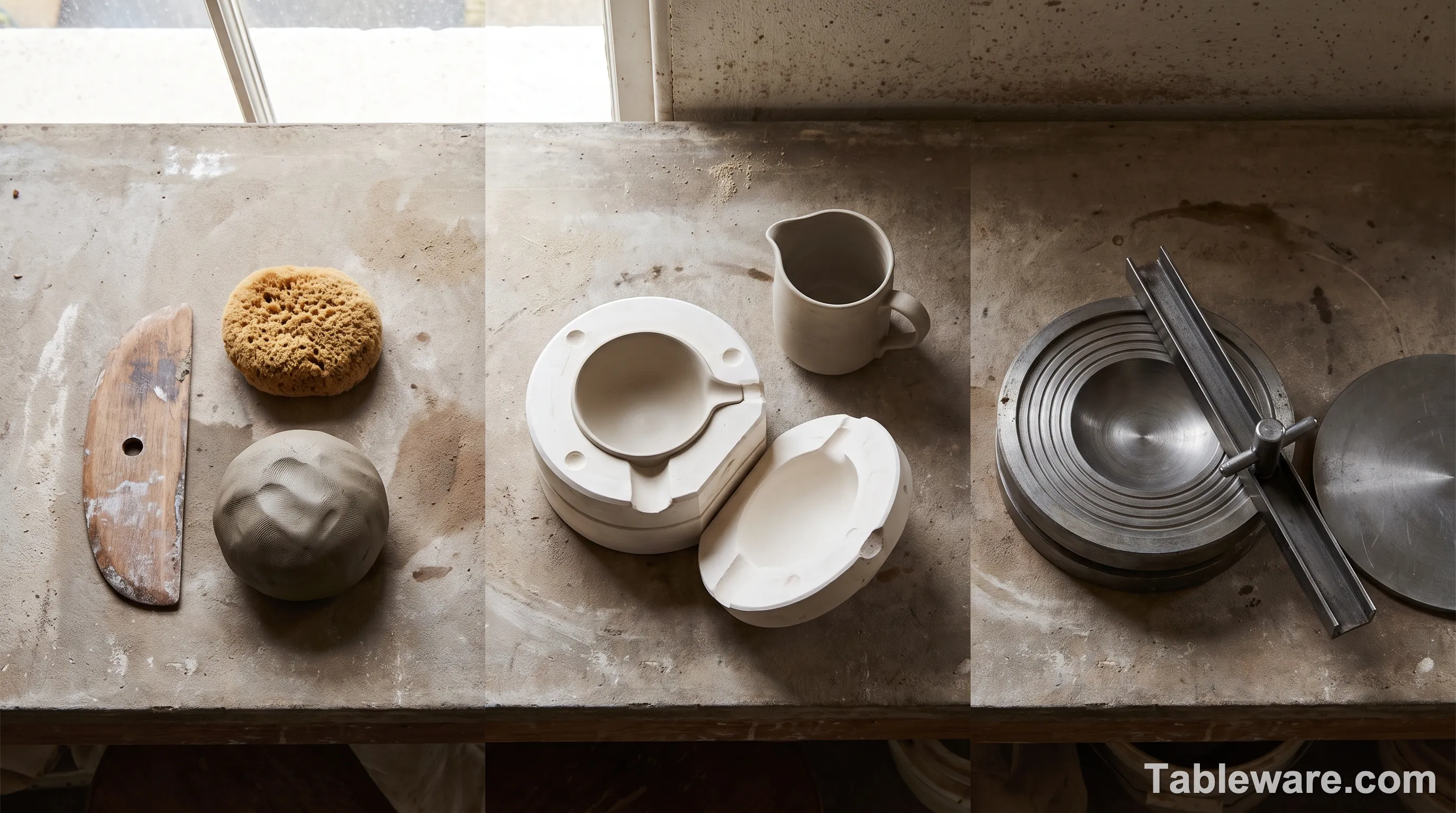
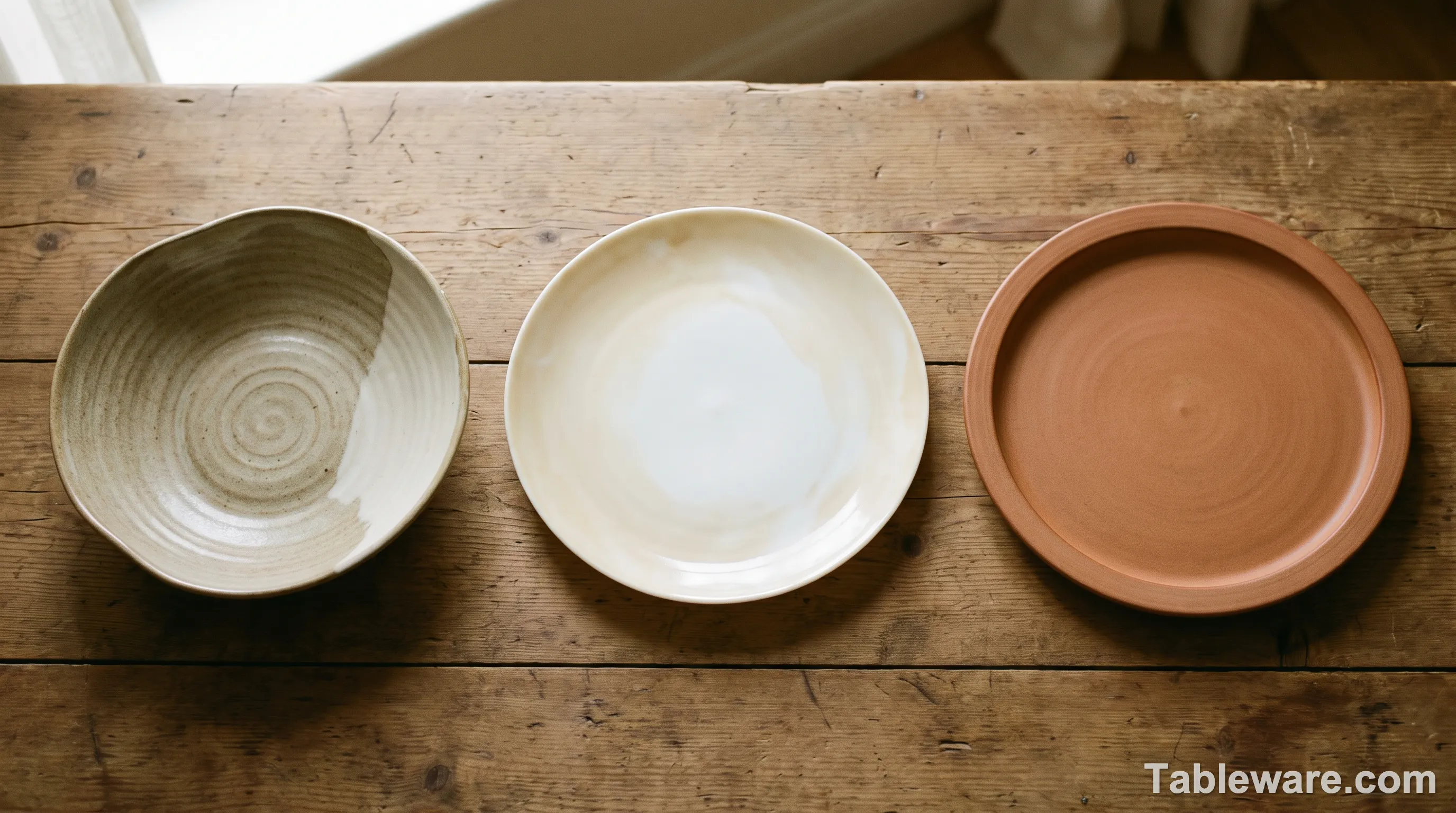
Fig 1. The three forming families at a glance: hand-thrown (left), slip-cast (center), pressed (right).
2. Hand-Throwing: The Potter's Wheel (and Why It Still Matters)
2.1 Where It Comes From
The potter's wheel is the oldest continuously used machine in human history. The earliest wheel-thrown pottery, found in Mesopotamia, dates to roughly 3,500 BCE—older than the Egyptian pyramids. For roughly 5,000 years, every single ceramic vessel on Earth was either coiled by hand or thrown on a wheel.
The principle is deceptively simple. A disc of clay is centered on a rotating head. The potter applies water and pressure with their hands, and the centrifugal force of the spinning wheel does the rest. The clay "rises" between the hands like a column, then opens up, then collapses into a vessel of the desired shape. There is no mold. There is no machine pulling or pushing. The wall thickness, the curve, the foot ring—all of it is encoded in the potter's muscle memory and the angle of their fingers.
2.2 The Physical Process
A trained potter can throw a basic cylinder (a "bottle" in pottery parlance) in under two minutes. Turning that cylinder into a finished dinner plate, however, takes much longer. Here is the typical sequence:
- Wedging the clay (kneading it by hand to remove air bubbles—air pockets explode in the kiln).
- Centering the clay on the wheel head.
- Opening the form by pressing thumbs into the center.
- Pulling the walls upward, thinning them to roughly 4–6 mm.
- Shaping the rim, the curve of the body, the foot.
- Trimming the foot ring once the piece has dried to "leather-hard" stiffness (roughly 12–24 hours later).
- Drying completely (3–7 days).
- Bisque firing (the first kiln trip, around 950°C).
- Glazing by dipping, pouring, or brushing.
- Glaze firing (the second kiln trip, up to 1,280°C for stoneware).
By the time a plate is finished, it has been touched by human hands at least a dozen times. Each touch leaves a trace.
2.3 What Hand-Throwing Leaves Behind (The Tell-Tale Signs)
This is the part collectors care about. A hand-thrown piece has several visible and tactile signatures you can use to identify it:
- Spiral throwing lines on the inside of bowls and the foot of plates. These concentric grooves are the fingerprint of the wheel.
- Slight asymmetry. Two hand-thrown bowls from the same potter on the same day will never be perfectly identical. The diameter of the rim may differ by 2–3 mm. The weight may differ by 10–20 grams.
- A pulled-up or trimmed foot ring. A skilled potter cuts a deliberate foot ring with a wire tool; a less skilled potter leaves a slightly ragged one. Either way, you can usually see the tool marks.
- Variable wall thickness. If you run your finger around the inside of a hand-thrown bowl, you will feel subtle high and low points where the potter's fingers moved at different speeds.
- A "throwing mark"—a small spiral or dimple on the very bottom, where the clay was centered against the wheel head.
2.4 Who Uses It, and Why
Hand-throwing today is essentially an artisanal and fine-dining phenomenon. Studio potters, small-batch makers, and Michelin-starred restaurant collaborations use it because:
- No mold cost. A potter can start a new shape today without spending $5,000 on a plaster mold.
- Authentic variation is a feature, not a bug. Restaurant diners pay a premium for plates that look made by a person.
- Complex one-off shapes are possible. No mold is needed for sculptural or experimental forms.
The downside is brutal: hand-throwing is physically exhausting and slow. A single skilled potter produces 30–50 pieces per day at the upper end, and only a fraction of those will pass quality control. The labor cost alone explains why a hand-thrown dinner plate can retail for $80–$300 per setting, while a pressed one costs $4.
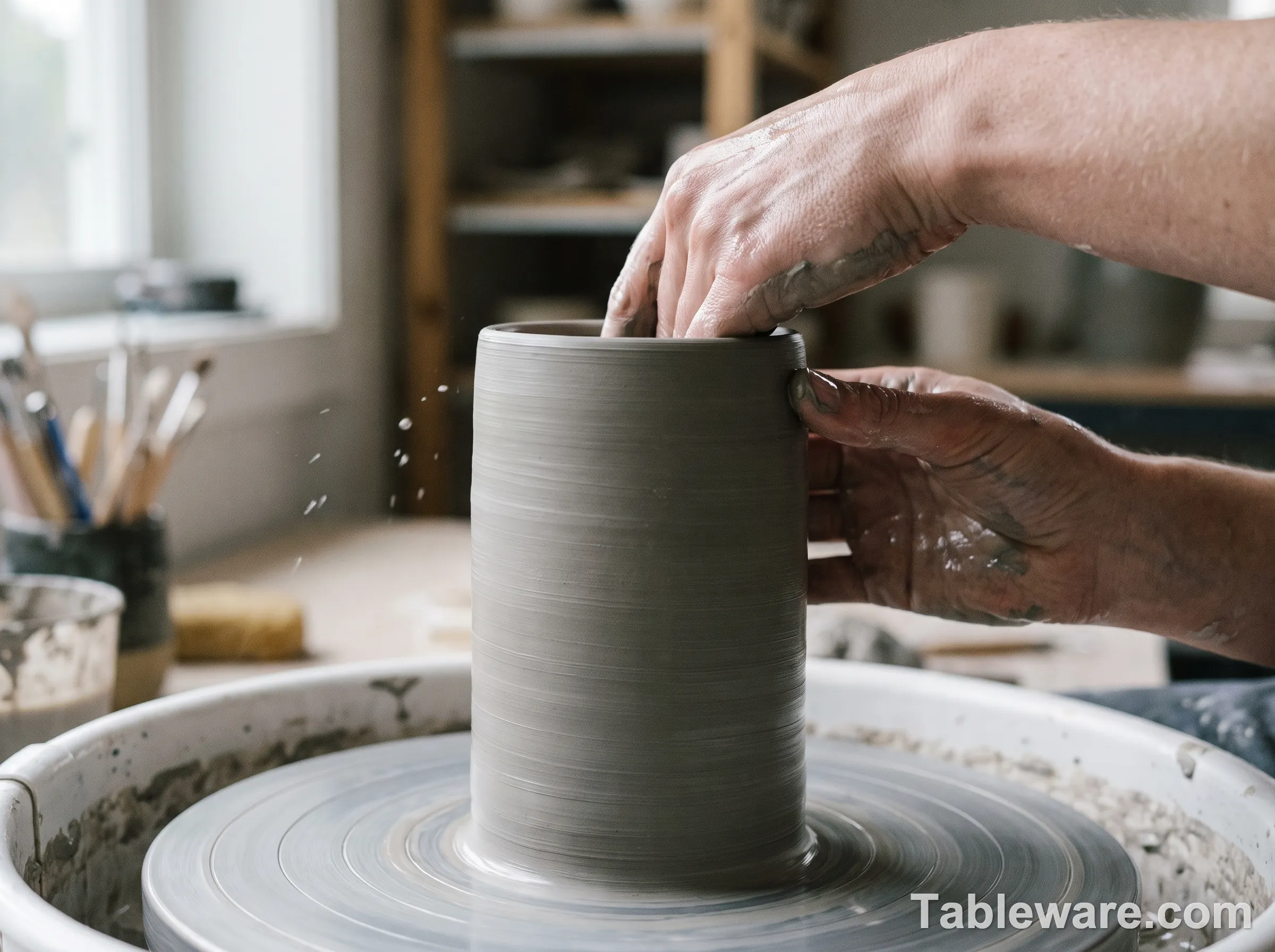
Fig 2. The signature of hand-throwing: a potter's thumbs opening a centered cylinder of clay. The wall is shaped entirely by hand pressure against centrifugal force.
3. Slip-Casting: The Plaster Mold Revolution
3.1 Where It Comes From
Slip-casting was invented in 18th-century Europe, primarily to solve one specific problem: how to make bone china thin enough to be translucent, but in repeatable, identical pieces. The English bone china industry—Wedgwood, Spode, Royal Worcester—pioneered the method because wheel-throwing was incapable of producing the thin, even-walled pieces the market demanded. A thrown bone china cup would be too thick to glow when held to a candle.
The breakthrough was a simple piece of plaster. Plaster of Paris is porous. When you pour liquid clay (called "slip") into a plaster mold, the plaster wicks the water out of the slip, leaving a layer of solid clay fused to the mold's interior surface. After 20–60 minutes, you pour out the excess slip, wait another hour, and the cast piece can be removed from the mold like a finished cake from a pan.
3.2 The Physical Process
The modern slip-casting line looks like this:
- Slip preparation. Dry clay is mixed with water and a deflocculant (usually sodium silicate) to create a creamy liquid with the consistency of heavy cream.
- Mold filling. The slip is pumped or poured into a multi-part plaster mold. A single mold for a dinner plate has 3–5 parts that lock together.
- Dwell time. The plaster wicks water. The cast layer grows from the inside of the mold outward. For a 3 mm plate wall, the dwell time is roughly 45–90 minutes.
- Drain. Excess slip is poured back into the tank for reuse.
- Demolding. The mold is opened and the cast piece is removed—still wet and fragile.
- Fettling. The seam line (the ridge left where the mold parts meet) is sanded or sponged off by hand or by a small rotating tool.
- Drying, bisque firing, glazing, glaze firing—the same downstream steps as hand-throwing.
A modern bone china factory like Wedgwood's Barlaston plant or Royal Doulton's Burslem works runs dozens of molds simultaneously, with workers fettling and reloading on a 20-minute cycle. A single line can produce several thousand pieces per day.
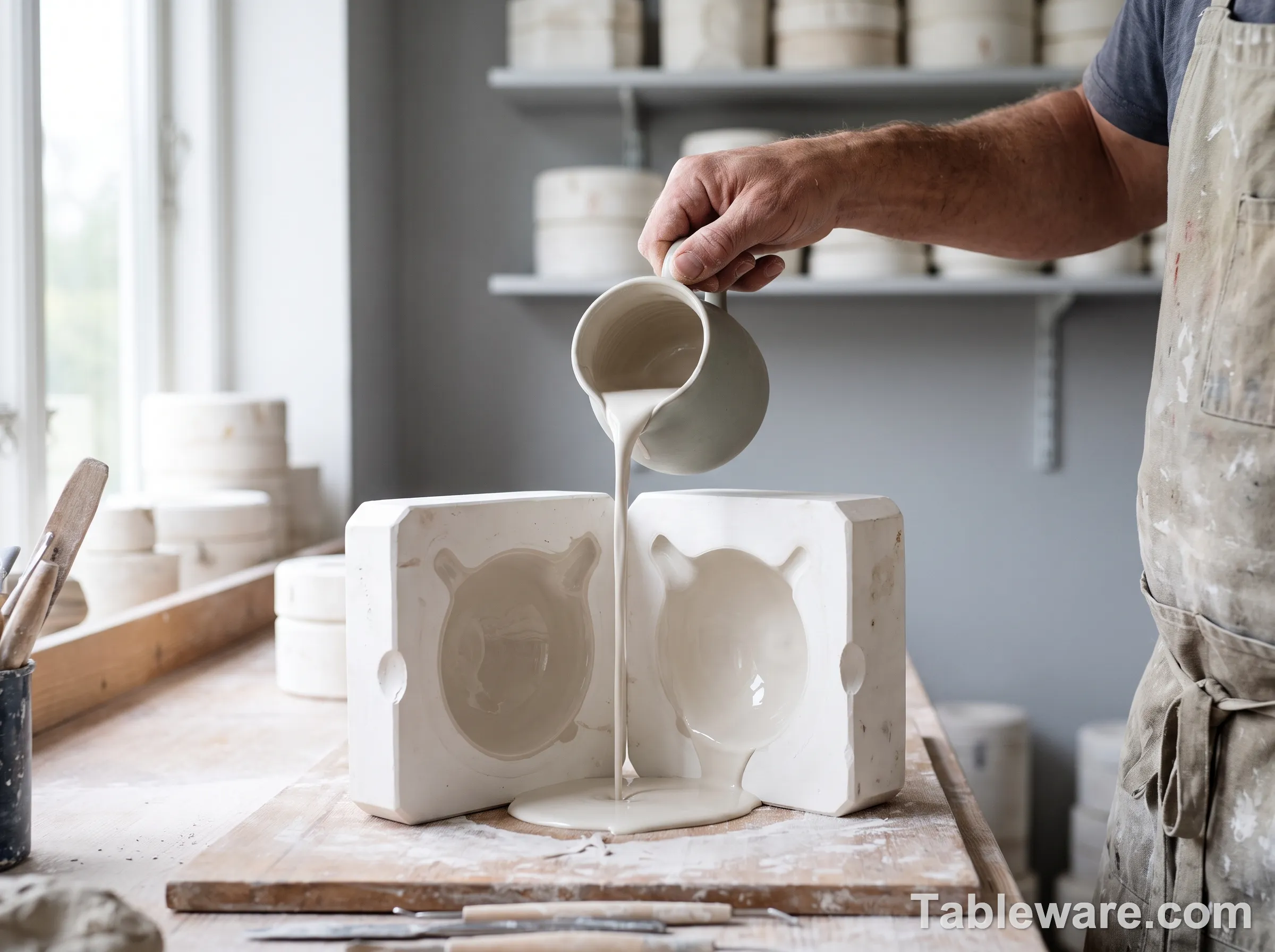
Fig 3. A two-part plaster mold being filled with porcelain slip. The plaster wicks water from the slip, depositing a thin, even layer of clay against the mold's interior surface.
3.3 What Slip-Casting Leaves Behind
Slip-cast pieces have their own signatures—most of them the opposite of hand-thrown:
- Seam lines. Look at the side of a slip-cast mug or the rim of a slip-cast plate. You will see a faint vertical line where two halves of the mold met. It is normally sanded smooth, but on cheap pieces you can feel it with a fingernail.
- Perfect symmetry. Slip-cast pieces are too identical. A 12-piece set from a major brand will weigh within 5 grams of each other per piece. The rim diameter will be identical to within 0.5 mm. This is the surest sign of casting.
- Thin, even walls. A slip-cast bone china teacup wall can be 2 mm thick and still ring like a bell. A thrown cup of the same size would be 4–5 mm.
- A "spine" inside. Some cast pieces have a thicker ridge on one side where the mold's parting line was. You can feel it if you run a finger along the inside of a cast bowl.
- Pinholes. Tiny pockmarks in the glaze, caused by air bubbles in the slip that burst against the mold. A few are normal; dozens is a sign of poor quality control.
3.4 Who Uses It, and Why
Slip-casting is the workhorse of the fine dining and hospitality industries. Bone china, hotel-grade porcelain, restaurant-grade plates with intricate patterns, and any shape that is too thin or too complex for throwing ends up slip-cast. The major British heritage brands—Wedgwood, Royal Doulton, Spode, Royal Worcester—use slip-casting for almost everything they sell. So do most high-end European porcelain makers (Villeroy & Boch, Rosenthal, Bernardaud) and Japanese makers of fine porcelain (Noritake, Nikko).
The trade-off is mold cost. A single plaster mold for a complex shape can cost $1,000–$5,000 and last only 80–150 casts before it wears out. This is why a slip-cast set still costs more than a pressed one, but far less than a hand-thrown one. The mold absorbs the design cost; the production cost per piece is then very low.
4. Pressing and Jiggering: The Industrial Mainstream
4.1 Where It Comes From
Pressing and jiggering are the methods you encounter most often without realizing it. If you have ever bought a $20–$60 dinnerware set at Target, IKEA, Walmart, or Amazon, it was almost certainly made by one of these two processes. Together, they account for perhaps 80% of all ceramic tableware sold in the world.
Jiggering was developed in the 19th century as a mechanized alternative to throwing. A flat disc of clay is placed on a spinning mold (the "jigger"), and a profiled tool (the "jigger arm") presses down on the clay to shape the inside of the plate. Think of it as a potter's wheel with a metal finger. The result is a perfectly formed plate, every 15–30 seconds, with a near-identical rim profile.
Pressing is a more recent descendant. A measured amount of clay (a "billet") is placed between two metal dies, and a hydraulic press squeezes them together. This is the standard method for saucers, square plates, shallow bowls, and any shape that does not need a curved interior.
4.2 The Physical Process
A modern jiggering line for dinner plates looks like this:
- Clay preparation. Clay is pugged (extruded through a vacuum chamber) to remove air and create a uniform body.
- Blank forming. A rolling cutter stamps flat circular "blanks" out of a continuous clay slab.
- Jiggering. Each blank is dropped onto a spinning mold. The jigger arm descends and shapes the plate in 2–4 seconds.
- Drying. Plates ride a conveyor through a temperature- and humidity-controlled dryer for 6–12 hours.
- Fettling and sponging. A light sanding removes the mold seam; the foot is sponged smooth.
- Bisque firing, glazing, glaze firing.
Pressing follows the same flow, but the forming step is a hydraulic press instead of a spinning mold. Pressing is faster and cheaper for shallow shapes but cannot produce the curved interior of a deep bowl or a coupe plate.
4.3 What Pressing and Jiggering Leave Behind
Pressed and jiggered pieces are the hardest to identify by touch, because the processes are very mature. But there are clues:
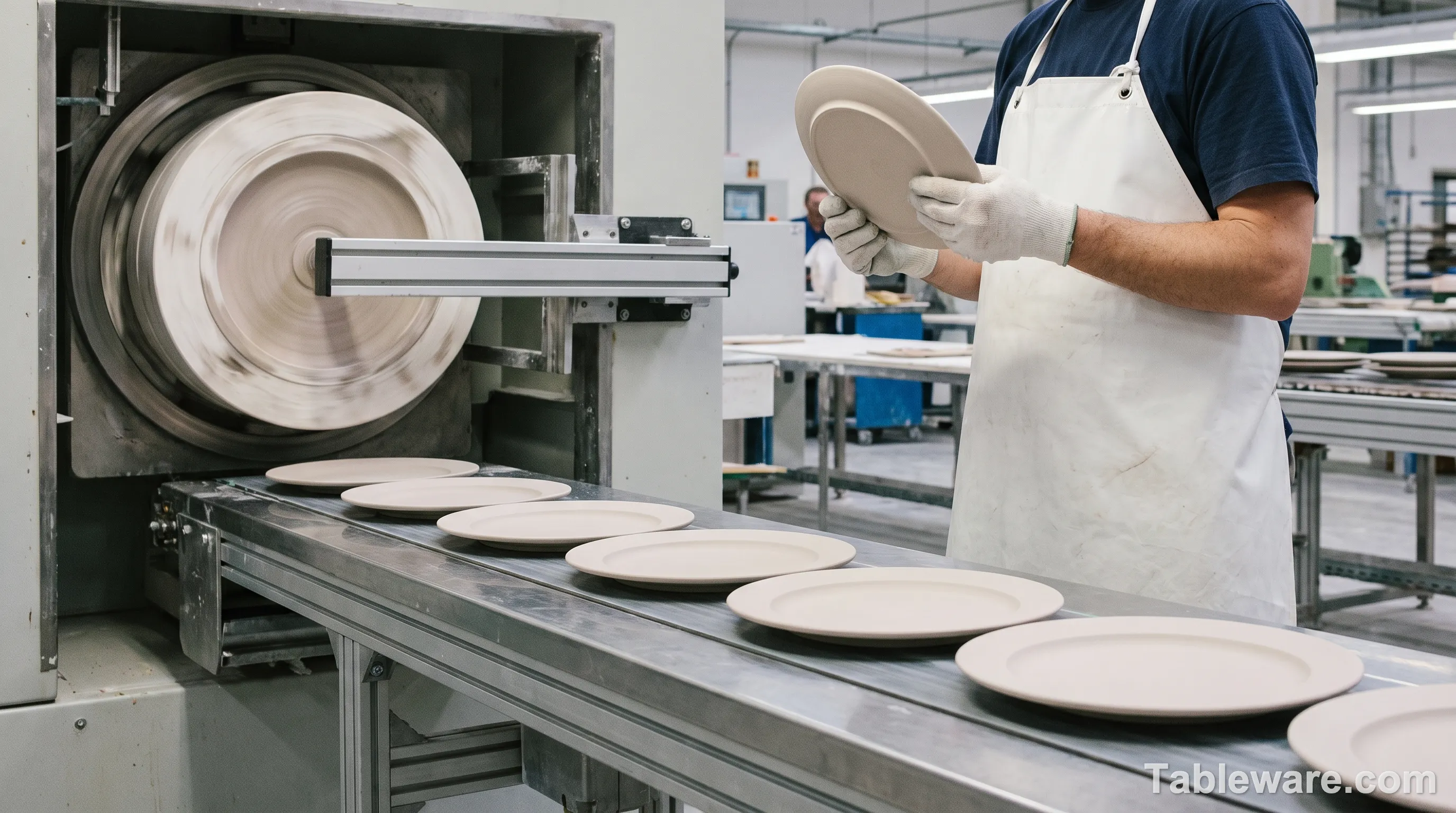
Fig 4. A modern jiggering line: a profiled arm presses the clay into shape on a spinning plaster mold. The cycle takes seconds, and every plate is dimensionally identical to its neighbor.
- A perfectly flat back with concentric ridges. The bottom of a jiggered plate is flat and shows a circular "spider" pattern of faint ridges from the mold. Pressed plates often have a faint rectangular seam from the die.
- Sharp, machine-perfect rims. A jiggered plate has a near-perfectly round rim. If you put it on a flat surface and spin it, it rotates smoothly. A hand-thrown plate will wobble slightly.
- A "spine" on the underside of the foot ring. Jiggered plates have a small burr where the mold parting line meets the foot.
- Industrial uniformity. All 12 plates in a set are visually interchangeable. This is by design, and it is the most reliable tell.
4.4 Who Uses It, and Why
Every mass-market dinnerware brand uses pressing or jiggering. Corelle's Vitrelle glass plates are a special case (they are pressed from a glass laminate, not clay), but for ceramic dinnerware, the list of jiggering/pressing users includes IKEA, Gibson, Stone Lain, Elama, Amazon Basics, Threshold (Target), and most private-label brands.
The advantages are obvious:
- Speed. A modern jiggering line produces one plate every 5–10 seconds.
- Consistency. Every plate from a single mold run is dimensionally identical within fractions of a millimeter.
- Low cost. Labor is minimal; the only expensive input is the metal mold and the kiln fuel.
- Scalability. A single factory can produce hundreds of thousands of plates per month.
The trade-off is that pressed plates feel thinner and lighter than hand-thrown ones of the same size, and they lack the slight "soul" of an artisanal product. For daily family use, this is almost always a feature, not a bug.
5. How to Tell Which Method Your Plates Used
So you have a plate in front of you and you want to know how it was made. Here is a quick field test.
5.1 The Visual Inspection
- Look at the bottom. A hand-thrown plate will have a "throwing mark"—a small spiral on the very bottom where the clay was centered on the wheel. A slip-cast plate will have a small pinhole (the "punch mark") where the slip was poured in. A jiggered plate will have a clean, flat back with concentric mold ridges.
- Look at the rim. Slip-cast and pressed plates have a perfectly round, uniform rim. Hand-thrown plates vary by a millimeter or two.
- Look at the foot ring. Slip-cast pieces have a sanded seam line on the foot. Jiggered pieces have a mold-parting burr. Hand-thrown pieces have either a pulled-up or wire-trimmed foot with visible tool marks.
5.2 The Tactile Test
- Run a finger around the inside of the bowl. Hand-thrown: subtle thickness variation. Slip-cast: silky smooth and uniform. Jiggered: a faint ridge where the jigger arm passed.
- Pick up a stack of identical plates. Hand-thrown: each plate is slightly different in weight. Slip-cast: nearly identical. Jiggered: identical to within a gram.
- Tap the rim with a fingernail. A slip-cast bone china plate will ring for 10+ seconds. A pressed plate will give a duller, shorter ring. A hand-thrown plate will be in between, depending on thickness.
5.3 The Provenance Test
The easiest method of all: read the back stamp. Major brands print their country of origin and sometimes their forming method.
- "Hand-thrown in" or a potter's name = throwing.
- "Bone China" without further info = almost always slip-cast.
- "Stoneware" with a country like Portugal, Thailand, or China and a mass-market brand name = jiggered or pressed.
6. Why the Method Matters for Your Kitchen
The forming method is not just a curiosity. It has practical consequences for the way a set will perform in your home.
6.1 Durability
- Hand-thrown stoneware is the most durable of the three. The clay is usually high-fired, and the variable wall thickness means the plate can absorb small impacts without cracking.
- Slip-cast bone china is paradoxically strong for its thickness—the chemical fusion of the bone ash creates a very hard, non-porous body—but a hard drop on a tile floor will shatter it. The thinner the wall, the less forgiving it is.
- Pressed and jiggered stoneware is durable for daily use but tends to chip at the rim if dropped. The thin, machine-perfect rim is also the weakest point.
6.2 Weight and Ergonomics
This is where you really feel the difference. A hand-thrown 10-inch dinner plate typically weighs 700–1,000 g. A slip-cast porcelain plate of the same size weighs 500–700 g. A jiggered stoneware plate weighs 400–600 g. If you have arthritis, weak wrists, or simply prefer lighter plates, the forming method is more important than the brand.
6.3 Price and Resale Value
A pressed 16-piece set can retail for $40–$80. A slip-cast set from a heritage brand retails for $150–$600. A hand-thrown set, if you can find one at all, retails for $500–$2,000. The reason is labor cost, not material cost. A hand-thrown plate uses the same kaolin clay as a slip-cast one. The difference is the hours of human work.
6.4 Aesthetic and "Soul"
This is the most subjective factor, but it is the one most people care about. Hand-thrown pieces have visible variation, slight asymmetries, and a feeling of being made by a person. Slip-cast pieces are perfect but can feel sterile. Pressed pieces are functional and unremarkable. There is no right answer here; the right answer is the one that matches your dining philosophy.
7. A Practical Buying Recommendation
If you are choosing a new dinnerware set, here is how to map forming method to lifestyle.
- For a young family, a rental kitchen, or a starter set: Pressed or jiggered stoneware from a major brand. You want replaceability, dishwasher durability, and a low replacement cost when a plate inevitably breaks.
- For a forever home where you entertain regularly: Slip-cast porcelain or bone china. The thin walls, the translucency, the precise rims, and the way they ring when set down on a tablecloth all contribute to a more formal dining experience.
- For a chef, a serious foodie, or someone who treats dinner as art: A mix. Use hand-thrown pieces for statement serving (a single large pasta bowl, a charger plate) and slip-cast or pressed for the everyday stack. This is what most high-end restaurants do.
8. Conclusion: The Plate Remembers
A ceramic plate is not just a surface for food. It is a record of a process. The spiral on the bottom of a hand-thrown bowl is the ghost of a potter's thumb. The seam line on a slip-cast saucer is the memory of a plaster mold. The flat back of a jiggered plate is the fingerprint of a hydraulic press.
When you understand the three methods, you stop seeing dinnerware as a single category of product. You start seeing it as a family of related but very different objects, each made by a different process for a different reason, each with its own strengths and quirks. That is the beginning of being a knowledgeable buyer, a careful owner, and—eventually—a collector.
The next time you eat a meal, pick up the plate and look at its bottom. You will see a story.