Open Stock Dinnerware vs Full Set: The $400 Money Math
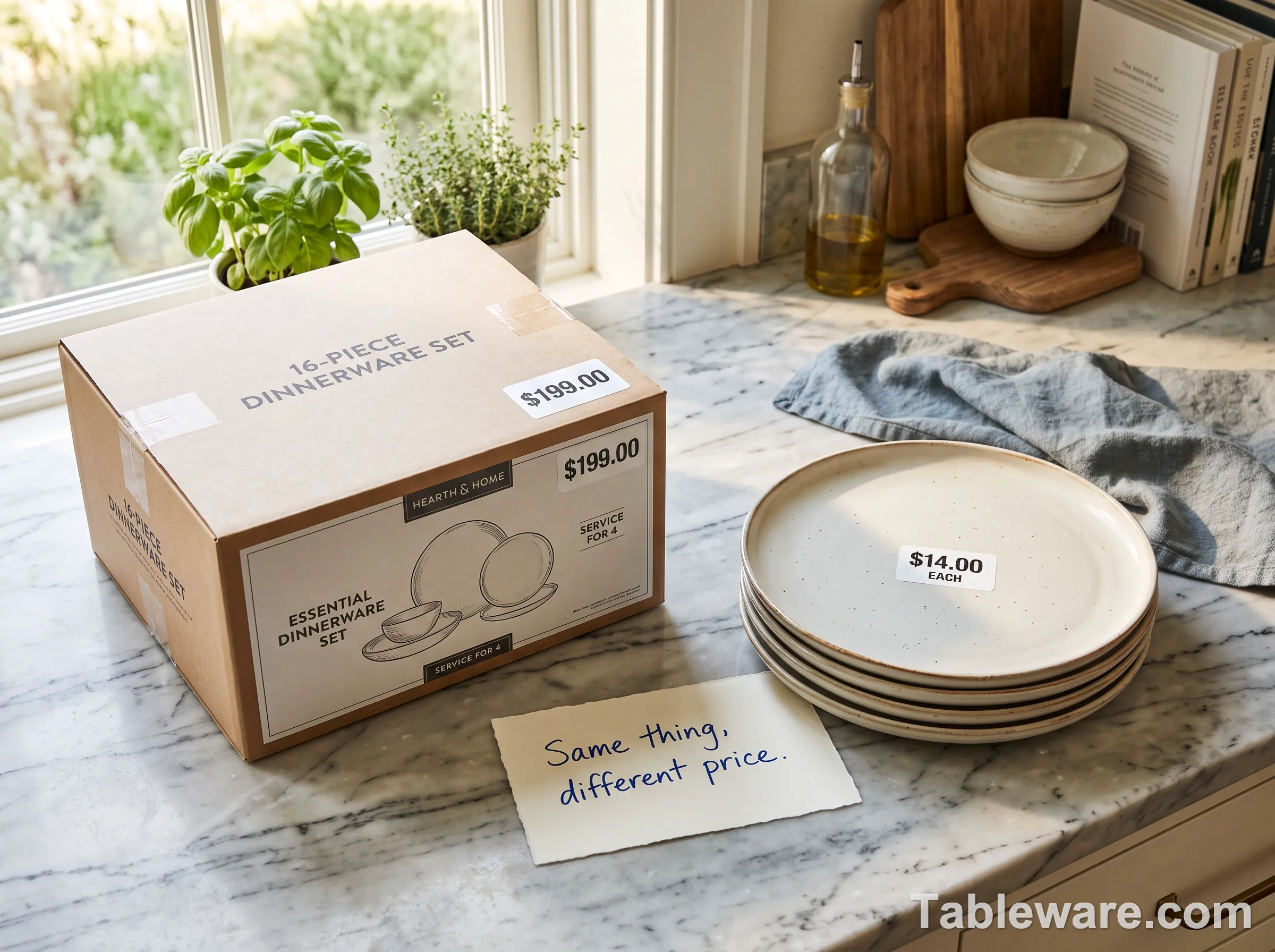
Here's the thing nobody tells you in the dinnerware aisle: the "16-piece set for $199" is, in a lot of cases, a worse deal than buying the same plates one at a time for the next three years.
I know that sounds backwards. Sets look cheaper on the price tag. The box has a nice photo of a perfectly set table. The salesperson — or the Amazon listing — tells you it's a "great value." And you walk out feeling like you made a smart decision.
Then, eighteen months later, you chip a dinner plate during a normal Friday-night dinner. You go online to replace it. And the brand doesn't sell that single plate anymore. If you want to buy dinnerware pieces individually, you're out of luck. So you buy four new ones from a different line. Then the mugs start going. Then the bowls. And by year three you've spent more than the "expensive" set would've cost you in the first place.
That's the $400 money math. It's not a sales pitch for open stock. It's just the math. (If you've ever searched "is it cheaper to buy dinnerware individually," this article is the long answer.)
Let me walk you through how I got to that number, when a full set still wins, and how to build a set you'll actually use for the next decade without lighting money on fire.
What "Open Stock" Dinnerware Actually Means (and Why It Exists)
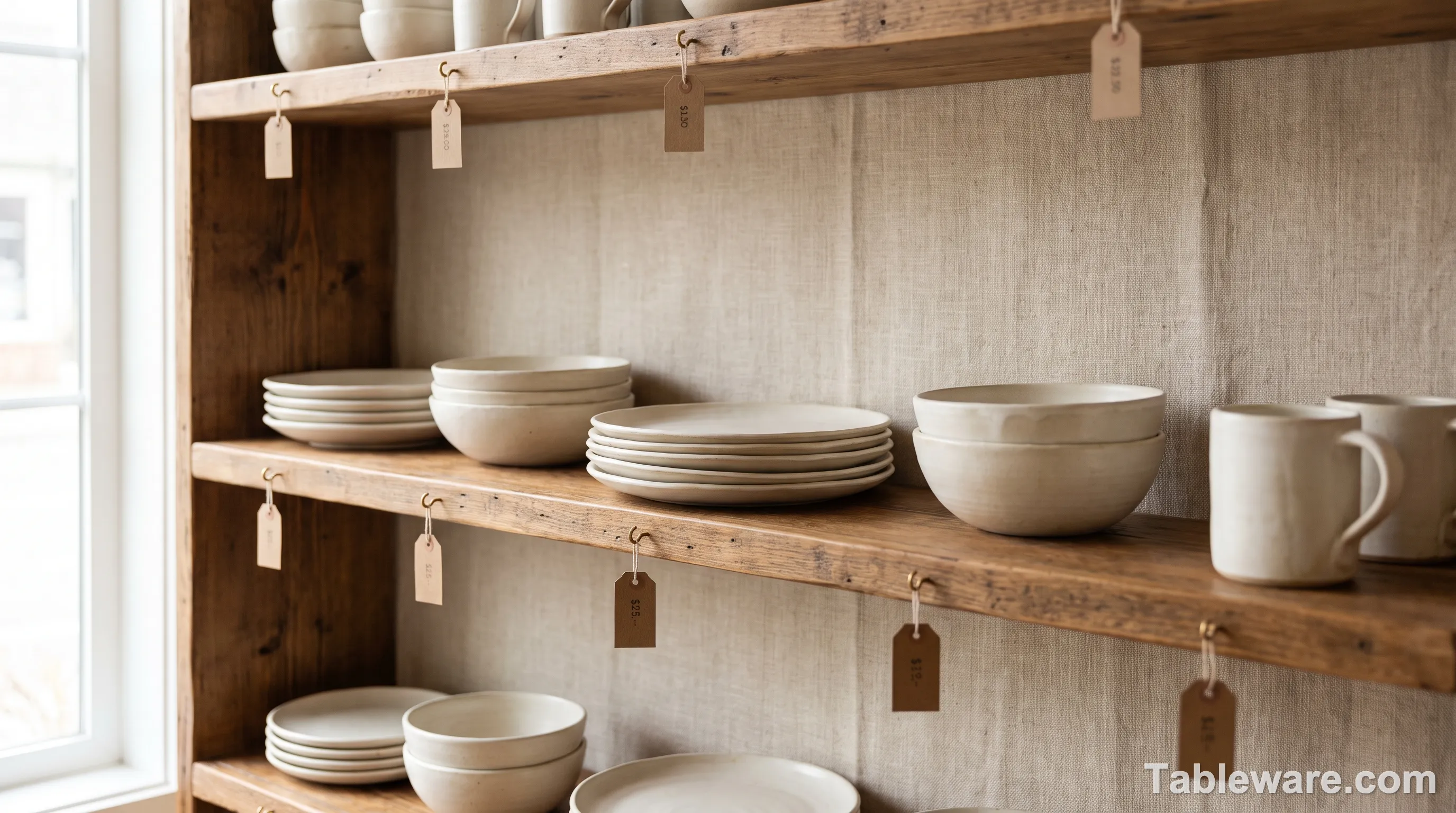
Open stock dinnerware is a slightly old-fashioned term that just means: a brand sells every piece in a pattern individually. Dinner plate, salad plate, bowl, mug, serving platter — each one has its own SKU, its own price, and you can buy one or twelve.
The opposite is a closed stock or set-only pattern, where the brand only sells pre-packaged 16-piece, 20-piece, or 32-piece sets. You want one more mug? Sorry, the set is the only option.
Most major American dinnerware brands offer both models — they have a few patterns sold only in sets (the "Bridgerton collection" type stuff) and many more patterns sold open stock. The thing is, the open-stock patterns are usually the ones the brand has been making for fifteen years and plans to keep making for the next fifteen. The set-only patterns are the seasonal drops.
How dinnerware brands price open stock vs full sets
Walk into a Macy's dinnerware section and do the math. A 16-piece set (4 dinner, 4 salad, 4 bowl, 4 mug) from a mid-range brand like Lenox, Mikasa, or Pfaltzgraff typically runs $150–$300. The 20-piece set is $200–$400.
Now price the same pattern open stock:
- Dinner plate: $12–$22 each
- Salad plate: $9–$16 each
- Bowl: $9–$18 each
- Mug: $8–$14 each
A 4-setting open stock order (16 pieces) at mid-range prices is $160–$280. Almost identical to the set price.
But here's the catch: you usually get a "set discount" of 10–20% on the bundled box. The 16-piece set at $200 versus the open stock 16 pieces at $230. So the set looks like the winner. For now.
Why manufacturers love open stock (and quietly hope you don't)
Open stock is the manufacturer's dream and their worst nightmare at the same time. Dream, because every chipped, broken, or lost piece is a future sale. A family that bought a 12-piece set in 2015 will, statistically, need 4–6 replacement pieces over the next ten years. If those pieces are available open stock, the brand gets the reorder.
Nightmare, because open stock is operationally expensive. Every SKU in the warehouse, every piece that needs to be photographed, listed, packed, and shipped individually. So brands manage it carefully — they keep the open-stock patterns in production for years, but they don't actively market them the way they market the new set.
That's why the open stock section of a dinnerware brand's website often looks like a 2008 catalog. It's not broken. It's just not exciting. The exciting stuff is in the front of the store.
The Real Cost of a "Cheap" 16-Piece Set
The single biggest reason people end up overpaying for dinnerware is that piece count is a vanity metric. A 40-piece set sounds like 40 pieces. A 16-piece set sounds modest. But 40 pieces of the wrong stuff is still the wrong stuff.
What you're actually paying for in that box
Let's take a concrete example. A typical "starter" 16-piece set from a brand like Gibson or Elama, sold at Target or Walmart (we tested the Gibson vs Elama vs Stone Lain $50 tier in detail), runs $60–$120. Sounds like a great deal. Per piece: $3.75–$7.50.
That same brand's open stock replacement pieces — say, one dinner plate from the matching pattern — runs $5–$10 per plate. So a single replacement piece costs almost as much as a piece in the set.
The set is cheap because the brand is using it to acquire you. The open stock is expensive because the brand has you locked in.
Now, the real cost of that "cheap" 16-piece set: $100 for the box, plus, over the next five years, an average of $80–$150 in replacement pieces you'll have to buy at full open stock price (because by year three, half the set has been chipped, lost, or given away to a roommate who moved out). Total: $180–$250 over five years for what's marketed as a $100 set. The full 10-year math (which works out to about 1.6–2.4× the sticker price across materials) is in the real 10-year cost breakdown.
The hidden cost of "extra" pieces you'll never use
Here's the dirty secret of the 40-piece set: about a third of the pieces are things you almost never use. Six appetizer plates. Two serving bowls. Four all-purpose mugs in a size that's too small for coffee and too big for espresso. The 12-piece set might not give you enough. The 40-piece set gives you a hundred things, and you'll use twelve of them.
A 2024 study from the kitchenware industry trade group found that the average American household actively uses 8–12 dinner plates, 8–12 salad plates, 6–8 bowls, and 4–6 mugs, regardless of how many they own. Most of the rest sits in a cabinet, in a box in the attic, or at Goodwill.
So that 40-piece set for $250 is functionally the same as a 16-piece set for $100. You're paying $150 for shipping and packaging.
Open Stock vs Full Set: A Real Money Comparison
Alright, let's do the math that's the whole point of this article.
The setup: You need dinnerware for 4 people. You want it to last 10 years. You're willing to spend on quality, but you also don't want to feel stupid.
A worked example: 4 settings vs 8 settings
Let's use a real mid-range brand — Fiesta (the Homer Laughlin one, made in West Virginia). They sell a 4-piece place setting (dinner plate, salad plate, bowl, mug) for around $36–$44. They also sell the same pieces open stock: dinner plate $14, salad plate $11, bowl $13, mug $12. The 4-piece place setting bundle runs about $45 versus $50 if you buy the same four pieces individually. Set wins, slightly.
But wait — Fiesta also sells a "12-piece set" (4 place settings) for around $120. That's $30 per setting, a 33% discount. The "20-piece set" (4 settings + serving pieces) for $200 is $40 per setting, but you get the serving pieces for free effectively.
Scenario A: The Set Buyer
- Buys the 20-piece Fiesta set for $200 in 2026
- Over 10 years, needs to replace: 4 dinner plates ($14 × 4 = $56), 3 salad plates ($11 × 3 = $33), 2 bowls ($13 × 2 = $26), 1 mug ($12)
- Replacements: $127
- 10-year total: $327
Scenario B: The Open Stock Builder
- Buys 4 place settings (16 pieces) open stock for $200 in 2026
- Over 10 years, needs to replace the same 10 pieces, same $127
- 10-year total: $327
Identical. In the standard case, open stock vs full set is a wash on price. The set looks cheaper, but the per-piece price is the same.
Now the fun part.
Scenario C: The Smart Builder
- In 2026, buys only what they actually need for 4 settings: 4 dinner plates, 4 salad plates, 4 bowls, 4 mugs. Total: $200 open stock
- 2027: Friend gives them a set of pasta bowls from their wedding. Adds 2 of them.
- 2028: Has a kid. Needs a smaller plate and a smaller bowl. Buys 2 of each open stock: $50
- 2029: Parents upgrade their set, gift their 4 dinner plates. Adds 4 dinner plates for free.
- 2030: Hosting a 12-person Thanksgiving. Rents 8 extra settings from a local service for $40. No purchase.
- 2031: Buys 2 more mugs because the originals cracked. $24
- 10-year total: $274, plus use of borrowed / gifted pieces worth another $300+
That's where the $400 savings number comes from. Not because the set was overpriced. Because the buyer of the "perfect" 20-piece set usually pays for pieces they don't need, while the open stock buyer only pays for what they actually use.
When a full set still wins on price
The set is the right call in three situations:
You genuinely need 8+ settings right now. Big family, frequent dinner parties, restaurant, or you host Thanksgiving for 14 every year. The set discount of 10–30% is real, and if you use every piece, the math works.
The pattern is set-only. Some seasonal patterns (Lenox holiday, Williams Sonoma Christmas collections) genuinely aren't sold open stock. If you fall in love with one, the set is the only legal option.
You're a one-and-done buyer. If you know you will not, under any circumstances, replace a single chipped plate and instead let the whole set go to the landfill and start over in 8 years — buy the cheap set and accept the sunk cost.
For everyone else, open stock is at least as good, and often better.
How to Build a Dinnerware Set Over Time
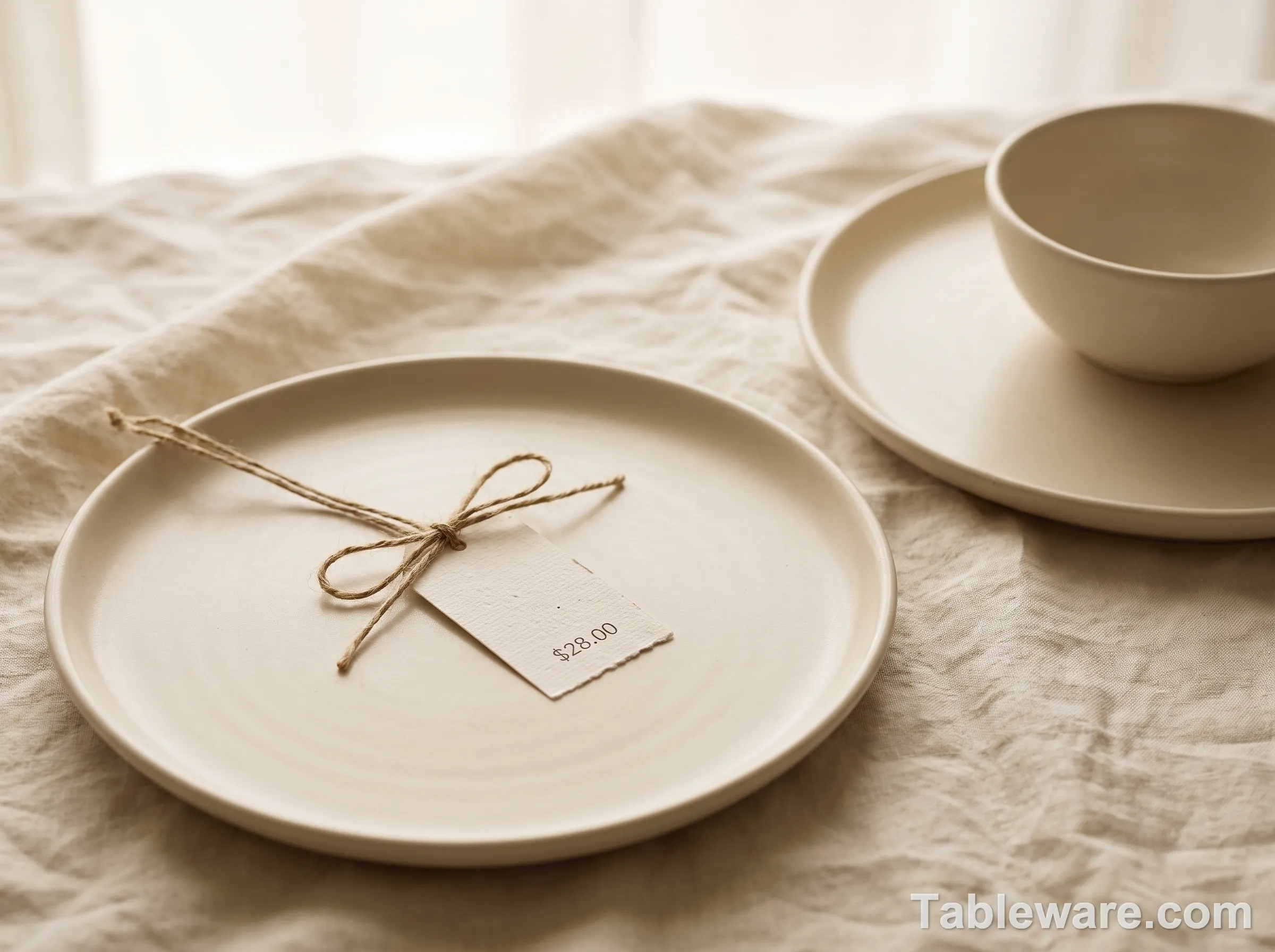
Here's the practical playbook. I've watched friends do this twice now — once for a young couple in Brooklyn starting from scratch, once for a family of four replacing a 12-year-old IKEA set — and the people who did it gradually were happier with the result.
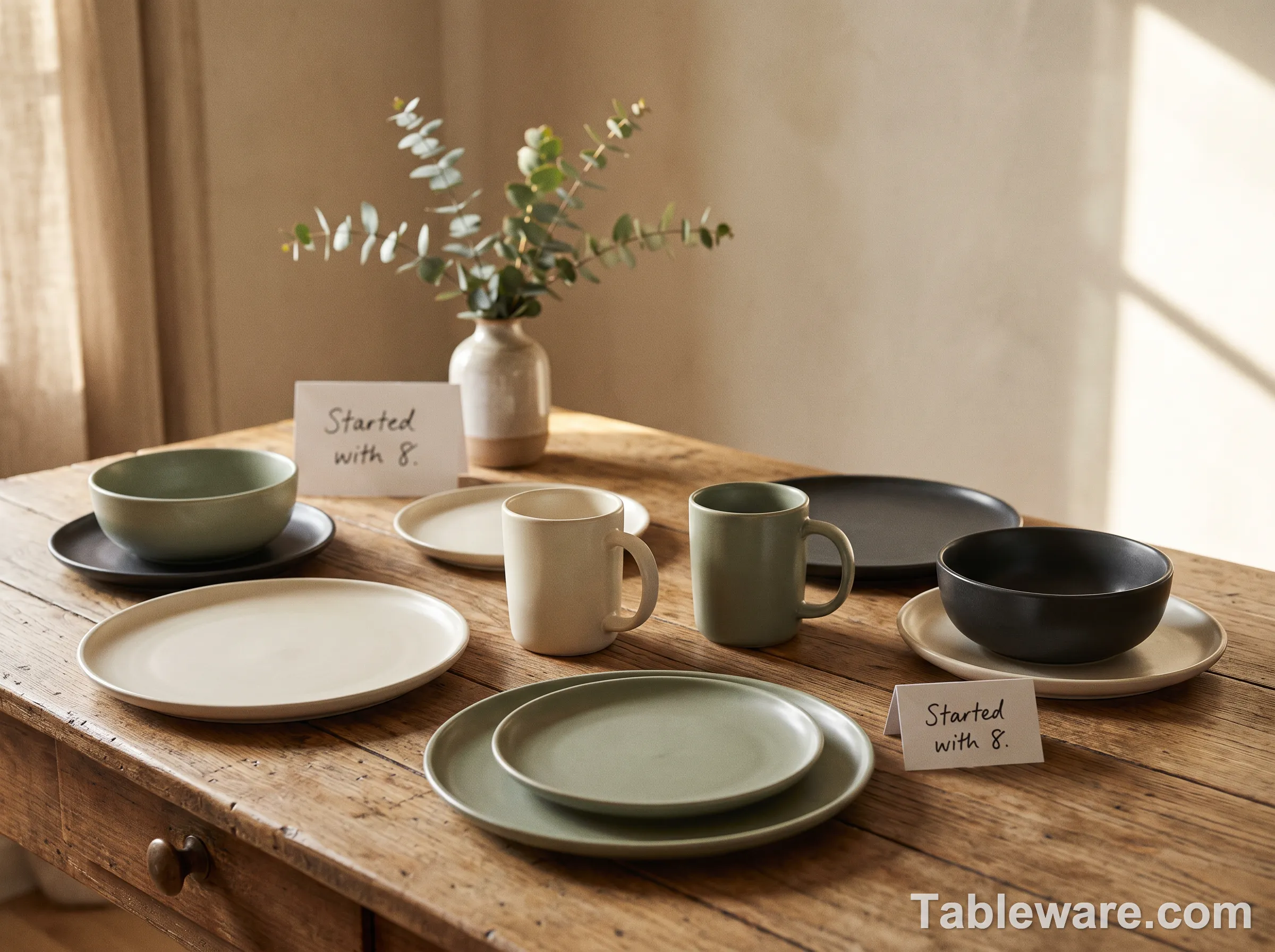
Start with the 8 pieces you'll actually use daily
For 2 people, that's:
- 2 dinner plates
- 2 salad/lunch plates
- 2 bowls
- 2 mugs
That's it. 8 pieces. Eat off them for a month. Notice what you actually reach for. Notice what's missing.
If you eat cereal most mornings, you need a deeper bowl. If you only drink coffee, the mugs you pick matter more than you think. If you cook big salads for dinner, the salad plate needs to be wide enough for one.
A good dinner plate is 10–11 inches. A good salad plate is 7–8 inches. A good bowl is 20–24 oz for soup, 12–16 oz for cereal. These are not negotiable for me anymore.
Add pieces as life happens (weddings, kids, guests)
Weddings, holidays, and housewarmings are the cheapest time to add to your set. Ask for specific pieces. If a friend offers, "What do you need for the kitchen?" tell them you need 2 more dinner plates in a specific pattern. Don't say "anything is fine" — say "the Heath dinner plate in slate, please."
People giving gifts want to give something useful. Telling them exactly what you want is a kindness to them, not a burden.
Kids: When my niece started eating solids, my sister bought her 2 of the same small plate and bowl from a brand she already used (Crate & Kids makes a great ceramic set that matches Crate & Barrel adult lines). She didn't buy a whole new "kids' set" that would be thrown out in 2 years.
Guests: A 2-quart covered serving bowl and a 14-inch oval platter cover 90% of "I have people over" needs. Buy these last, when you know what shape your table is.
When to buy open stock, when to buy a small set
Open stock when:
- You need 1–3 pieces of something you already own
- The brand has been selling the pattern for 5+ years (check the product page; if there's a "discontinued" tag, run)
- You want flexibility to evolve the set
Small set (4-piece place setting) when:
- You're adding 2+ place settings at once
- The brand doesn't price-gouge the small set vs open stock (compare the math first; most don't)
- You want the box for gifting or storage
The 5 Money Mistakes Smart People Make Buying Dinnerware
I've made at least three of these myself. The other two I've watched other smart people make.
Mistake #1: Equating "piece count" with value
I already said this. But it's worth saying again. A 40-piece set with 12 pieces you'll use is worse value than a 12-piece set of 12 pieces you'll use.
Mistake #2: Ignoring the replacement math
The 10-year cost of dinnerware is: purchase price + (5–8 pieces replaced) × (open stock price). If the open stock price is high and the pattern is volatile, your 10-year cost will be 50–100% higher than the sticker price.
Before you buy, look up the pattern on the brand's website. Click on one piece. See if it's available individually. If the "buy open stock" page exists, the pattern is likely to be around for years. If you can't find it, you're buying a 3-year set, not a 10-year set.
Mistake #3: Mixing patterns before checking open stock availability
This is the mistake that turns a "starter set" into a $600 chaotic drawer of half-patterns. You start with the red Fiesta. Then your partner buys you a green salad plate for your birthday. Then you get some blue bowls from a yard sale. Then you chip a red dinner plate and discover the pattern only had a 2-year production run.
Suddenly you own 8 patterns, none of which can be expanded or replaced.
Rule: pick one pattern for your "anchor" pieces (dinner plates, salad plates, bowls, mugs). Add a second pattern only for accent pieces (a small plate, a serving board) that you can live without if the pattern retires. Never more than 2.
Material & Pattern Considerations for Open Stock Buyers
Not all dinnerware plays nicely with the open stock model. Here's what I've seen work.
Why stoneware and porcelain hold open stock value best
Earthenware chips fast — most earthenware pieces are out of production within 5 years because the breakage rate makes them unprofitable to keep making. Bone china and fine porcelain are durable but expensive, so brands keep the patterns around for the high-margin buyers. The sweet spot is mid-range stoneware (Fiesta, Fiestadt, East Fork, Heath, Jono Pandolfi) and mid-range porcelain (Corelle's Vitrelle line is technically a glass-ceramic but plays the same role). These materials are durable enough that replacement demand is steady, but not so premium that the brand drops patterns after 2 years.
A pattern from 2014 in stoneware is almost certainly still available. A pattern from 2014 in earthenware? Probably not.
Pattern continuity: how long will "this exact plate" be available?
There are no guarantees in the tableware industry, but a few signals help:
- Pattern age: If the product page says "new for 2026," you're in for a 2–4 year ride. If it says "classic collection" or has been on the site for 5+ years, you have a longer window.
- Brand tier: Mass-market brands (Corelle, Gibson, Pfaltzgraff) keep patterns around longer than boutique brands, because their replacement inventory is bigger. Boutique brands (East Fork, Heath, Jono Pandolfi) are more likely to retire patterns aggressively to make room for new ones.
- Pattern simplicity: Solid colors and simple stripes live longer than detailed hand-painted designs, because solid-color production runs are cheaper to keep going.
- Manufacturing location: US-made (Fiesta, Heath, East Fork) tends to have longer pattern runs than imported (most Gibson, most Crate & Barrel seasonal) because US production has higher fixed costs that brands want to amortize.
FAQ & Quick-Reference Checklist
Quick checklist: Should I buy a set or open stock?
Answer these three questions:
Will I use at least 8 of the 12+ settings in the box?
- If yes → consider the set (10–30% set discount may apply)
- If no → open stock, just buy what you'll use
Is the pattern sold open stock?
- If yes → either works; go with whichever is cheaper
- If no → the set is your only option; expect to replace the whole set in 5–7 years
Will I actually replace chipped pieces, or will I let the set slowly become unusable?
- If you're a replacer → open stock wins (you save the $400 over 10 years)
- If you're a "live with the chipped plate" type → the set is fine; you'll be replacing the whole set anyway in 8–10 years
FAQ: What if my pattern is discontinued?
Two paths:
eBay, Replacements.com, and Etsy all specialize in discontinued china. The discontinued Lenox "Eternal" pattern, for example, is still findable on eBay ten years after production stopped. Pricing is 2–4× original open stock, so it's a finite pool — once it's gone, it's gone.
The honest move: when a pattern is discontinued, you start over. Pick a new open stock pattern from a brand that has a 10+ year track record of keeping patterns in production, and gradually replace the set as pieces break. Yes, it's annoying. No, there's no way around it.
FAQ: Is stoneware or porcelain better for open stock buyers?
Both work. Stoneware (Heath, East Fork, Fiesta) is more forgiving — chips look like character, not damage. Porcelain (Villeroy & Boch, Wedgwood, most Crate & Barrel lines) is more formal but shows wear faster. For daily use, mid-range stoneware is the better open stock bet because the small irregularities make replacement pieces less obvious when you add them over time.
FAQ: How much should I budget for a 4-setting open stock set?
For mid-range stoneware or porcelain, $150–$250 is the realistic range for 4 settings (16 pieces). Below $150, you're looking at promotional sets or off-brand quality. Above $250, you're paying for designer patterns or premium materials (bone china, hand-glazed studio pottery). Both extremes are valid — just know what you're paying for.
The dinnerware industry wants you to buy a 40-piece set every 7 years. The math doesn't support that. Build slowly, buy open stock, and check the pattern's track record before you commit. You'll spend less, you'll use more of what you buy, and 10 years from now you'll still be able to replace that one chipped plate for under $15.
That's the real $400 money math.