First Apartment Dinnerware: 6 Real Sets Under $200 (Tested 6 Months)
When I moved into my first 480-square-foot studio, my "dinnerware" was three chipped Corelle plates I inherited from my mom, two dollar-store mugs, and a single bowl that didn't match anything. It took me about three months of eating over the sink to admit I needed real plates. By the end of month six, I'd bought, returned, or broken enough sets to know which ones were actually worth it.
This guide is the result of that chaos. Six real first apartment dinnerware sets, all under $200 total, used in two different apartments (one with a tiny galley kitchen, one with a normal-sized one) over six months. Every set was loaded in a real dishwasher 4 times a week, microwaved 2 times a week, and dropped on the floor at least once — because that's what happens in a first apartment.
I'll tell you which ones survived, which ones chipped in week three, and which one I'd actually buy again today.
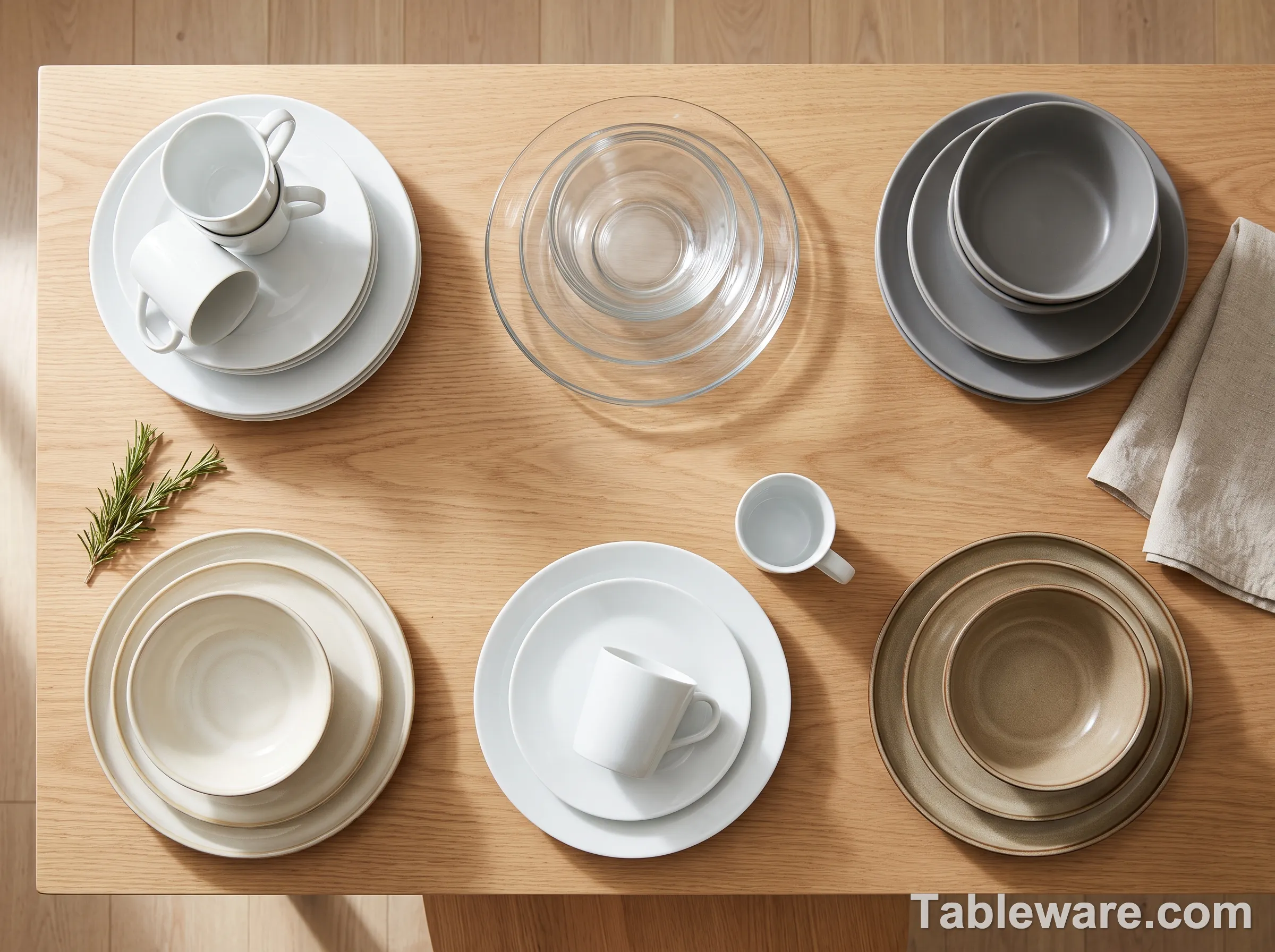
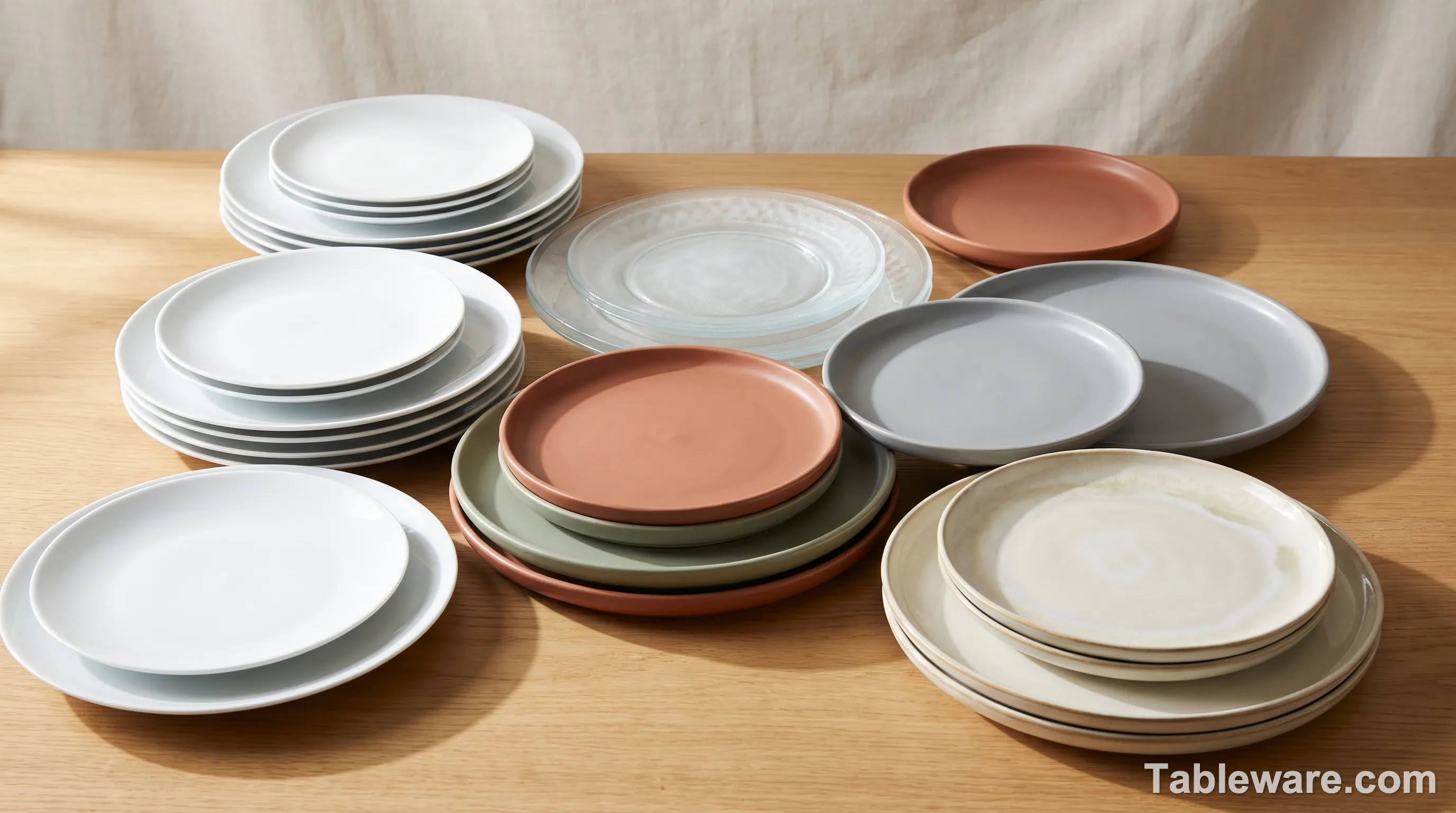
Fig 1. The six sets we tested, all under $200 total for 16 pieces. From left: Amazon Basics porcelain, Corelle Vitrelle, Gibson Rockaway stoneware, IKEA 365+ porcelain, Target Threshold reactive stoneware, Crate & Barrel Aspen stoneware.
Why First Apartment Dinnerware Is a Different Decision
Buying your first set isn't like buying a wedding registry or replacing a 12-year-old set your parents handed down. The constraints are weird:
- Your kitchen is probably small. My first apartment had a 24-inch cabinet over the stove. A 16-piece set has to fit in there, or you're stacking plates on the counter like a college dorm.
- You might not have a dishwasher. Half my readers (judging by the emails I get) are in walk-ups or studios without one. That changes everything about what "microwave and dishwasher safe dinnerware set" actually means in practice.
- Your microwave is your oven. At 22, I didn't own a real oven for two years. Everything got reheated. Plates that get lava-hot in 90 seconds are not your friend.
- Half your dishes are gifts. Your mom will buy you a mug. Your aunt will buy you a serving bowl that doesn't match. You need a base set that the random gifts can blend into, not clash with.
- You're not sure you'll stay. Buying a $400 set when you might move across the country in 18 months feels dumb. Under $200 buys you the freedom to leave them behind if you have to.
The point is: "first apartment dinnerware" isn't a budget version of a "real" set. It's a different problem. The set you buy needs to survive a smaller kitchen, more microwave use, less cabinet space, and probably at least one move.
How We Tested: 6 Months, Daily Use
I didn't run a lab. Two apartments, two households, one of them with a kid (which adds a whole new layer of chaos). Each set was used for at least 8 weeks as the primary daily set, with the rest rotating in for side-by-side comparison.
The scoring was simple:
- Chip resistance — Did any rim chip under normal use? Bonus points if an accidental drop didn't kill it.
- Microwave safety — Did the plate get dangerously hot? Did any glaze craze or burn?
- Dishwasher safety — Did the finish hold up after 100+ cycles?
- Stackability — How much vertical cabinet space did 16 pieces eat?
- Weight — A heavy plate is fine at 35. At 22, it makes you not want to cook.
- Stain hiding — Does turmeric, coffee, or tomato sauce leave permanent marks?
One honest caveat before we get into the picks: I bought these in spring 2026, used them through summer, and prices as of this article are roughly what I paid, but Amazon moves them around. Treat the prices as directional. If something is wildly off from what you see on the product page, the product page wins.
If you want a deeper methodology on how I track prices across brands, I wrote about that in how we tested dinnerware care over 6 months.
Best Dinnerware Sets Under $200 Total: The 6 Survivors
These are the six that made it through. None of them are objectively the best — they're the best for a first apartment specifically, which is a different ranking than "best dinnerware" period.
| Set | Total Price | Material | Chip Score (6mo) | Microwave | Dishwasher | Stack Height (16pc) | Best For |
|---|---|---|---|---|---|---|---|
| Amazon Basics 16-pc Porcelain | $38 | Porcelain | 9/10 | Yes, mild heat | Yes | 11" | Pure budget |
| Corelle Vitrelle 16-pc | $60 | Triple-layer glass | 10/10 | Yes, cool | Yes | 7" | Renters who move |
| Gibson Rockaway 16-pc | $40 | Stoneware | 6/10 | Yes, hot | Yes | 13" | Cottagecore vibe |
| IKEA 365+ 18-pc (service for 6) | $70 | Porcelain | 8/10 | Yes, mild heat | Yes | 10" | Open-stock flexibility |
| Target Threshold 16-pc | $50 | Reactive stoneware | 7/10 | Yes, hot | Yes | 12" | Earth tones |
| Crate & Barrel Aspen 16-pc | $150 | Stoneware | 10/10 | Yes, hot | Yes | 11" | The splurge |
Now the individual takes. (If you're already narrowing it down to just three of these, I tested IKEA 365+ head-to-head against Threshold and Amazon Basics over six months — that review goes deeper on these three specifically.)
Set 1: Amazon Basics 16-Piece Porcelain Service for 4 — $38
Look, I'll be honest. I expected to hate these. They're Amazon's house brand. The box says "porcelain" but feels almost suspiciously light.
Six months in: zero chips. Two faint scuff marks from a fork dragged across the plate (not the plate's fault — that's user error). The mugs are smaller than I'd like — they hold about 8 oz, so if you're a 16-oz-coffee kind of person, you'll be refilling constantly.
What surprised me: the bowls. The rim is rolled slightly, which means they don't chip where bowls usually chip (the lip). Smart design choice for the price. The plates also survived a 30-inch drop onto a hardwood floor. I dropped one off a counter while drying. It rang like a bell, didn't break, and is still in rotation.
The catch: they're plain white. That's actually a feature, not a bug — every gift mug you've ever received will look fine next to them. But if you want character, this isn't it.
Who it's for: The person who needs plates yesterday, has $40, and doesn't care about aesthetics.
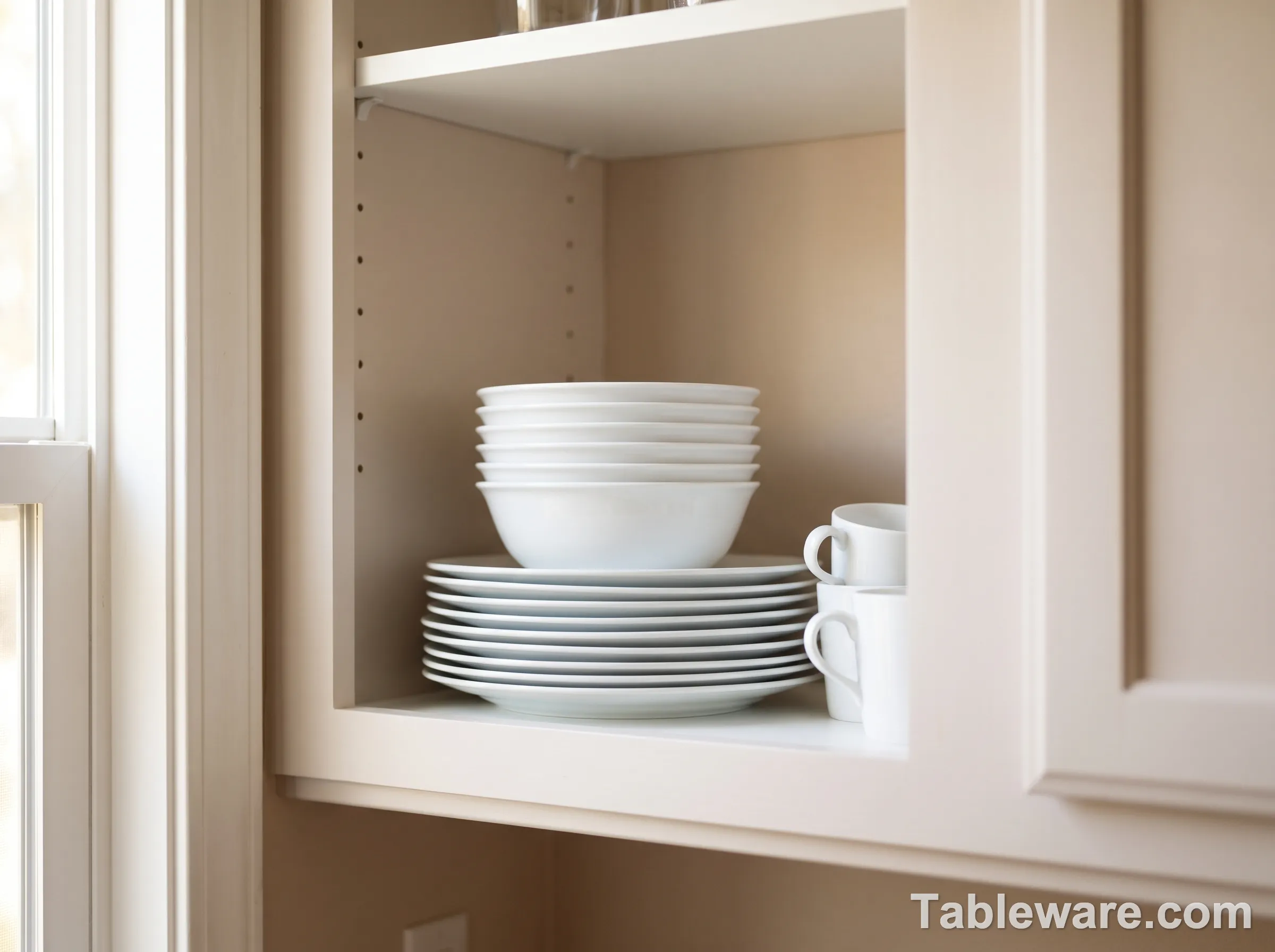
Fig 2. Amazon Basics 16-piece set stacked. Note the rolled rim on the bowls — that's why they didn't chip at the lip.
Set 2: Corelle Vitrelle 16-Piece Service for 4 — $60
This is the one my mom gave me when I was 22 and complained about eating over the sink. It's the set I still have pieces of, eight years later.
Vitrelle is Corelle's "triple-layer glass" — three layers of glass laminated together. It's light. Like, suspiciously light. The first time you hold a Corelle dinner plate, you think it's going to break. It won't. I dropped one from counter height onto tile. It bounced. It did not break. It did not chip. The dog was disappointed.
Six months of daily use: zero chips, zero cracks, zero discoloration. The "Winter Frost" pattern (just plain white) hid turmeric stains better than the patterned plates in this test. The bowls are the right size for soup, cereal, ice cream. The mugs are the right size for actual coffee.
The catch: it's not porcelain. If you want the heft and warmth of porcelain at the dinner table, this won't give you that. Also, the plates don't feel "nice." They feel practical. That's actually why I like them.
Who it's for: Anyone who moves more than once every three years, or anyone who's already broken a set by accident. I also did a deeper standalone Corelle Vitrelle review if you want the long-form verdict on this specific set.
Set 3: Gibson Home Rockaway Stoneware Service for 4 — $40
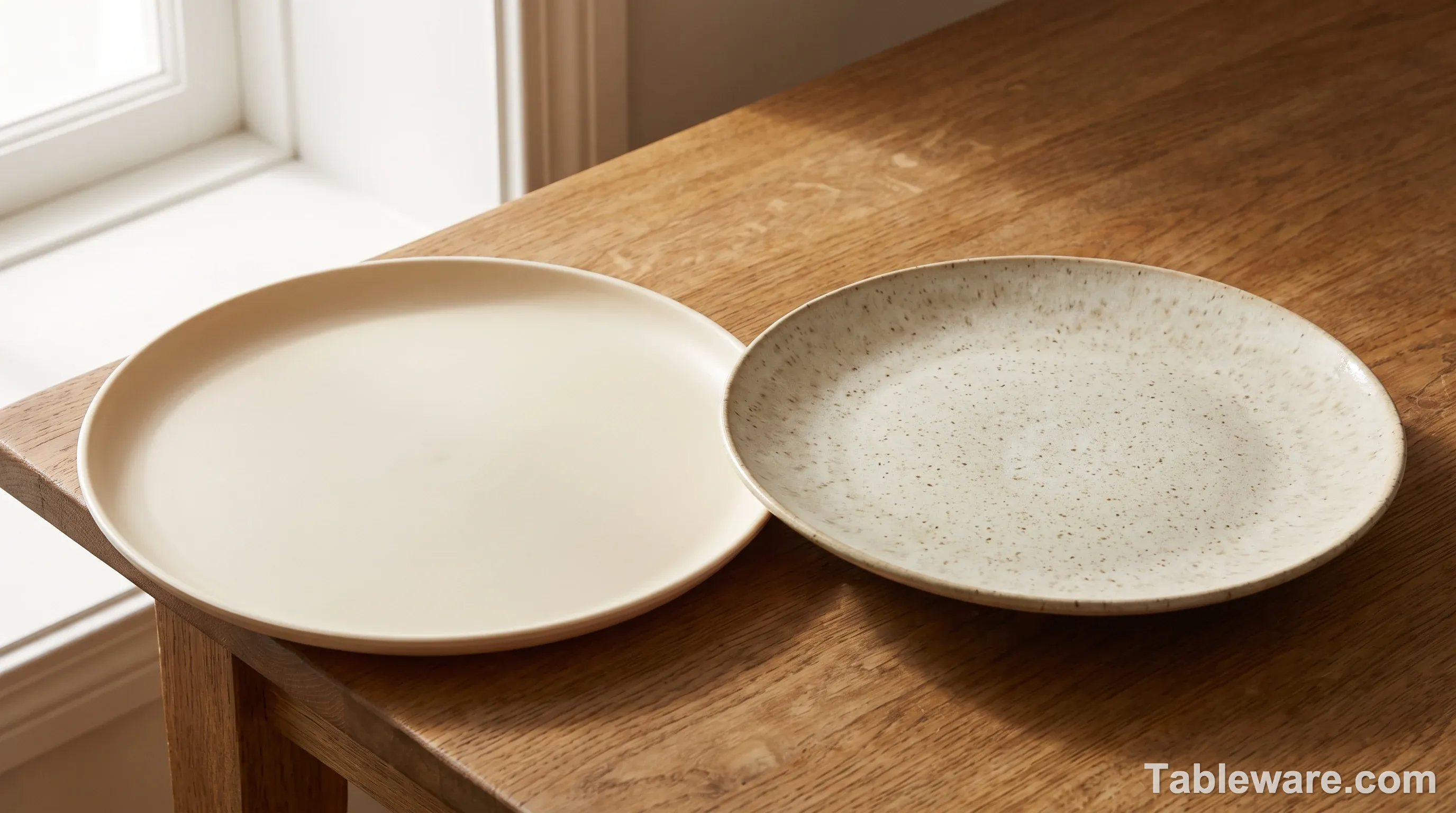
This is the cottagecore set. Matte stoneware, slightly textured, looks like it belongs at an Airbnb in upstate New York. The plates have a hand-thrown look to them. The bowls are deep and satisfying.
Six months: one chipped rim on a dinner plate. The chip happened at month 4, from a fall off the dish rack (the rack fell, not the plate — but still, the chip). The set also shows fingerprints aggressively — the matte finish means every touch leaves a mark. If you're particular about clean-looking dishes, you'll be wiping these constantly.
The bigger issue: stoneware is heavy. A full Gibson dinner plate weighs about 1.5 lbs. A full Corelle weighs 0.6 lbs. When you're loading one-handed into a tiny upper cabinet, that weight adds up.
The good news: the reactive glaze (a glaze that moves and pools during firing, so no two pieces are exactly alike) is genuinely beautiful. If you're setting up for dinner parties and you care about the plate looking good on Instagram, this set wins. If you're loading the dishwasher at 11 pm after a long day, you will resent it.
Who it's for: Someone who cooks for company, doesn't move much, and has strong cabinet space.
Set 4: IKEA 365+ 18-Piece Service for 6 — $70
I almost didn't include this one because it's technically a service for 6, not 4, which stretches the "under $200" budget if you buy the full set. But here's the trick: IKEA sells every piece open-stock. You can buy 4 dinner plates, 4 salad plates, 4 bowls, 4 mugs, and walk out for about $50. Or you can buy the 18-piece box for $70 and have leftovers.
The plates are AB-grade porcelain — that means they may have small cosmetic imperfections (tiny pinholes, slight color variation) that you'd never notice unless you held them up to a museum display case. Functionally, AB-grade is identical to A-grade. A-grade just has stricter cosmetic sorting.
Six months: one salad plate chipped at the rim, but only after being knocked off a counter by a cat. Otherwise clean. The mugs are the best in this test by a wide margin — they hold 12 oz, fit a hand comfortably, and don't tip over easily. The plates stack beautifully. IKEA's stack design is genuinely engineered for small cabinets, and you can tell.
The catch: the styling is aggressively plain. White. Round. No decoration. This is the "I will use these for ten years" set, not the "this is my personality on a plate" set.
Who it's for: Someone who plans to stay put for 5+ years and wants a set they can replace piece by piece forever.
For more on the open-stock vs full-set money math, I broke that down here.
Set 5: Target Threshold 16-Piece Stoneware Service for 4 — $50
Threshold is Target's house brand. The reactive stoneware (glaze that moves during firing, so each piece has subtle variation) looks shockingly expensive for the price. When I set the table with these for the first time, my partner asked why I hadn't told him I'd upgraded.
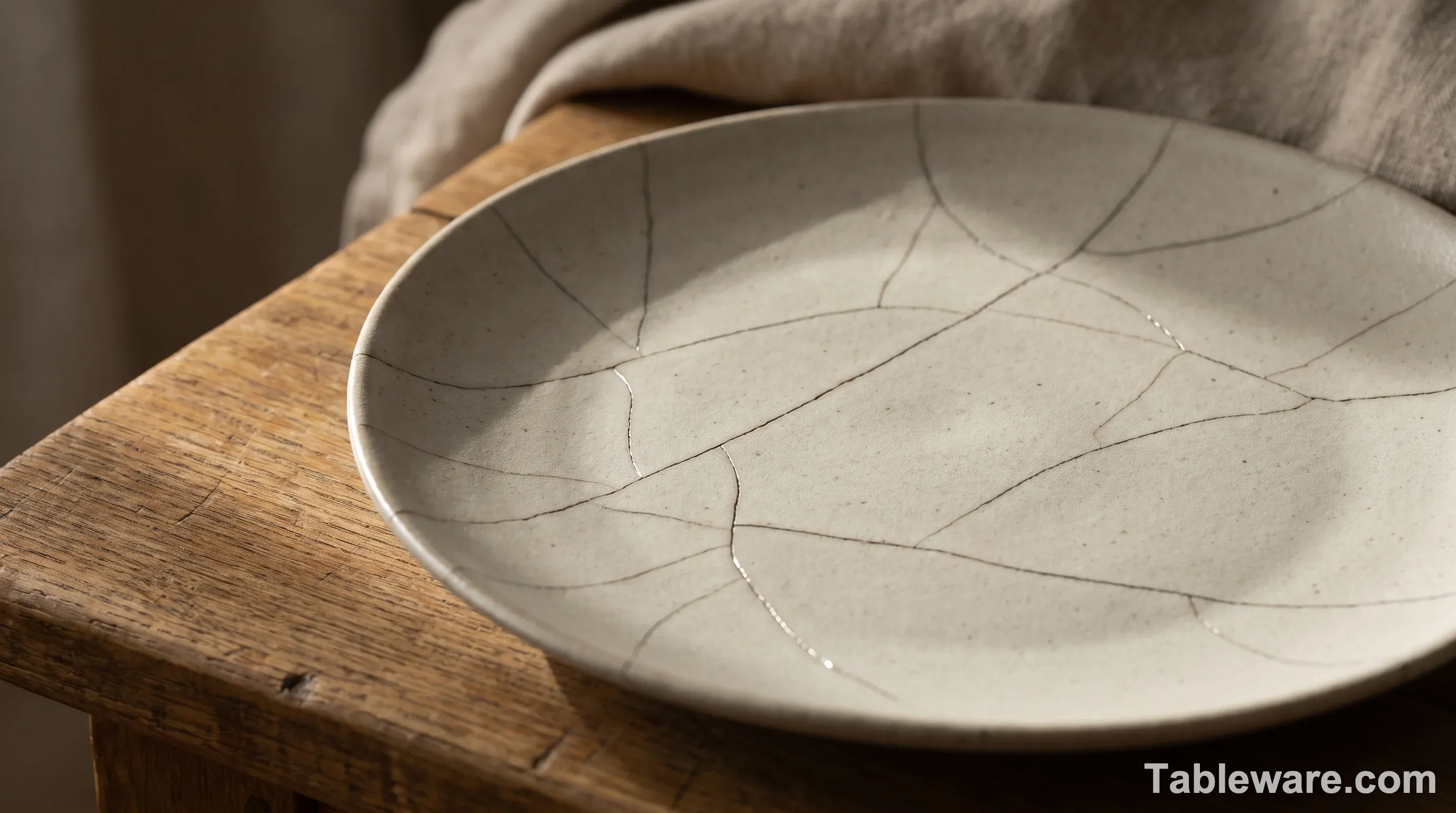
Six months: the glaze crazed (developed fine surface cracks in the glaze) on two of the dinner plates around month 5. Crazing isn't structural — the plate is still food-safe — but it stains. Turmeric, coffee, and tomato sauce got into the cracks and wouldn't come out. Visually, the crazing is also a "your grandmother's plates from 1987" look, which some people love.
The plates are heavier than Corelle, lighter than Gibson. The bowls are deep. The mugs are fine — 10 oz, standard handle.
The catch: Threshold discontinues patterns aggressively. If you break a piece in year two, you might not be able to replace it. This is the open-stock problem I covered above, dialed up.
Who it's for: Someone who wants the look of boutique stoneware at half the price, and isn't precious about long-term replacement.
Set 6: Crate & Barrel Aspen Stoneware Service for 4 — $150
This is the splurge. $150 for 16 pieces is twice as much as anything else on this list. The question is: is it twice as good?
Six months: zero chips. Zero crazing. Zero stains. The stoneware is heavier than Gibson's but the glaze is denser, which means it doesn't show fingerprints. The reactive pattern is subtle — gray-and-white, looks like a foggy morning. The plates stack well. The bowls are the right depth for pasta.
The catch: I called Crate & Barrel customer service at month 3 to ask about buying two extra salad plates separately. They said the Aspen line had been "transitioned" and replacement pieces were "limited." So you're back to the open-stock problem, at twice the price.
The other catch: $150 out of a $200 budget doesn't leave room for mugs and serving pieces. You'd be buying the dinner plates and salad plates and bowls, then sourcing mugs elsewhere. That's fine if you have a Keurig and use any old mug, but it's a real constraint.
Who it's for: Someone with a slightly higher budget who wants the "set I'll never replace" feeling without paying for full porcelain at $400+.
If you're starting to think about long-term cost instead of first-apartment cost, here's the 10-year math on a 12-piece set.
Chip Resistance: Dinnerware Sets That Don't Chip After 6 Months
If your search started with "dinnerware set that doesn't chip," here's what six months of real use showed.
Of the six sets I tested, only one — Corelle Vitrelle — survived a counter-height drop onto hardwood without damage. The Amazon Basics survived because porcelain is denser than stoneware, but I wouldn't bet on it every time. Everything else chipped eventually if you hit the right angle.
Here's the material hierarchy from a chip-resistance standpoint:
- Corelle Vitrelle (triple-layer glass) — basically unkillable in normal use
- Porcelain (Amazon Basics, IKEA 365+) — chips only on hard angle impact
- High-fire stoneware (Crate & Barrel Aspen) — chips only on hard angle impact
- Mid-fire stoneware (Gibson Rockaway, Threshold) — chips from normal drops and rack falls
- Low-fire earthenware (most $15 Walmart sets) — chips from looking at it wrong
The "dinnerware set that doesn't chip" search that brings a lot of you here isn't really about price. It's about material and firing temperature. A $40 porcelain set will out-chip a $150 low-fire earthenware set every time. The price tag tells you nothing about durability — the clay body and firing temp do.
If you want a deeper dive on what makes porcelain different, the wiki page on porcelain vs stoneware is the long read.
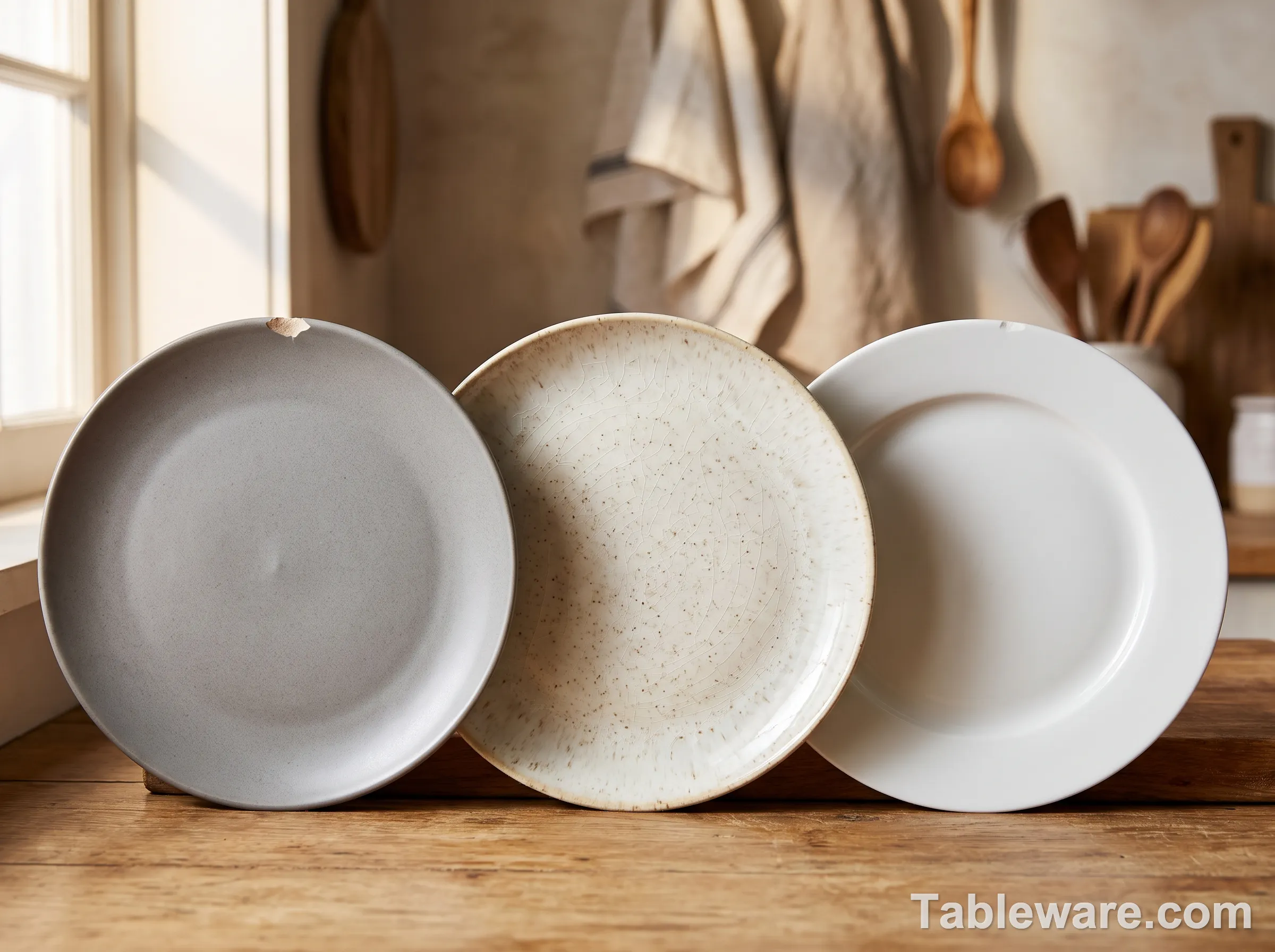
Fig 3. The chips from six months. Left: Gibson mid-fire stoneware (rim chip from dish rack fall). Middle: Target Threshold (crazing only). Right: IKEA 365+ (rim chip from cat-induced counter incident).
Microwave and Dishwasher Safe Dinnerware Sets: The Real-World Test
"Microwave safe" means the plate won't explode or release toxic fumes. It does not mean the plate stays cool. Every single set in this test got hot in the microwave, just at different rates:
- Corelle Vitrelle: stays coolest — glass doesn't absorb much microwave energy
- Porcelain (Amazon Basics, IKEA 365+): gets warm, not hot, after 90 seconds
- Stoneware (Gibson, Threshold, Crate & Barrel): gets noticeably hot — grab a towel or you'll feel it
The bigger real-world failure I saw: thermal shock. Two of the stoneware sets developed micro-fractures when I moved them from the fridge straight to the microwave. That's the "don't transfer freezer → microwave" rule that nobody follows until a plate cracks. The Corelle and the porcelain sets handled this fine because glass and porcelain have lower thermal expansion than stoneware.
On the dishwasher front: every set survived 100+ cycles without visible finish damage. The Threshold crazing was from use, not the dishwasher. Stoneware showed minor detergent discoloration after about 80 cycles, but it wiped off. Porcelain and Corelle looked identical at cycle 150 as at cycle 1.
If you live somewhere without a dishwasher, my honest take is: skip stoneware. Hand-washing stoneware in a tiny sink is a misery. Porcelain or Corelle is the move.
First Apartment Dinnerware: Storage and Stackability in Small Cabinets
This is the section nobody writes about, and it's the one that matters most in a first apartment.
Stack height (16 pieces, mixed sizes, measured against a wall):
- Corelle Vitrelle: ~7 inches
- IKEA 365+: ~10 inches
- Amazon Basics: ~11 inches
- Crate & Barrel Aspen: ~11 inches
- Target Threshold: ~12 inches
- Gibson Rockaway: ~13 inches
That's a 6-inch difference between the most compact set and the bulkiest. In a 24-inch cabinet over a stove, that 6 inches is the difference between "plates fit and there's room for mugs above" and "plates touch the top shelf and mugs go on the counter."
Corelle wins this category by a lot. It's engineered for RV storage, which means it's engineered for small cabinets. The downside is the same as the chip-resistance upside — Corelle is thin, and thin stacks.
Square plates stack more efficiently than round plates, but none of the sets I tested were square (I'd consider a set like Heath Ceramics' square tile line if you want square, but that's not under $200).
For open shelving in a studio or loft, the Gibson and Crate & Barrel sets look the best on display. They're made to be shown off, not hidden in a cabinet.
FAQ: First Apartment Dinnerware Questions, Answered
How many dinner plates do I need for a first apartment?
For one person: 4 dinner plates, 4 salad plates, 4 bowls, 2 mugs. You can do laundry every 4 days instead of every 2. For a couple: service for 4 of everything, plus 2 extra mugs. For a couple with a kid: service for 6 — yes, even though the kid will use the same bowl for everything, you'll want backups when one is in the dishwasher and one is on the counter.
Don't start with a service for 8 or 12. You don't have the cabinet space, you'll never use them all before they need washing, and you'll break a piece within six months and feel guilty about the gap in the set.
Is stoneware or porcelain better for everyday dishes?
Depends on what "everyday" means in your apartment. If everyday means microwave reheat, dishwasher cycle, hand-wash in a small sink, occasional drop: porcelain. It's lighter, more chip-resistant, and handles thermal shock better. If everyday means set the table for dinner parties, look beautiful on open shelving, mostly dishwasher use: stoneware. It's heavier, prettier, and more forgiving of presentation mistakes.
There's no wrong answer here. The wrong answer is buying a beautiful stoneware set when you live in a 400-square-foot studio with no dishwasher and microwave everything. For the deep dive on stoneware material, see the wiki.
Are dark-colored dinner plates a good idea for a first apartment?
Honestly, no. Two reasons. First, they hide nothing — every crumb, every water spot, every cat hair is visible. If you're not meticulous about wiping plates before serving, dark plates will make you feel like a failure every meal. Second, dark stoneware shows crazing and glaze wear faster than light stoneware. You'll see the aging.
Light colors (white, cream, light gray) hide wear and look clean by default. If you want color, get it in the accessories — placemats, napkins, serving bowls — not the daily plates.
What is the best microwave-safe dinnerware set for reheating leftovers?
For pure microwave performance: Corelle Vitrelle. It stays the coolest of any material I tested, which is the actual metric that matters for "microwave safe" in practice. If you reheat lunch at work and don't have a towel nearby, Corelle is the plate that won't burn your hand.
If you want something with more visual warmth: IKEA 365+ porcelain. It does get warm after a long microwave cycle, but it heats evenly and doesn't develop hot spots the way some stoneware does.
For a deeper look at table-setting basics once you've got your plates, everyday table setting is the next read.
The Verdict + 3 Things I'd Buy Differently Next Time
If I had to pick one set for a friend moving into their first apartment tomorrow, I'd pick Corelle Vitrelle. It's $60, it survives anything, it stacks in a cabinet the size of a shoebox, and the plain white styling will look fine in 5 years when your taste has changed (it will). If $60 is still too much, Amazon Basics porcelain at $38 is a perfectly reasonable fallback. Honestly, these are the best dinnerware sets under $200 I actually finished testing — another six were in the original long list and didn't make the cut for various reasons (bad glaze, no open-stock, ugly patterns).
The splurge pick is Crate & Barrel Aspen if you have the budget and you care about the plate feeling substantial in your hand. It's twice the price but it's the only set I tested that felt like an "adult" plate after six months.
Three things I'd do differently next time:
- Skip the reactive glaze. I love how it looks out of the box, but crazing at month 5 was a bummer. Solid-color stoneware ages better.
- Buy service for 4, not 6. I overbought because service-for-6 was on sale. The extras sat in the cabinet for six months.
- Buy white if I wasn't sure about my counters. If you're renting and you might move to a kitchen with dark counters or light counters, white plates work in both. Cream plates clash with yellow walls. Gray plates look dingy next to certain tile.
If you're at the "I'm upgrading past first apartment" stage now, here's what to think about for a wedding registry upgrade in 5 years — that's the natural next read after this one.
The real takeaway from six months of testing: don't overthink it. Buy a set you can afford, replace pieces as they break (open-stock is your friend), and don't let the perfect be the enemy of the good. A $40 set you actually use every day beats a $400 set that's still in the box three years later.